
✎ ANSWER ONLINE · EVERY MISTAKE LINKS BACK TO THE CONCEPT
Oscillations · Practice Worksheet
Answer each question here and it marks straight away, with the derivation and a link to the exact micro-concept to revisit.
1 question from this set could not be marked online — a
bonus or dual-key question, which has no single defensible answer. The print and
.docx versions still include it.
// CONCEPT AUDIT RESULT
Everything you missed has been added to your Error Arena — retest them blind there, and a concept clears once you get it right.
QUESTION 1
Oscillations
SECTION A · MCQ (+4, -1)
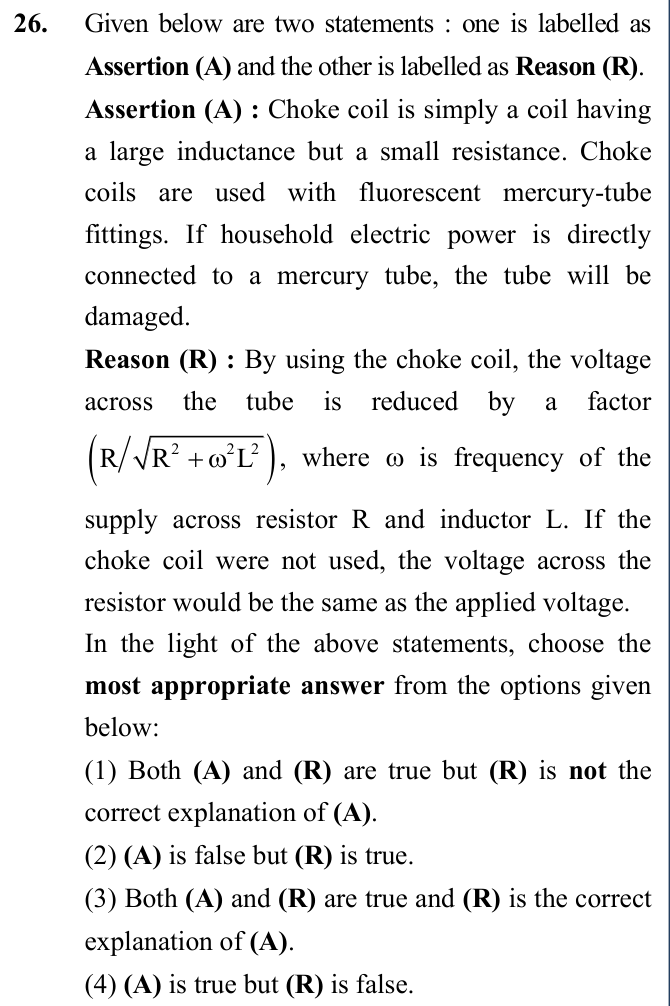
(1) Both (A) and (R) are true but (R) is not the
correct explanation of (A).
(2) (A) is false but (R) is true.
(3) Both (A) and (R) are true and (R) is the correct
explanation of (A).
(4) (A) is true but (R) is false.
A: Correct
B : Correct with correct explanation
QUESTION 2
Oscillations
SECTION A · MCQ (+4, -1)
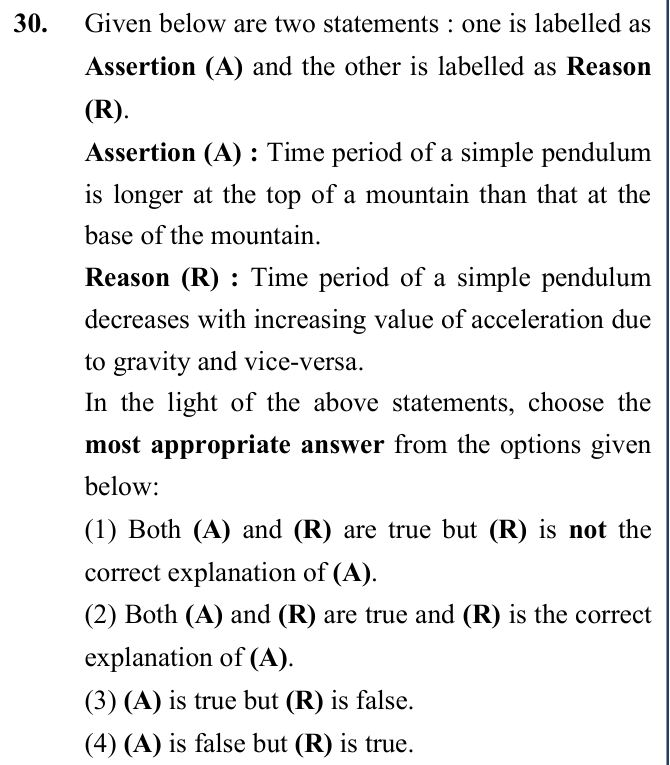
(1) Both (A) and (R) are true but (R) is not the
correct explanation of (A).
(2) Both (A) and (R) are true and (R) is the correct
explanation of (A).
(3) (A) is true but (R) is false.
(4) (A) is false but (R) is true.
As h increases, g decreases, T increases
=π
T
2
g = +
2
0
2
g R
g
(R
h)
QUESTION 3
Oscillations
SECTION A · MCQ (+4, -1)
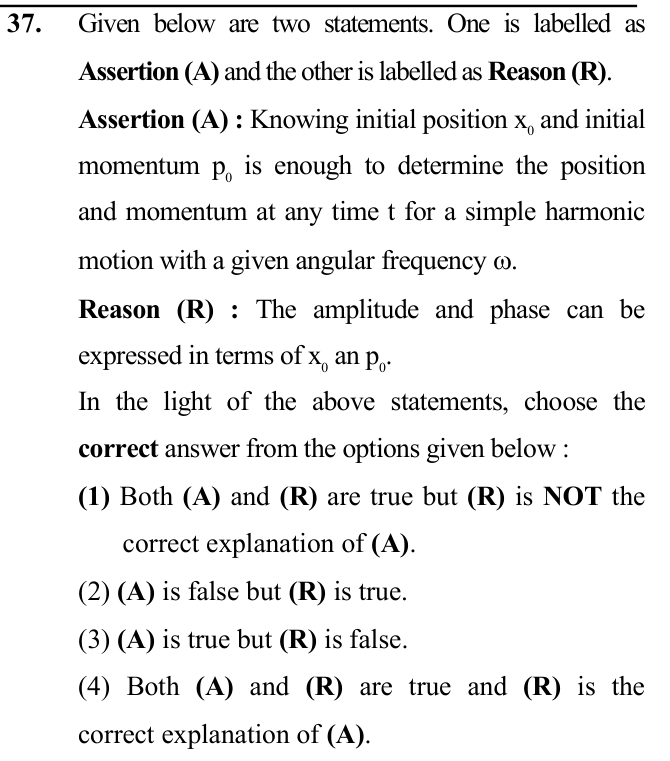
(1) Both (A) and (R) are true but (R) is NOT the
correct explanation of (A).
(2) (A) is false but (R) is true.
(3) (A) is true but (R) is false.
(4) Both (A) and (R) are true and (R) is the
correct explanation of (A).
x = A sin(ωt + φ)
x0 = A sinφ
…(1)
p = mAω cos(ωt + φ)
p0 = mAω cosφ
….(2)
(2)/(1) ⇒
0
0
x
tan
m
p
)
φ=
ω
(
[
)
0
2
2
0
0
x m
sin
(m x )
p
ω
φ=
ω + From (1),
2
2
0
0
0
(m x )
p
x
A
sin
m
ω + = = φ
ω
This means we can explain assertion with the given
reason.
QUESTION 4
Oscillations
SECTION A · MCQ (+4, -1)
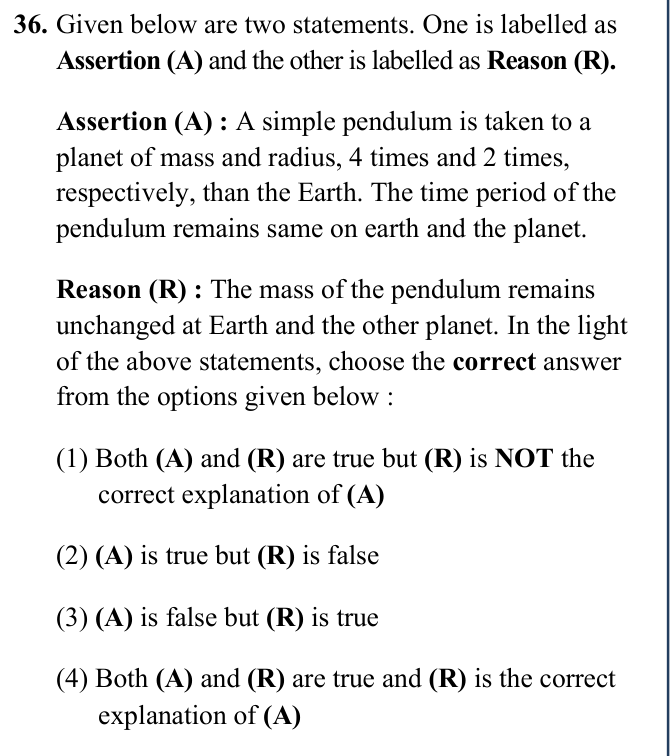
(1) Both (A) and (R) are true but (R) is NOT the
correct explanation of (A)
(2) (A) is true but (R) is false
(3) (A) is false but (R) is true
(4) Both (A) and (R) are true and (R) is the correct
explanation of (A)
2
GM
g
R = (
)
(
)
2
G 4M
g'
g
2R = =
A is correct, R is correct ; but since T = 2
g
π
doesn't depend on mass ; R doesn't explain A.
QUESTION 5
Oscillations
SECTION A · MCQ (+4, -1)
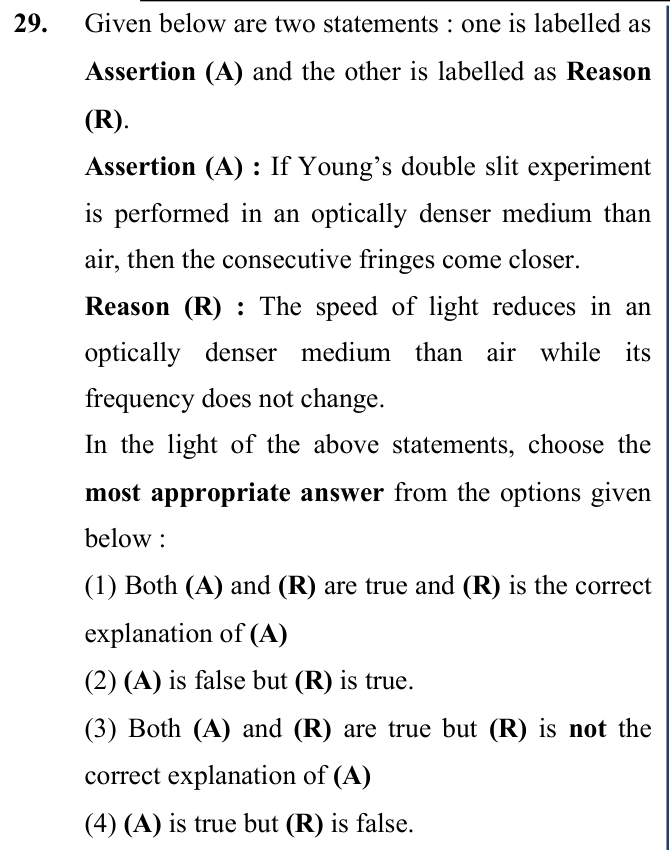
(1) Both (A) and (R) are true and (R) is the correct
explanation of (A)
(2) (A) is false but (R) is true.
(3) Both (A) and (R) are true but (R) is not the
correct explanation of (A)
(4) (A) is true but (R) is false.
β(fringe width)
D
d
λ = In denser medium, λ↓⇒β↓
⇒fringe come closer
Also,
c
c
µ
V
V
µ = ⇒ = Frequency remains same,
vac.
vac.
med
med
f
µ
f
µ
λ
λ
⇒ = ⇒λ = λ
QUESTION 6
Oscillations
SECTION A · MCQ (+4, -1)
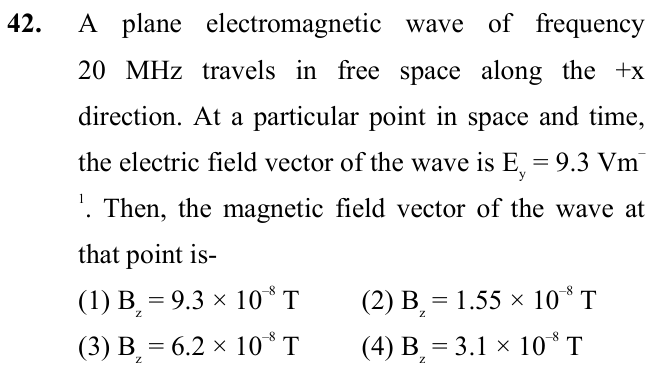
(1) Bz = 9.3 × 10
–8 T
(2) Bz = 1.55 × 10
–8 T
(3) Bz = 6.2 × 10
–8 T
(4) Bz = 3.1 × 10
–8 T
E = BC
9.3 = B × 3 × 10
8 = ×
8
9.3
B
3 10 = 3.1 × 10
–8 T
QUESTION 7
Oscillations
SECTION A · MCQ (+4, -1)
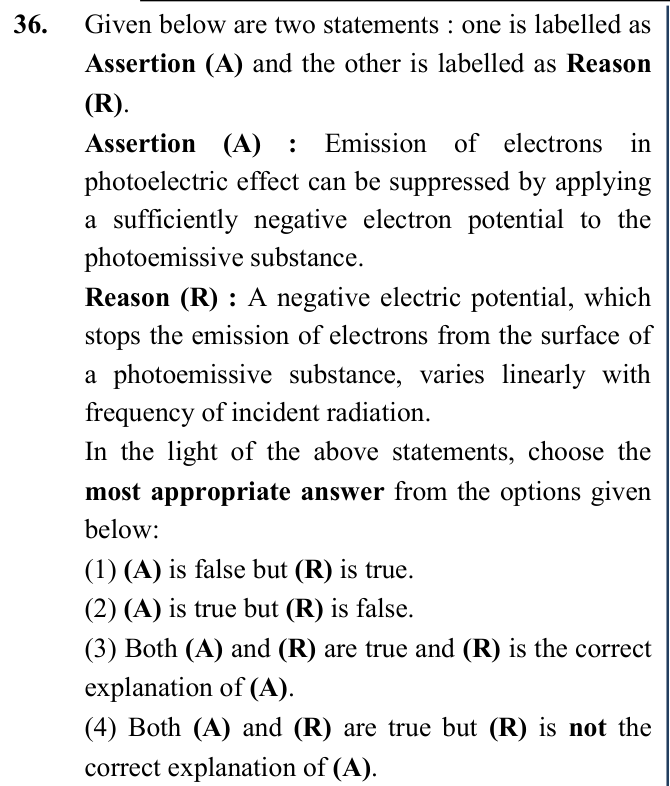
(1) (A) is false but (R) is true.
(2) (A) is true but (R) is false.
(3) Both (A) and (R) are true and (R) is the correct
explanation of (A).
(4) Both (A) and (R) are true but (R) is not the
correct explanation of (A).
(A) : True
(B) : True but not correct explanation
QUESTION 8
Oscillations
SECTION A · MCQ (+4, -1)
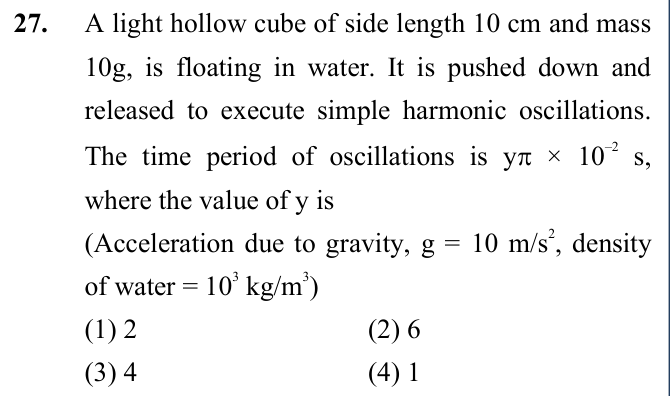
(1) 2
(2) 6
(3) 4
(4) 1
a2x ρg = manet
ρ = 2
net
L g x
a
m
T = 2π
ρ
2
m
L
g
where m = 10g, L = 10 cm, ρ = 1000 kg/m
3
QUESTION 9
Oscillations
SECTION A · MCQ (+4, -1)
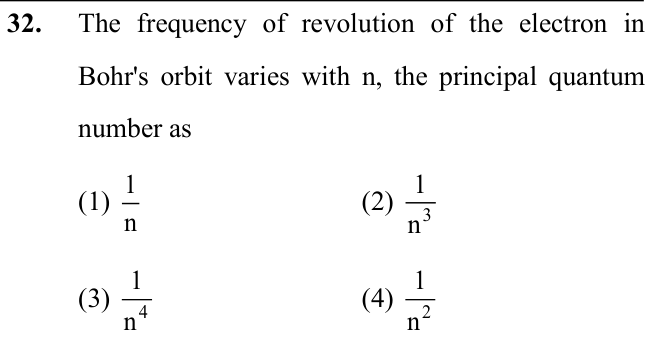
(1) 1
n
(2) 3
1
n
(3) 4
1
n
(4) 2
1
n
Frequency of revolution ∝
3
1
n
QUESTION 10
Oscillations
SECTION A · MCQ (+4, -1)
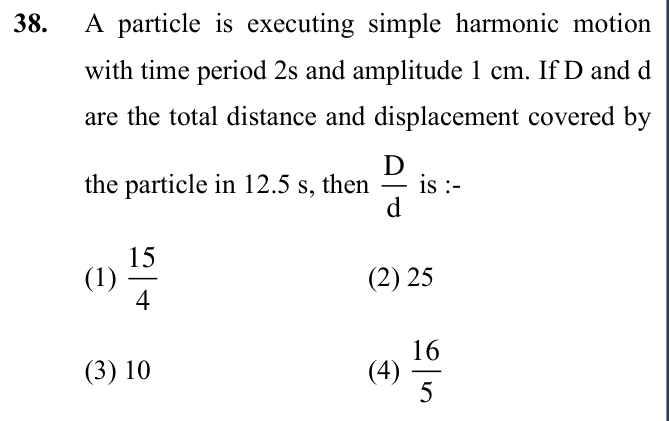
(1) 15
4
(2) 25
(3) 10
(4) 16
5
A = 1 cm
–A
A
12.5
n
6.25cycles
2 = =
∴ D = 4 × 6 + 1 = 25
d = 1
D
25
d =
QUESTION 11
Oscillations
SECTION A · MCQ (+4, -1)
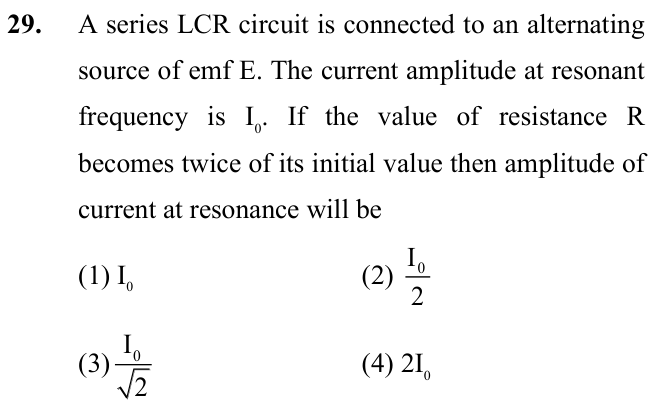
(1) I0
(2) 0I
2
(3) 0I
2
(4) 2I0
Initially,
m
0I
R
ε = Finally, 1
0
m
0
I
I
2R
2
ε = =
2
QUESTION 12
Oscillations
SECTION B · NUMERICAL (+4, 0)
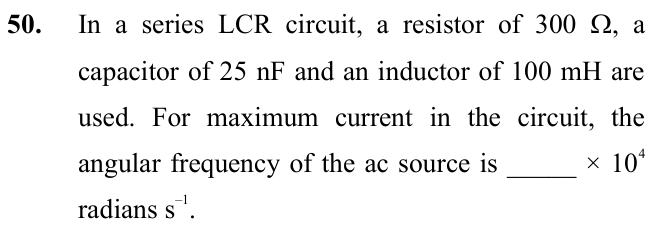
ω=
1
LC - ω= × × × –9
3
1
25 10
100 10 + ω= = ×
6
10
2
5 10
1
JEE–MAIN EXAMINATION – JANUARY 2025
QUESTION 13
Oscillations
SECTION A · MCQ (+4, -1)
A particle in SHM has maximum speed v_max and maximum acceleration a_max. The angular frequency ω and amplitude A are given by
(1) ω = a_max/v_max and A = v_max²/a_max
(2) ω = a_max/v_max and A = a_max²/v_max
(3) ω = a_max·v_max and A = v_max/a_max
(4) ω = v_max/a_max and A = a_max/v_max
Since v_max = ωA and a_max = ω²A, dividing gives ω = a_max/v_max, and then A = v_max²/a_max.
QUESTION 14
Oscillations
SECTION A · MCQ (+4, -1)
Two springs of force constants k₁ and k₂ are connected in series to a block. The equivalent spring constant k_eq is
(1) k_eq = k₁ + k₂
(2) k_eq = (k₁ + k₂)/2
(3) k_eq = k₁k₂/(k₁ + k₂) only if k₁ = k₂
(4) 1/k_eq = 1/k₁ + 1/k₂
Springs in series share the same force and their extensions add, so 1/k_eq = 1/k₁ + 1/k₂ (equivalently k_eq = k₁k₂/(k₁ + k₂)). The period then follows T = 2π√(m/k_eq).
QUESTION 15
Oscillations
SECTION A · MCQ (+4, -1)
A particle performs SHM and is released from rest at x = +A at t = 0. Which equation correctly describes its displacement?
(1) x = A cos(ωt)
(2) x = A sin(ωt)
(3) x = A cos(ωt + π/2)
(4) x = -A cos(ωt)
Starting at x = +A with zero velocity at t = 0 means the initial phase φ₀ = 0 in x = A cos(ωt + φ₀), giving x = A cos(ωt).
QUESTION 16
Oscillations
SECTION A · MCQ (+4, -1)
If a pendulum completes 10 oscillations in 5 seconds, its frequency is
(1) 10 Hz
(2) 5 Hz
(3) 2 Hz
(4) 0.5 Hz
Frequency equals oscillations per second, 10/5 = 2 Hz.
QUESTION 17
Oscillations
SECTION A · MCQ (+4, -1)
If a particle executes one complete oscillation in time T, which relation correctly links its frequency ν and angular frequency ω?
(1) ω = ν/2π
(2) ω = ν = 1/T
(3) ω = 2πν = 2π/T
(4) ω = 2π/T and ν = T
Frequency is ν = 1/T (in hertz). Angular frequency is ω = 2πν = 2π/T (in rad/s), giving the phase advance per unit time.
QUESTION 18
Oscillations
SECTION A · MCQ (+4, -1)
The potential energy of a particle moving along the x-axis is U(x). For the particle to be in stable equilibrium at a point x₀, which condition must hold?
(1) dU/dx > 0 at x = x₀
(2) d²U/dx² = 0 at x = x₀
(3) dU/dx = 0 and d²U/dx² > 0 at x = x₀
(4) dU/dx = 0 and d²U/dx² < 0 at x = x₀
Equilibrium requires zero net force F = -dU/dx = 0, i.e. dU/dx = 0. It is stable when a small displacement produces a restoring force, which happens when the potential energy is a minimum (d²U/dx² > 0). A maximum (d²U/dx² < 0) is unstable, and d²U/dx² = 0 is neutral.
QUESTION 19
Oscillations
SECTION A · MCQ (+4, -1)
The time period of a periodic motion whose frequency is 5 Hz is
(1) 2 s
(2) 0.5 s
(3) 5 s
(4) 0.2 s
Time period T = 1/f = 1/5 = 0.2 s.