
⚡ OFFICIAL NTA ASSESSMENT GENERATOR & WORD (.DOCX) EXPORTER
Waves · Practice Worksheet
JEE Main Physics · Curated Assessment Set Print directly or export as a beautifully formatted Microsoft Word document with embedded 180-DPI mathematical prompt clips and step-by-step derivations.
EDUPROD JEE MAIN TEST SERIES · NTA PATTERN
Waves · Practice Worksheet
JEE Main Physics · Curated Assessment Set · Assessment Code: JEE-101
Total Marks: 100
Marking: +4 / -1 (Sec A) · +4 / 0 (Sec B)
QUESTION 1
PHYSICS · Wave Optics
SECTION A · MCQ (+4, -1)
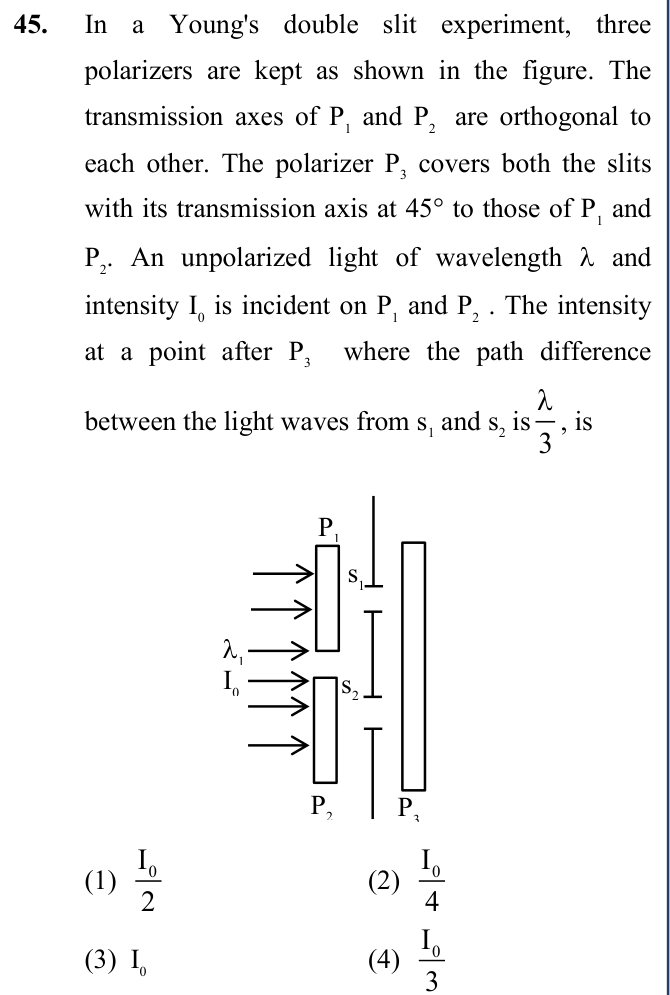
Candidate Response:
(1) (2) (3) (4)
⚡ OFFICIAL KEY: 3
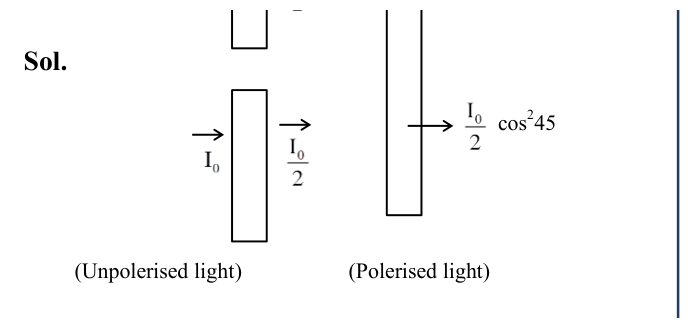
Step-by-Step Derivation
QUESTION 2
PHYSICS · Laws of Motion
SECTION A · MCQ (+4, -1)
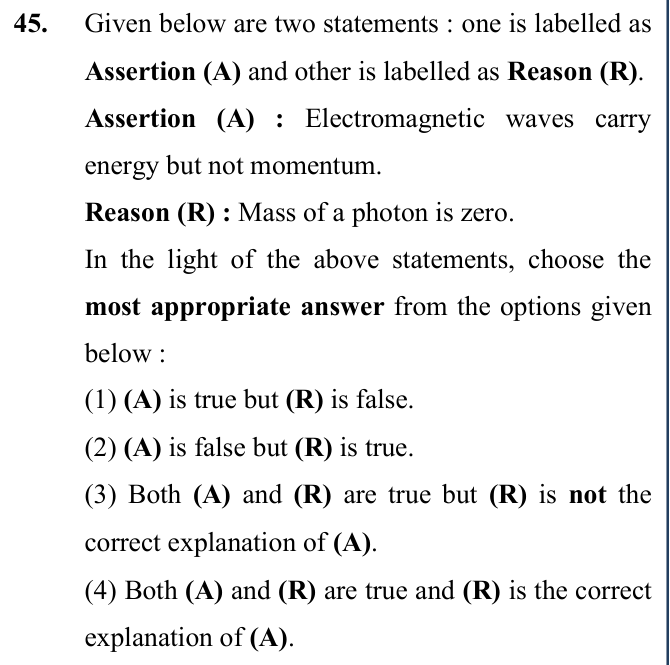
Candidate Response:
(1) (2) (3) (4)
⚡ OFFICIAL KEY: 2
Step-by-Step Derivation

QUESTION 3
PHYSICS · Units and Measurements
SECTION A · MCQ (+4, -1)
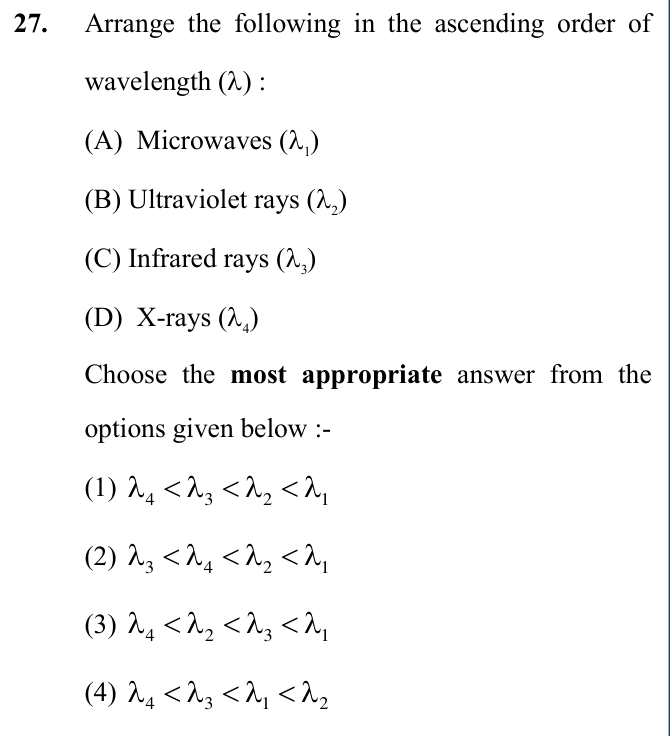
Candidate Response:
(1) (2) (3) (4)
⚡ OFFICIAL KEY: 3
Step-by-Step Derivation
QUESTION 4
PHYSICS · Waves
SECTION A · MCQ (+4, -1)
Two tuning forks of frequencies 256 Hz and 260 Hz are sounded together. The number of beats heard per second is:
(1) 4
(2) 2
(3) 516
(4) 256
Candidate Response:
(1) (2) (3) (4)
⚡ OFFICIAL KEY: 4
Step-by-Step Derivation
Beat frequency is the absolute difference of the two frequencies: f_beat = |260 - 256| = 4 Hz, i.e., 4 beats per second.
QUESTION 5
PHYSICS · Waves
SECTION A · MCQ (+4, -1)
A travelling wave has a wavelength of 2 m and a time period of 0.5 s; its speed is
(1) 4 m/s
(2) 0.25 m/s
(3) 2 m/s
(4) 1 m/s
Candidate Response:
(1) (2) (3) (4)
⚡ OFFICIAL KEY: 4 m/s
Step-by-Step Derivation
Wave speed v = λ/T = 2/0.5 = 4 m/s.
QUESTION 6
PHYSICS · Waves
SECTION A · MCQ (+4, -1)
Two coherent waves of intensities I₁ and I₂ interfere with phase difference φ. The resultant intensity is:
(1) I₁ + I₂
(2) I₁ + I₂ + 2√(I₁I₂) cos φ
(3) √(I₁² + I₂²)
(4) I₁ + I₂ - 2√(I₁I₂) cos φ
Candidate Response:
(1) (2) (3) (4)
⚡ OFFICIAL KEY: I₁ + I₂ + 2√(I₁I₂) cos φ
Step-by-Step Derivation
The resultant amplitude squared for two waves with phase difference φ gives I = I₁ + I₂ + 2√(I₁I₂) cos φ, the interference term being 2√(I₁I₂) cos φ.
QUESTION 7
PHYSICS · Waves
SECTION A · MCQ (+4, -1)
A wave has a frequency of 50 Hz and a wavelength of 0.4 m; its speed is
(1) 12.5 m/s
(2) 200 m/s
(3) 2 m/s
(4) 20 m/s
Candidate Response:
(1) (2) (3) (4)
⚡ OFFICIAL KEY: 20 m/s
Step-by-Step Derivation
Wave speed v = fλ = 50 × 0.4 = 20 m/s.
QUESTION 8
PHYSICS · Waves
SECTION A · MCQ (+4, -1)
A wave of frequency 500 Hz travels from air into water, where its speed increases. Which quantity remains unchanged as the wave enters the water?
(1) Wavelength
(2) Amplitude
(3) Frequency
(4) Speed
Candidate Response:
(1) (2) (3) (4)
⚡ OFFICIAL KEY: Frequency
Step-by-Step Derivation
The frequency of a wave is determined by its source and remains constant when the wave crosses a boundary into another medium. Since v = νλ, an increase in speed at constant frequency means the wavelength increases proportionally.
QUESTION 9
PHYSICS · Waves
SECTION A · MCQ (+4, -1)
A wave transports energy from one place to another without any net transfer of
(1) Energy
(2) Both energy and matter
(3) Charge
(4) Matter
Candidate Response:
(1) (2) (3) (4)
⚡ OFFICIAL KEY: Matter
Step-by-Step Derivation
Waves transfer energy but not matter; medium particles only oscillate about their positions.
QUESTION 10
PHYSICS · Waves
SECTION A · MCQ (+4, -1)
When a wave is reflected from a rigid (fixed) boundary, the reflected wave undergoes a phase change of:
(1) 0 (no phase change)
(2) π (180°), i.e., the pulse is inverted
(3) 2π (360°)
(4) π/2 (90°)
Candidate Response:
(1) (2) (3) (4)
⚡ OFFICIAL KEY: π (180°), i.e., the pulse is inverted
Step-by-Step Derivation
A rigid boundary cannot move, so the reflected wave is inverted (a crest reflects as a trough), corresponding to a phase change of π. At a free (open) boundary there is no phase reversal.
QUESTION 11
PHYSICS · Waves
SECTION A · MCQ (+4, -1)
The speed of sound in a gas is proportional to the square root of its absolute (Kelvin) temperature. If the Kelvin temperature is increased by a factor of 4, the speed of sound:
(1) Quadruples
(2) Doubles
(3) Stays the same
(4) Halves
Candidate Response:
(1) (2) (3) (4)
⚡ OFFICIAL KEY: Doubles
Step-by-Step Derivation
v = √(γRT/M), so v ∝ √T. Increasing T by a factor 4 increases v by √4 = 2, i.e., the speed doubles.
QUESTION 12
PHYSICS · Waves
SECTION A · MCQ (+4, -1)
Two waves of equal intensity I₀ interfere constructively. The resultant intensity is:
(1) √2 I₀
(2) I₀
(3) 4I₀
(4) 2I₀
Candidate Response:
(1) (2) (3) (4)
⚡ OFFICIAL KEY: 4I₀
Step-by-Step Derivation
For two waves of equal amplitude, constructive interference doubles the amplitude (2A) and intensity is proportional to amplitude squared, so I = (2A)² ∝ 4I₀. Equivalently I_max = (√I₀ + √I₀)² = 4I₀.
QUESTION 13
PHYSICS · Waves
SECTION A · MCQ (+4, -1)
A pipe closed at one end resonates at its fundamental frequency. Which harmonics can be produced in this pipe?
(1) Only odd harmonics (1st, 3rd, 5th, ...)
(2) Both odd and even harmonics
(3) Only even harmonics (2nd, 4th, 6th, ...)
(4) Only the fundamental, no higher harmonics
Candidate Response:
(1) (2) (3) (4)
⚡ OFFICIAL KEY: Only odd harmonics (1st, 3rd, 5th, ...)
Step-by-Step Derivation
A closed pipe has a node at the closed end and an antinode at the open end, so it supports only odd harmonics f_n = (2n-1)v/(4L). An open pipe supports all harmonics f_n = nv/(2L).
QUESTION 14
PHYSICS · Waves
SECTION A · MCQ (+4, -1)
The speed of a transverse wave on a stretched string is given by v = √(T/μ), where μ is the linear mass density. If the tension T is quadrupled (μ unchanged), the wave speed:
(1) Doubles
(2) Halves
(3) Remains the same
(4) Quadruples
Candidate Response:
(1) (2) (3) (4)
⚡ OFFICIAL KEY: Doubles
Step-by-Step Derivation
Since v ∝ √T, quadrupling the tension increases speed by a factor √4 = 2, so the speed doubles.
QUESTION 15
PHYSICS · Waves
SECTION A · MCQ (+4, -1)
The wave number k of a wave of wavelength λ is
(1) 2λ
(2) λ
(3) λ/2π
(4) 2π/λ
Candidate Response:
(1) (2) (3) (4)
⚡ OFFICIAL KEY: 2π/λ
Step-by-Step Derivation
Wave number k = 2π/λ.
QUESTION 16
PHYSICS · Waves
SECTION A · MCQ (+4, -1)
A transverse mechanical wave can propagate only in a medium that can support shear stress (rigidity). Which of the following media can transmit a transverse mechanical wave?
(1) Solids only
(2) Liquids and gases only
(3) Vacuum (no medium)
(4) All states — solid, liquid, and gas
Candidate Response:
(1) (2) (3) (4)
⚡ OFFICIAL KEY: Solids only
Step-by-Step Derivation
Transverse waves require a restoring shear force, so they need a medium with shear modulus (rigidity). Only solids have significant shear modulus; liquids and gases cannot sustain transverse mechanical waves.
QUESTION 17
PHYSICS · Waves
SECTION A · MCQ (+4, -1)
The speed of sound in air at room temperature is approximately
(1) 340 m/s
(2) 3×10⁸ m/s
(3) 1500 m/s
(4) 34 m/s
Candidate Response:
(1) (2) (3) (4)
⚡ OFFICIAL KEY: 340 m/s
Step-by-Step Derivation
Sound travels in air at about 340 m/s (≈ 343 m/s).
QUESTION 18
PHYSICS · Waves
SECTION A · MCQ (+4, -1)
Two waves of amplitudes 3 cm and 4 cm superpose exactly in phase; the resultant amplitude is
(1) 1 cm
(2) 7 cm
(3) 12 cm
(4) 5 cm
Candidate Response:
(1) (2) (3) (4)
⚡ OFFICIAL KEY: 7 cm
Step-by-Step Derivation
For in-phase superposition, amplitudes add: 3 + 4 = 7 cm.
QUESTION 19
PHYSICS · Waves
SECTION A · MCQ (+4, -1)
For a transverse wave y = A sin(kx - ωt), the maximum speed of a particle of the medium is:
(1) ω/k
(2) ωA
(3) A/ω
(4) kA
Candidate Response:
(1) (2) (3) (4)
⚡ OFFICIAL KEY: ωA
Step-by-Step Derivation
Particle velocity is v_p = ∂y/∂t = -Aω cos(kx - ωt). Its maximum value is Aω. Note this is different from the wave (phase) speed v = ω/k.
QUESTION 20
PHYSICS · Waves
SECTION A · MCQ (+4, -1)
When a wave is reflected from a fixed (rigid) end, the reflected wave undergoes a phase change of
(1) 2π
(2) π/2
(3) π
(4) 0
Candidate Response:
(1) (2) (3) (4)
⚡ OFFICIAL KEY: π
Step-by-Step Derivation
Reflection at a fixed end reverses the phase by π (180°).
QUESTION 21
PHYSICS · Waves
SECTION A · MCQ (+4, -1)
In the progressive wave equation y = A sin(ωt − kx), the quantity k is called the
(1) Frequency
(2) Phase
(3) Wave number
(4) Wavelength
Candidate Response:
(1) (2) (3) (4)
⚡ OFFICIAL KEY: Wave number
Step-by-Step Derivation
k is the angular wave number, given by k = 2π/λ.
QUESTION 22
PHYSICS · Waves
SECTION A · MCQ (+4, -1)
A tuning fork is loaded with a small amount of wax on its prongs. This loading:
(1) Doubles its frequency
(2) Does not change its frequency
(3) Decreases its frequency
(4) Increases its frequency
Candidate Response:
(1) (2) (3) (4)
⚡ OFFICIAL KEY: Decreases its frequency
Step-by-Step Derivation
Adding wax increases the mass of the prongs. Since frequency of vibration decreases with increasing mass (ν ∝ 1/√m), loading lowers the frequency. Filing the prongs removes mass and raises the frequency.
QUESTION 23
PHYSICS · Waves
SECTION A · MCQ (+4, -1)
For a progressive wave described by y = A sin(kx - ωt), the wave speed v is given by:
(1) v = k/ω
(2) v = kA
(3) v = Aω
(4) v = ω/k
Candidate Response:
(1) (2) (3) (4)
⚡ OFFICIAL KEY: v = ω/k
Step-by-Step Derivation
For a wave y = A sin(kx - ωt), the phase is (kx - ωt). Points of constant phase move with speed v = dx/dt = ω/k. Since k = 2π/λ and ω = 2πν, this equals v = νλ.
QUESTION 24
PHYSICS · Waves
SECTION A · MCQ (+4, -1)
A mechanical wave propagates through a material medium. Which of the following does the wave transport from one point to another?
(1) Energy and momentum, but no net transport of matter
(2) Matter particles along the direction of propagation
(3) Mass without any accompanying energy
(4) Only electric charge through the medium
Candidate Response:
(1) (2) (3) (4)
⚡ OFFICIAL KEY: Energy and momentum, but no net transport of matter
Step-by-Step Derivation
A wave is a disturbance that carries energy and momentum through a medium. The particles of the medium merely oscillate about their mean positions and return to them, so there is no net displacement (transport) of matter.
QUESTION 25
PHYSICS · Waves
SECTION A · MCQ (+4, -1)
In which type of wave do the particles of the medium oscillate perpendicular to the direction of wave propagation?
(1) Longitudinal wave
(2) Transverse wave
(3) Neither; particles always move along the direction of propagation
(4) Both transverse and longitudinal waves
Candidate Response:
(1) (2) (3) (4)
⚡ OFFICIAL KEY: Transverse wave
Step-by-Step Derivation
In a transverse wave, particle displacement is perpendicular to the direction of energy propagation (e.g., a wave on a stretched string), producing crests and troughs. In a longitudinal wave the particles move parallel to propagation, producing compressions and rarefactions.