
✎ ANSWER ONLINE · EVERY MISTAKE LINKS BACK TO THE CONCEPT
Waves · Practice Worksheet
Answer each question here and it marks straight away, with the derivation and a link to the exact micro-concept to revisit.
2 questions from this set could not be marked online — a
bonus or dual-key question, which has no single defensible answer. The print and
.docx versions still include them.
// CONCEPT AUDIT RESULT
Everything you missed has been added to your Error Arena — retest them blind there, and a concept clears once you get it right.
QUESTION 1
Wave Optics
SECTION A · MCQ (+4, -1)
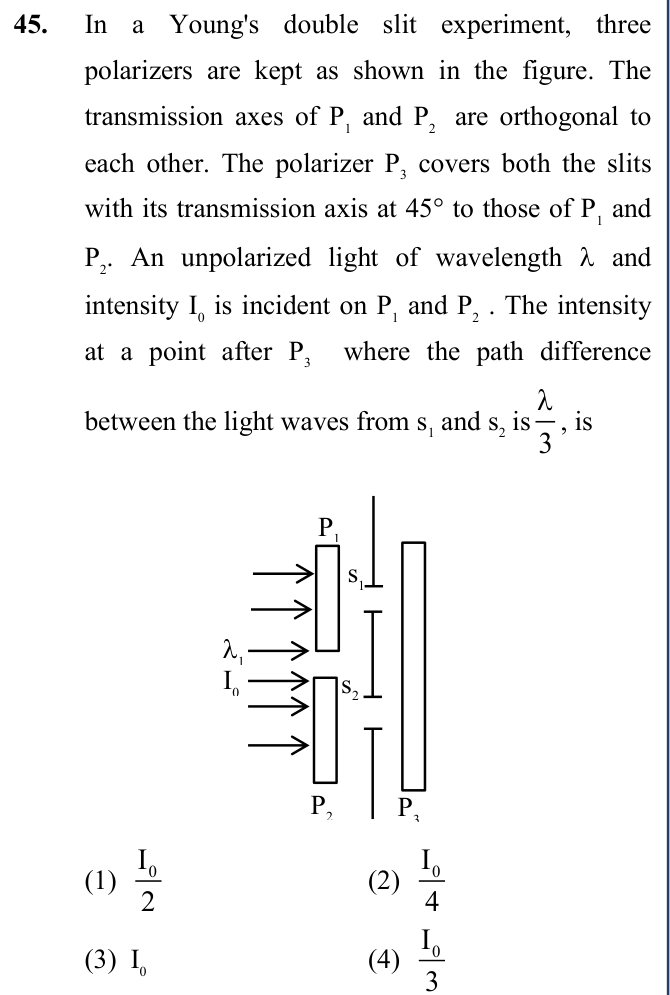
(1) 0I
2
(2) 0I
4
(3) I0
(4) 0I
3
cos245
cos245
(Unpolerised light)
(Polerised light)
after passing through third poleriser, Intensity of
both the waves must be
0I
4
now, at a point where path diff is λ
3 , phase
difference
Δφ =
Δ
π
)=
(
λ
[
)
x
2
2K
3
π
)
)
)
∴ = + + (
(
(
[
)
[
)
[
)
2
2
2
0
0
0
res
I
I
I
2
I
2
cos
4
4
4
3 = 0I
4
QUESTION 2
Laws of Motion
SECTION A · MCQ (+4, -1)
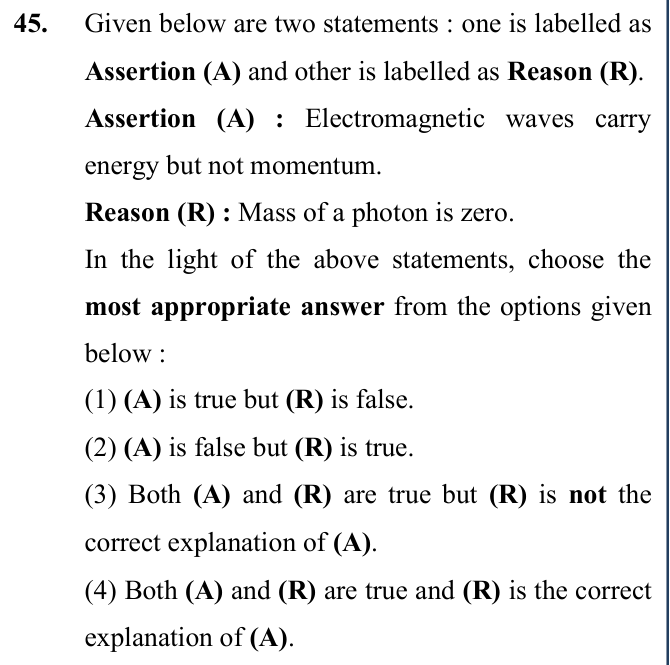
(1) (A) is true but (R) is false.
(2) (A) is false but (R) is true.
(3) Both (A) and (R) are true but (R) is not the
correct explanation of (A).
(4) Both (A) and (R) are true and (R) is the correct
explanation of (A).
Assertion is false because em waves have
momentum.
SECTION-B
QUESTION 3
Units and Measurements
SECTION A · MCQ (+4, -1)
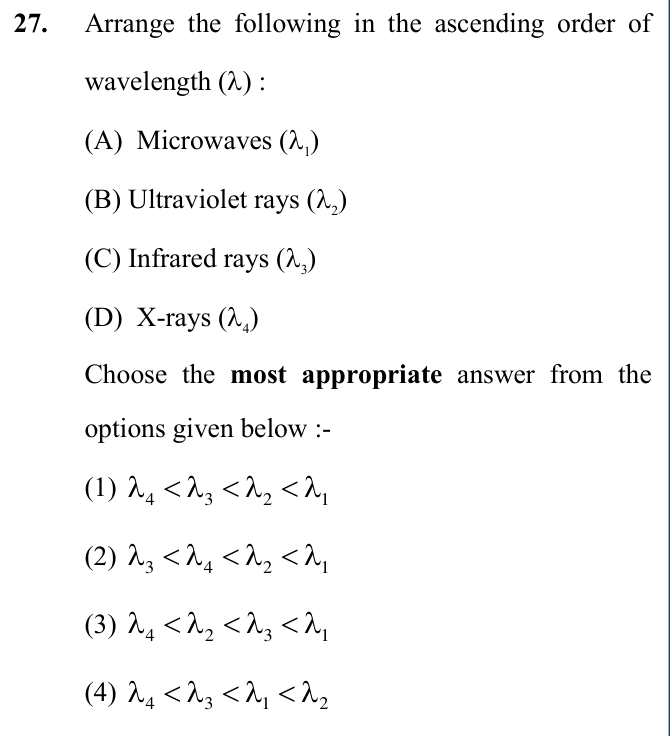
(1) 4
3
2
1
λ<λ<λ<λ
(2) 3
4
2
1
λ<λ<λ<λ
(3) 4
2
3
1
λ<λ<λ<λ
(4) 4
3
1
2
λ<λ<λ<λ
γ-rays X-rays U.V
rays
Visible
rays
IR
rays
Micro
waves
Radio
waves
λ
QUESTION 4
Waves
SECTION A · MCQ (+4, -1)
Two tuning forks of frequencies 256 Hz and 260 Hz are sounded together. The number of beats heard per second is:
(1) 4
(2) 2
(3) 516
(4) 256
Beat frequency is the absolute difference of the two frequencies: f_beat = |260 - 256| = 4 Hz, i.e., 4 beats per second.
QUESTION 5
Waves
SECTION A · MCQ (+4, -1)
A travelling wave has a wavelength of 2 m and a time period of 0.5 s; its speed is
(1) 4 m/s
(2) 0.25 m/s
(3) 2 m/s
(4) 1 m/s
Wave speed v = λ/T = 2/0.5 = 4 m/s.
QUESTION 6
Waves
SECTION A · MCQ (+4, -1)
Two coherent waves of intensities I₁ and I₂ interfere with phase difference φ. The resultant intensity is:
(1) I₁ + I₂
(2) I₁ + I₂ + 2√(I₁I₂) cos φ
(3) √(I₁² + I₂²)
(4) I₁ + I₂ - 2√(I₁I₂) cos φ
The resultant amplitude squared for two waves with phase difference φ gives I = I₁ + I₂ + 2√(I₁I₂) cos φ, the interference term being 2√(I₁I₂) cos φ.
QUESTION 7
Waves
SECTION A · MCQ (+4, -1)
A wave has a frequency of 50 Hz and a wavelength of 0.4 m; its speed is
(1) 12.5 m/s
(2) 200 m/s
(3) 2 m/s
(4) 20 m/s
Wave speed v = fλ = 50 × 0.4 = 20 m/s.
QUESTION 8
Waves
SECTION A · MCQ (+4, -1)
A wave of frequency 500 Hz travels from air into water, where its speed increases. Which quantity remains unchanged as the wave enters the water?
(1) Wavelength
(2) Amplitude
(3) Frequency
(4) Speed
The frequency of a wave is determined by its source and remains constant when the wave crosses a boundary into another medium. Since v = νλ, an increase in speed at constant frequency means the wavelength increases proportionally.
QUESTION 9
Waves
SECTION A · MCQ (+4, -1)
A wave transports energy from one place to another without any net transfer of
(1) Energy
(2) Both energy and matter
(3) Charge
(4) Matter
Waves transfer energy but not matter; medium particles only oscillate about their positions.
QUESTION 10
Waves
SECTION A · MCQ (+4, -1)
The speed of sound in a gas is proportional to the square root of its absolute (Kelvin) temperature. If the Kelvin temperature is increased by a factor of 4, the speed of sound:
(1) Quadruples
(2) Doubles
(3) Stays the same
(4) Halves
v = √(γRT/M), so v ∝ √T. Increasing T by a factor 4 increases v by √4 = 2, i.e., the speed doubles.
QUESTION 11
Waves
SECTION A · MCQ (+4, -1)
Two waves of equal intensity I₀ interfere constructively. The resultant intensity is:
(1) √2 I₀
(2) I₀
(3) 4I₀
(4) 2I₀
For two waves of equal amplitude, constructive interference doubles the amplitude (2A) and intensity is proportional to amplitude squared, so I = (2A)² ∝ 4I₀. Equivalently I_max = (√I₀ + √I₀)² = 4I₀.
QUESTION 12
Waves
SECTION A · MCQ (+4, -1)
The speed of a transverse wave on a stretched string is given by v = √(T/μ), where μ is the linear mass density. If the tension T is quadrupled (μ unchanged), the wave speed:
(1) Doubles
(2) Halves
(3) Remains the same
(4) Quadruples
Since v ∝ √T, quadrupling the tension increases speed by a factor √4 = 2, so the speed doubles.
QUESTION 13
Waves
SECTION A · MCQ (+4, -1)
The wave number k of a wave of wavelength λ is
(1) 2λ
(2) λ
(3) λ/2π
(4) 2π/λ
Wave number k = 2π/λ.