
⚡ OFFICIAL NTA ASSESSMENT GENERATOR & WORD (.DOCX) EXPORTER
Electromagnetic Waves · Practice Worksheet
JEE Main Physics · Curated Assessment Set Print directly or export as a beautifully formatted Microsoft Word document with embedded 180-DPI mathematical prompt clips and step-by-step derivations.
EDUPROD JEE MAIN TEST SERIES · NTA PATTERN
Electromagnetic Waves · Practice Worksheet
JEE Main Physics · Curated Assessment Set · Assessment Code: JEE-101
Total Marks: 80
Marking: +4 / -1 (Sec A) · +4 / 0 (Sec B)
QUESTION 1
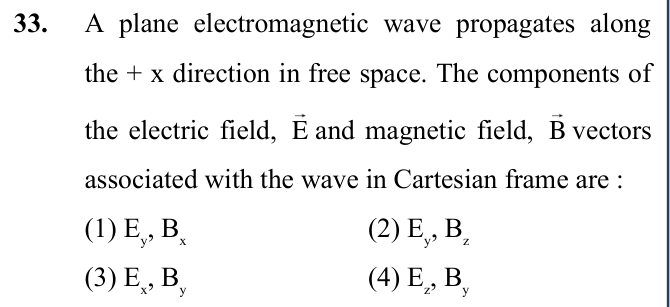
PHYSICS · Electric Charges and Fields
SECTION A · MCQ (+4, -1)
Candidate Response:
(1) (2) (3) (4)
QUESTION 2
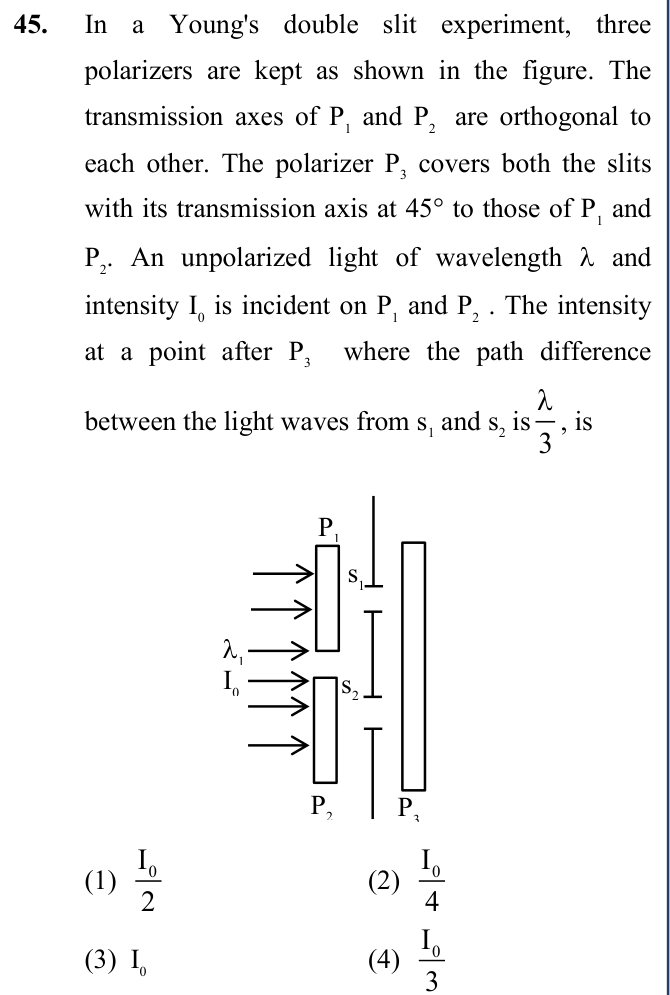
PHYSICS · Wave Optics
SECTION A · MCQ (+4, -1)
Candidate Response:
(1) (2) (3) (4)
QUESTION 3
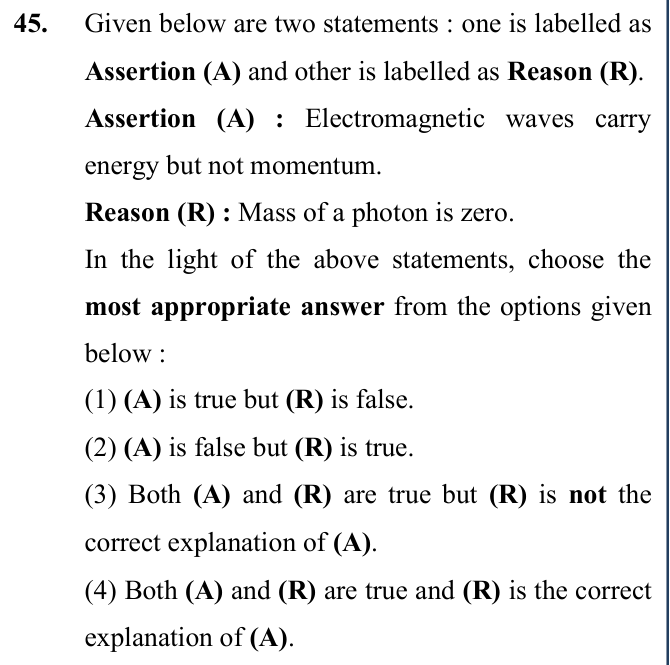
PHYSICS · Laws of Motion
SECTION A · MCQ (+4, -1)
Candidate Response:
(1) (2) (3) (4)
QUESTION 4
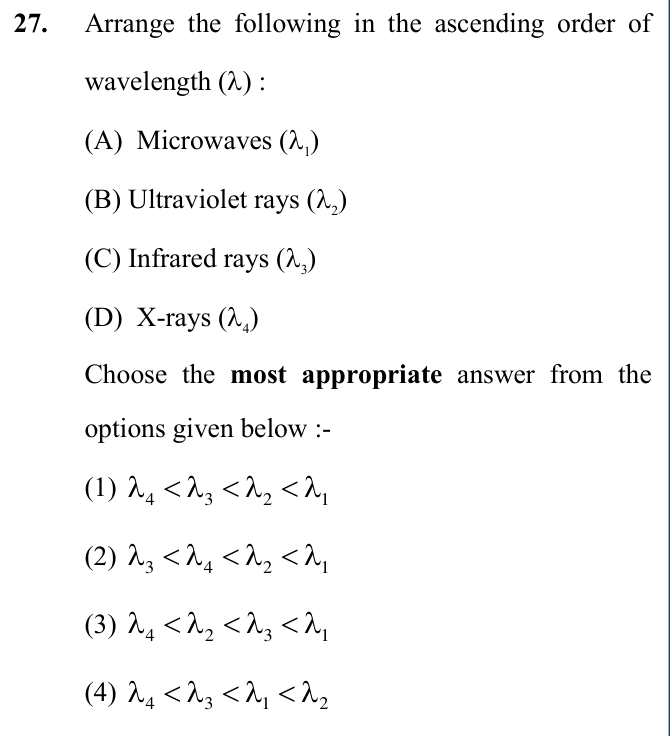
PHYSICS · Units and Measurements
SECTION A · MCQ (+4, -1)
Candidate Response:
(1) (2) (3) (4)
QUESTION 5
PHYSICS · Electric Charges and Fields
SECTION A · MCQ (+4, -1)
Candidate Response:
(1) (2) (3) (4)
QUESTION 6
PHYSICS · Current Electricity
SECTION A · MCQ (+4, -1)
Candidate Response:
(1) (2) (3) (4)
QUESTION 7
PHYSICS · Oscillations
SECTION A · MCQ (+4, -1)
Candidate Response:
(1) (2) (3) (4)
QUESTION 8
PHYSICS · Electromagnetic Waves
SECTION A · MCQ (+4, -1)
In vacuum, the speed of an electromagnetic wave is given by
(1) √(μ0 ε0)
(2) √(μ0/ε0)
(3) μ0 ε0
(4) 1/√(μ0 ε0)
Candidate Response:
(1) (2) (3) (4)
QUESTION 9
PHYSICS · Electromagnetic Waves
SECTION A · MCQ (+4, -1)
Who first predicted the existence of electromagnetic waves on theoretical grounds?
(1) James Clerk Maxwell
(2) Albert Einstein
(3) Heinrich Hertz
(4) Michael Faraday
Candidate Response:
(1) (2) (3) (4)
QUESTION 10
PHYSICS · Electromagnetic Waves
SECTION A · MCQ (+4, -1)
A plane electromagnetic wave propagates in vacuum along the +x direction, with its electric field oscillating along the +y direction. What is the correct direction and magnitude relation of the magnetic field?
(1) The magnetic field oscillates along the −x direction, opposite to the propagation direction.
(2) The magnetic field oscillates along the +z direction, with E0/B0 = c, and E, B, and the propagation direction are mutually perpendicular.
(3) The magnetic field oscillates along the +x direction, parallel to the propagation direction.
(4) The magnetic field oscillates along the +y direction (parallel to E), with E0 = B0.
Candidate Response:
(1) (2) (3) (4)
QUESTION 11
PHYSICS · Electromagnetic Waves
SECTION A · MCQ (+4, -1)
Which of the following lists electromagnetic radiations in the correct order of increasing frequency (decreasing wavelength)?
(1) Radio waves < Infrared < Microwaves < Visible < X-rays < Ultraviolet < Gamma rays
(2) Microwaves < Radio waves < Infrared < Ultraviolet < Visible < X-rays < Gamma rays
(3) Gamma rays < X-rays < Ultraviolet < Visible < Infrared < Microwaves < Radio waves
(4) Radio waves < Microwaves < Infrared < Visible < Ultraviolet < X-rays < Gamma rays
Candidate Response:
(1) (2) (3) (4)
QUESTION 12
PHYSICS · Electromagnetic Waves
SECTION A · MCQ (+4, -1)
The speed of electromagnetic waves in vacuum is approximately
(1) 3 × 10⁸ m/s
(2) 3 × 10¹⁰ m/s
(3) 3 × 10⁶ m/s
(4) 3 × 10⁵ m/s
Candidate Response:
(1) (2) (3) (4)
QUESTION 13
PHYSICS · Electromagnetic Waves
SECTION A · MCQ (+4, -1)
Given μ0 = 4π × 10⁻⁷ H/m and ε0 = 8.85 × 10⁻¹² F/m, the speed of electromagnetic waves in vacuum is c = 1/√(μ0ε0). Which value is closest to c?
(1) 3 × 10¹² m/s
(2) 3 × 10⁸ m/s
(3) 3 × 10¹⁰ m/s
(4) 3 × 10⁶ m/s
Candidate Response:
(1) (2) (3) (4)
QUESTION 14
PHYSICS · Electromagnetic Waves
SECTION A · MCQ (+4, -1)
The SI unit of displacement current is the
(1) coulomb
(2) volt
(3) ampere
(4) farad
Candidate Response:
(1) (2) (3) (4)
QUESTION 15
PHYSICS · Electromagnetic Waves
SECTION A · MCQ (+4, -1)
In Maxwell's modification of Ampere's law, the displacement current is proportional to the
(1) conduction current only
(2) rate of change of magnetic flux
(3) rate of change of electric flux
(4) rate of change of charge
Candidate Response:
(1) (2) (3) (4)
QUESTION 16
PHYSICS · Electromagnetic Waves
SECTION A · MCQ (+4, -1)
Which statement about Maxwell's equations correctly explains why electromagnetic waves can propagate through vacuum?
(1) A time-varying electric field produces a magnetic field, but a time-varying magnetic field never produces an electric field.
(2) Electromagnetic waves propagate through vacuum because electric field lines originate on and terminate on isolated magnetic monopoles.
(3) A time-varying magnetic field produces a curling electric field (Faraday's law), and a time-varying electric field produces a curling magnetic field (Ampere-Maxwell law); these mutually sustaining fields travel as a wave at c = 1/√(μ0ε0).
(4) Electromagnetic waves require a material medium to propagate, just like sound waves.
Candidate Response:
(1) (2) (3) (4)
QUESTION 17
PHYSICS · Electromagnetic Waves
SECTION A · MCQ (+4, -1)
The approximate wavelength range of visible light is
(1) 4000 nm to 7000 nm
(2) 0.1 nm to 10 nm
(3) 400 nm to 700 nm
(4) 1 mm to 1 m
Candidate Response:
(1) (2) (3) (4)
QUESTION 18
PHYSICS · Electromagnetic Waves
SECTION A · MCQ (+4, -1)
A microwave oven operates at a frequency of 2.45 GHz. What is the approximate wavelength of these microwaves in vacuum? (c = 3 × 10⁸ m/s)
(1) 7.35 × 10¹⁷ m
(2) 1.2 × 10⁻¹¹ m
(3) 12 m
(4) 0.12 m
Candidate Response:
(1) (2) (3) (4)
QUESTION 19
PHYSICS · Electromagnetic Waves
SECTION A · MCQ (+4, -1)
Which region of the electromagnetic spectrum has the shortest wavelength?
(1) X-rays
(2) Gamma rays
(3) Infrared
(4) Ultraviolet
Candidate Response:
(1) (2) (3) (4)
QUESTION 20
PHYSICS · Electromagnetic Waves
SECTION A · MCQ (+4, -1)
In an electromagnetic wave, the electric field E and magnetic field B are
(1) mutually perpendicular to each other and to the direction of propagation
(2) parallel to each other
(3) perpendicular to each other but parallel to the direction of propagation
(4) both along the direction of propagation
Candidate Response:
(1) (2) (3) (4)