
✎ ANSWER ONLINE · EVERY MISTAKE LINKS BACK TO THE CONCEPT
Electromagnetic Waves · Practice Worksheet
Answer each question here and it marks straight away, with the derivation and a link to the exact micro-concept to revisit.
1 question from this set could not be marked online — a
bonus or dual-key question, which has no single defensible answer. The print and
.docx versions still include it.
// CONCEPT AUDIT RESULT
Everything you missed has been added to your Error Arena — retest them blind there, and a concept clears once you get it right.
QUESTION 1
Electric Charges and Fields
SECTION A · MCQ (+4, -1)
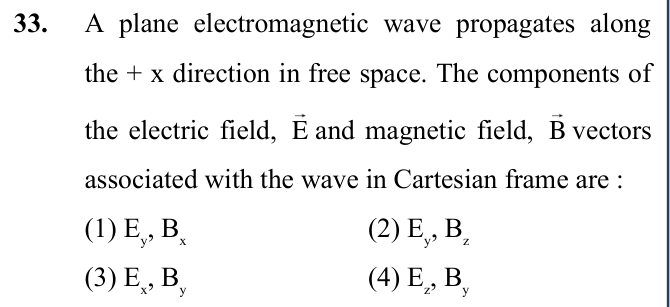
(1) Ey, Bx
(2) Ey, Bz
(3) Ex, By
(4) Ez, By
x
y
z
Direction of propogation
E
B = ×
QUESTION 2
Wave Optics
SECTION A · MCQ (+4, -1)
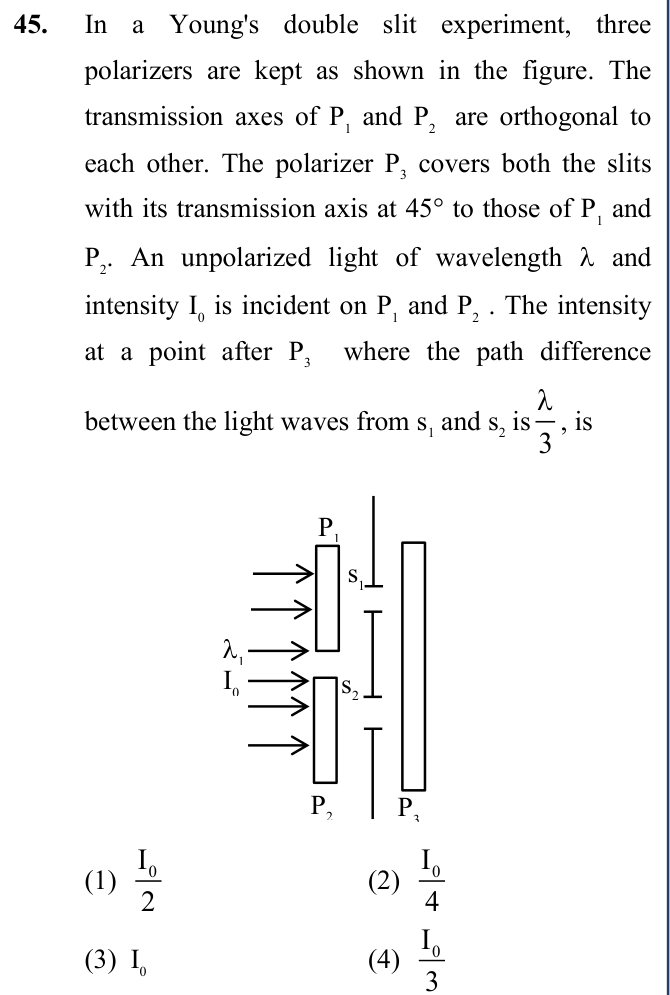
(1) 0I
2
(2) 0I
4
(3) I0
(4) 0I
3
cos245
cos245
(Unpolerised light)
(Polerised light)
after passing through third poleriser, Intensity of
both the waves must be
0I
4
now, at a point where path diff is λ
3 , phase
difference
Δφ =
Δ
π
)=
(
λ
[
)
x
2
2K
3
π
)
)
)
∴ = + + (
(
(
[
)
[
)
[
)
2
2
2
0
0
0
res
I
I
I
2
I
2
cos
4
4
4
3 = 0I
4
QUESTION 3
Laws of Motion
SECTION A · MCQ (+4, -1)
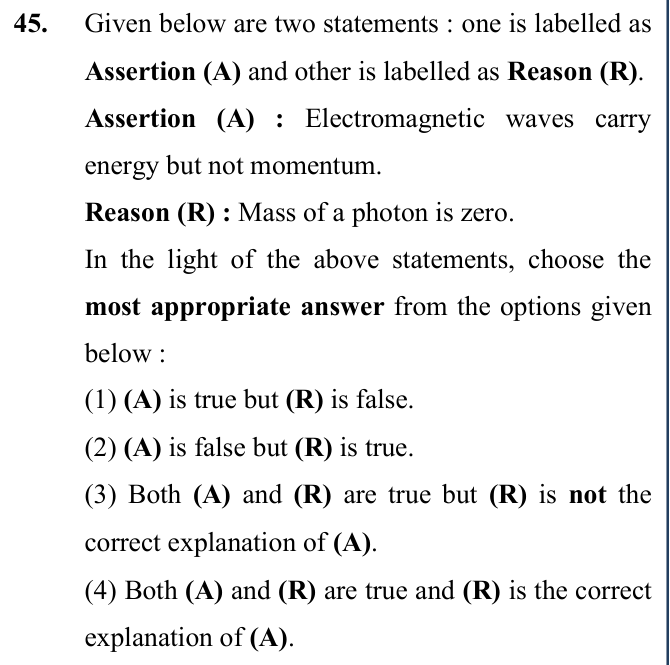
(1) (A) is true but (R) is false.
(2) (A) is false but (R) is true.
(3) Both (A) and (R) are true but (R) is not the
correct explanation of (A).
(4) Both (A) and (R) are true and (R) is the correct
explanation of (A).
Assertion is false because em waves have
momentum.
SECTION-B
QUESTION 4
Units and Measurements
SECTION A · MCQ (+4, -1)
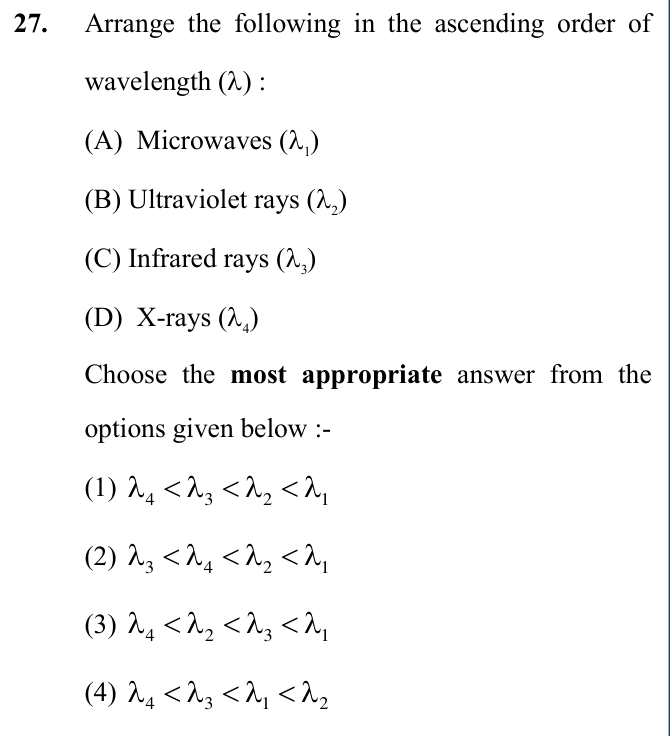
(1) 4
3
2
1
λ<λ<λ<λ
(2) 3
4
2
1
λ<λ<λ<λ
(3) 4
2
3
1
λ<λ<λ<λ
(4) 4
3
1
2
λ<λ<λ<λ
γ-rays X-rays U.V
rays
Visible
rays
IR
rays
Micro
waves
Radio
waves
λ
QUESTION 5
Electric Charges and Fields
SECTION A · MCQ (+4, -1)
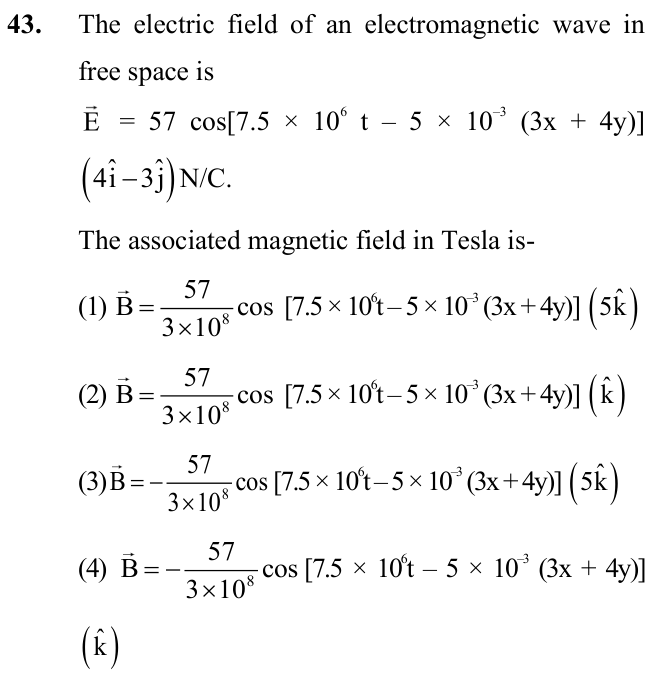
(1) = × 8
57
B
cos
3 10
[7.5 × 10
6t – 5 × 10
–3 (3x + 4y)] (
)
ˆ
5k
(2) = × 8
57
B
cos
3 10
[7.5 × 10
6t – 5 × 10
–3 (3x + 4y)] ()
ˆk
(3) =- × 8
57
B
cos
3 10
[7.5 × 10
6t – 5 × 10
–3 (3x + 4y)] (
)
ˆ
5k
(4) =-×
8
57
B
cos
3 10
[7.5 × 10
6t – 5 × 10
–3 (3x + 4y)]
()
ˆk
= + ˆ
ˆ
K
3i
4j + =
ˆ
ˆ
3i
4j
ˆK
5 = ˆ
ˆ
4i – 3j
ˆE
5 = ×
ˆ
ˆ
ˆ
B
K
E = ˆ
ˆ
B
–Z
B0 = = ×
0
8
E
57
C
3 10
7
QUESTION 6
Current Electricity
SECTION A · MCQ (+4, -1)
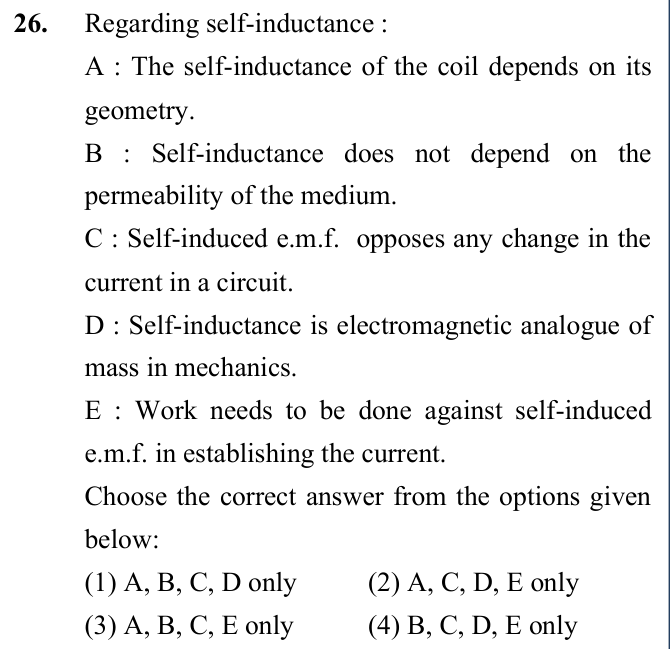
(1) A, B, C, D only
(2) A, C, D, E only
(3) A, B, C, E only
(4) B, C, D, E only
Self inductance of coil
L = μ
π
2
0N A
2 R
QUESTION 7
Oscillations
SECTION A · MCQ (+4, -1)
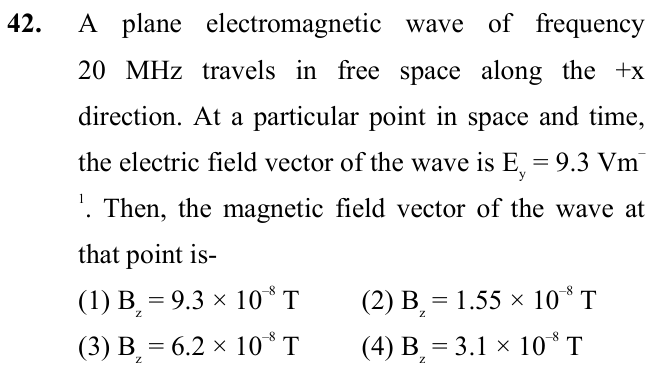
(1) Bz = 9.3 × 10
–8 T
(2) Bz = 1.55 × 10
–8 T
(3) Bz = 6.2 × 10
–8 T
(4) Bz = 3.1 × 10
–8 T
E = BC
9.3 = B × 3 × 10
8 = ×
8
9.3
B
3 10 = 3.1 × 10
–8 T
QUESTION 8
Electromagnetic Waves
SECTION A · MCQ (+4, -1)
In vacuum, the speed of an electromagnetic wave is given by
(1) √(μ0 ε0)
(2) √(μ0/ε0)
(3) μ0 ε0
(4) 1/√(μ0 ε0)
c = 1/√(μ0 ε0) in free space.
QUESTION 9
Electromagnetic Waves
SECTION A · MCQ (+4, -1)
Who first predicted the existence of electromagnetic waves on theoretical grounds?
(1) James Clerk Maxwell
(2) Albert Einstein
(3) Heinrich Hertz
(4) Michael Faraday
Maxwell predicted EM waves theoretically; Hertz later confirmed them experimentally.
QUESTION 10
Electromagnetic Waves
SECTION A · MCQ (+4, -1)
Which of the following lists electromagnetic radiations in the correct order of increasing frequency (decreasing wavelength)?
(1) Radio waves < Infrared < Microwaves < Visible < X-rays < Ultraviolet < Gamma rays
(2) Microwaves < Radio waves < Infrared < Ultraviolet < Visible < X-rays < Gamma rays
(3) Gamma rays < X-rays < Ultraviolet < Visible < Infrared < Microwaves < Radio waves
(4) Radio waves < Microwaves < Infrared < Visible < Ultraviolet < X-rays < Gamma rays
Ordered by increasing frequency (decreasing wavelength), the electromagnetic spectrum is: Radio → Microwave → Infrared → Visible → Ultraviolet → X-ray → Gamma.
QUESTION 11
Electromagnetic Waves
SECTION A · MCQ (+4, -1)
The speed of electromagnetic waves in vacuum is approximately
(1) 3 × 10⁸ m/s
(2) 3 × 10¹⁰ m/s
(3) 3 × 10⁶ m/s
(4) 3 × 10⁵ m/s
EM waves propagate in vacuum at c = 3 × 10⁸ m/s.
QUESTION 12
Electromagnetic Waves
SECTION A · MCQ (+4, -1)
Given μ0 = 4π × 10⁻⁷ H/m and ε0 = 8.85 × 10⁻¹² F/m, the speed of electromagnetic waves in vacuum is c = 1/√(μ0ε0). Which value is closest to c?
(1) 3 × 10¹² m/s
(2) 3 × 10⁸ m/s
(3) 3 × 10¹⁰ m/s
(4) 3 × 10⁶ m/s
1/√(μ0ε0) = 1/√[(4π × 10⁻⁷)(8.85 × 10⁻¹²)] ≈ 1/√(1.11 × 10⁻¹⁷) ≈ 3 × 10⁸ m/s, which equals the measured speed of light in vacuum.
QUESTION 13
Electromagnetic Waves
SECTION A · MCQ (+4, -1)
The SI unit of displacement current is the
(1) coulomb
(2) volt
(3) ampere
(4) farad
Displacement current is a current, so its SI unit is the ampere.
QUESTION 14
Electromagnetic Waves
SECTION A · MCQ (+4, -1)
In Maxwell's modification of Ampere's law, the displacement current is proportional to the
(1) conduction current only
(2) rate of change of magnetic flux
(3) rate of change of electric flux
(4) rate of change of charge
Displacement current I_D = ε0 (dΦ_E/dt).