
⚡ OFFICIAL NTA ASSESSMENT GENERATOR & WORD (.DOCX) EXPORTER
Wave Optics · Practice Worksheet
JEE Main Physics · Curated Assessment Set Print directly or export as a beautifully formatted Microsoft Word document with embedded 180-DPI mathematical prompt clips and step-by-step derivations.
EDUPROD JEE MAIN TEST SERIES · NTA PATTERN
Wave Optics · Practice Worksheet
JEE Main Physics · Curated Assessment Set · Assessment Code: JEE-101
Total Marks: 120
Marking: +4 / -1 (Sec A) · +4 / 0 (Sec B)
QUESTION 1
PHYSICS · Wave Optics
SECTION A · MCQ (+4, -1)
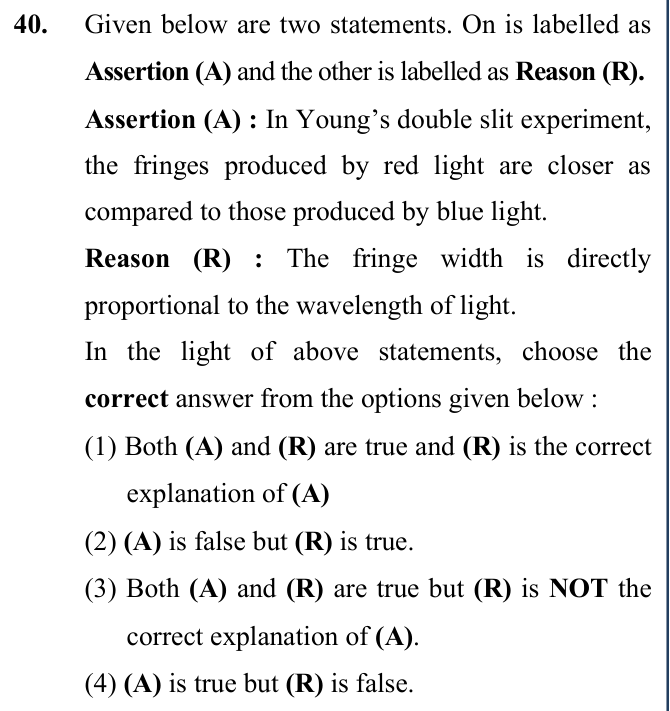
Candidate Response:
(1) (2) (3) (4)
QUESTION 2
PHYSICS · Wave Optics
SECTION A · MCQ (+4, -1)
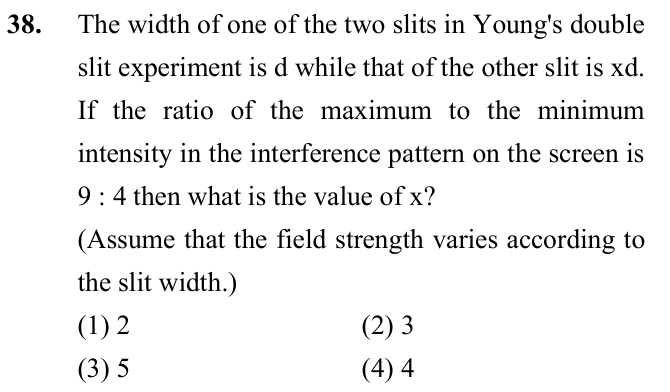
Candidate Response:
(1) (2) (3) (4)
QUESTION 3
PHYSICS · Wave Optics
SECTION A · MCQ (+4, -1)
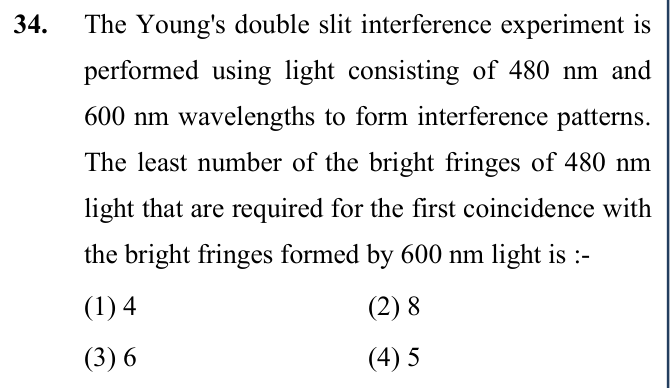
Candidate Response:
(1) (2) (3) (4)
QUESTION 4
PHYSICS · Wave Optics
SECTION A · MCQ (+4, -1)
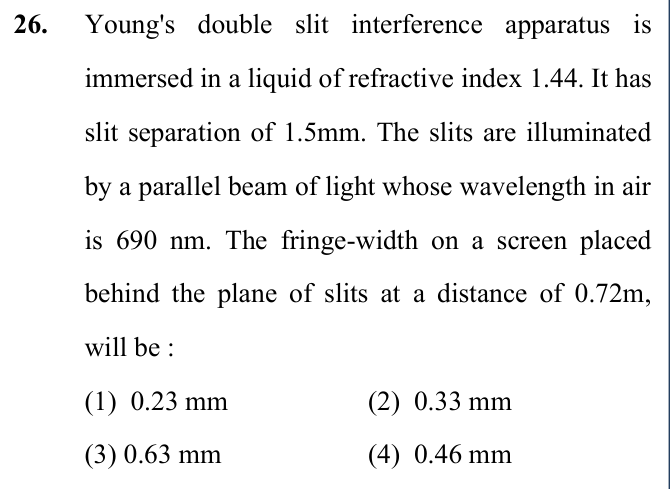
Candidate Response:
(1) (2) (3) (4)
QUESTION 5
PHYSICS · Wave Optics
SECTION A · MCQ (+4, -1)
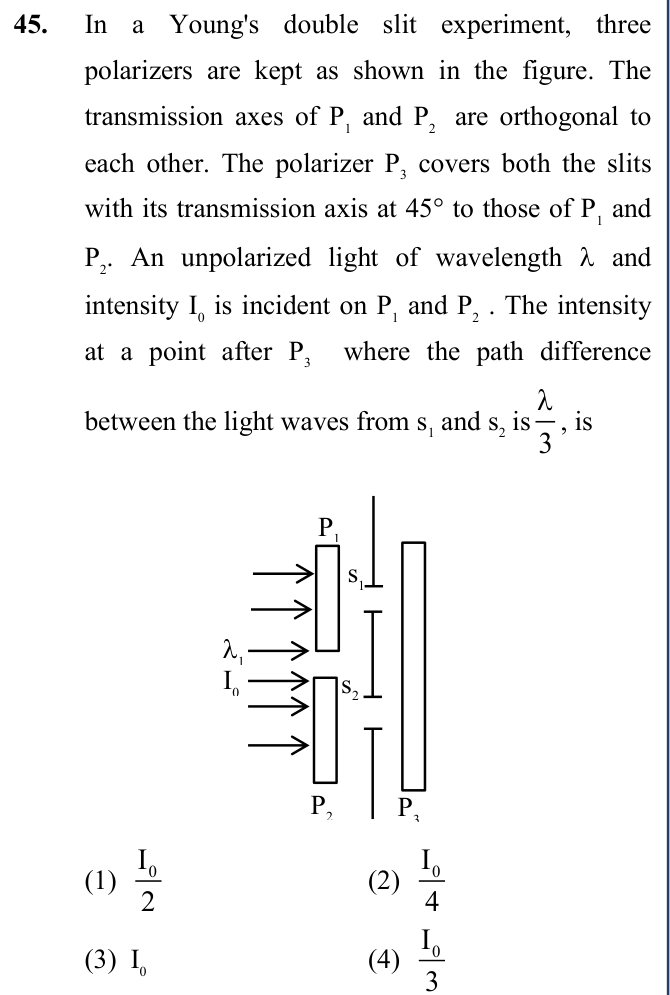
Candidate Response:
(1) (2) (3) (4)
QUESTION 6
PHYSICS · Wave Optics
SECTION B · NUMERICAL (+4, 0)
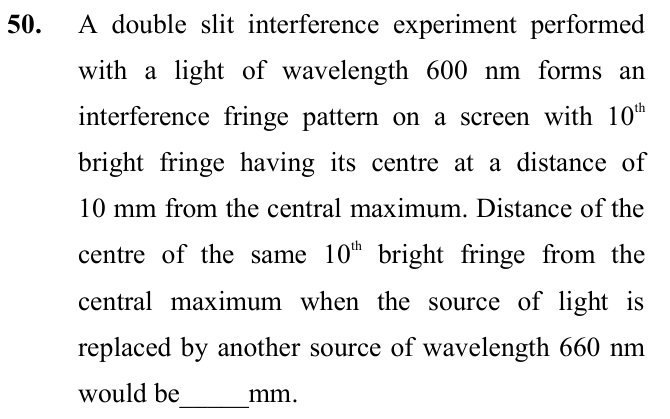
Numerical Value:
[ ]
QUESTION 7
PHYSICS · Wave Optics
SECTION A · MCQ (+4, -1)
In wave optics, a wavefront is best described as which of the following?
(1) The surface on which the electric and magnetic fields are always exactly out of phase.
(2) The locus of all points where the wave amplitude reaches its maximum value.
(3) The locus of all points in a medium that oscillate with the same phase, so the phase difference between any two points on it is zero.
(4) The path traced by a single photon as it propagates through the medium.
Candidate Response:
(1) (2) (3) (4)
QUESTION 8
PHYSICS · Wave Optics
SECTION A · MCQ (+4, -1)
The intensity of light received from a point source in free space varies with distance r from the source as:
(1) I ∝ 1/r²
(2) I ∝ 1/r
(3) I = constant
(4) I ∝ r
Candidate Response:
(1) (2) (3) (4)
QUESTION 9
PHYSICS · Wave Optics
SECTION A · MCQ (+4, -1)
According to Huygens' principle, the new wavefront at a later instant is obtained by:
(1) Extending each ray forward by an amount equal to one wavelength.
(2) Joining all points of maximum amplitude on the previous wavefront.
(3) Drawing the backward tangent envelope of the secondary wavelets.
(4) Treating every point on the existing wavefront as a source of secondary wavelets and drawing the forward tangent envelope of those wavelets.
Candidate Response:
(1) (2) (3) (4)
QUESTION 10
PHYSICS · Wave Optics
SECTION A · MCQ (+4, -1)
The obliquity factor in the direction directly forward of a Huygens wavelet (θ = 0 degrees) has the value:
(1) 1/2
(2) 0
(3) 1
(4) √(2)/2
Candidate Response:
(1) (2) (3) (4)
QUESTION 11
PHYSICS · Wave Optics
SECTION A · MCQ (+4, -1)
Using Huygens' principle, the ratio sin i / sin r for a plane wave crossing from medium 1 into medium 2 equals:
(1) v1 / v2, where v1 and v2 are the wave speeds in the two media.
(2) λ1 / λ2.
(3) v2 / v1, where v1 and v2 are the wave speeds in the two media.
(4) n1 / n2, where n is the refractive index.
Candidate Response:
(1) (2) (3) (4)
QUESTION 12
PHYSICS · Wave Optics
SECTION A · MCQ (+4, -1)
Light of wavelength λ in vacuum enters a medium of refractive index n. Its wavelength in the medium is:
(1) n * λ
(2) λ / √(n)
(3) λ / n
(4) λ (unchanged)
Candidate Response:
(1) (2) (3) (4)
QUESTION 13
PHYSICS · Wave Optics
SECTION A · MCQ (+4, -1)
In Young's double-slit experiment, two waves arrive at a point with a path difference of 3 λ. The interference at that point is:
(1) Constructive (a bright fringe), because the path difference is an integral multiple of λ.
(2) Constructive only if the two slits have equal width.
(3) Destructive (a dark fringe), because the path difference is an odd number of half-wavelengths.
(4) Neither bright nor dark, because 3 λ is too large.
Candidate Response:
(1) (2) (3) (4)
QUESTION 14
PHYSICS · Wave Optics
SECTION A · MCQ (+4, -1)
In Young's double-slit experiment, the fringe width β is given by:
(1) d D / λ
(2) λ d / D
(3) λ D / d
(4) D / (λ d)
Candidate Response:
(1) (2) (3) (4)
QUESTION 15
PHYSICS · Wave Optics
SECTION A · MCQ (+4, -1)
For a single slit of width a illuminated normally, the condition for the first diffraction minimum is:
(1) a sin θ = 2 λ
(2) a sin θ = n λ / 2 for integer n
(3) a sin θ = λ / 2
(4) a sin θ = λ
Candidate Response:
(1) (2) (3) (4)
QUESTION 16
PHYSICS · Wave Optics
SECTION A · MCQ (+4, -1)
In single-slit diffraction, the intensity of the first secondary maximum relative to the central maximum is approximately:
(1) I0 / 2 (50%)
(2) I0 / 10 (10%)
(3) I0 / 22 (about 4.5%)
(4) I0 / 4 (25%)
Candidate Response:
(1) (2) (3) (4)
QUESTION 17
PHYSICS · Wave Optics
SECTION A · MCQ (+4, -1)
The phenomenon of polarisation of light provides direct evidence that light waves are:
(1) Transverse in nature
(2) Both transverse and longitudinal
(3) Mechanical waves
(4) Longitudinal in nature
Candidate Response:
(1) (2) (3) (4)
QUESTION 18
PHYSICS · Wave Optics
SECTION A · MCQ (+4, -1)
At Brewster's angle i_p for a transparent medium of refractive index n, which relation holds?
(1) tan i_p = 1 / n
(2) tan i_p = n
(3) cos i_p = n
(4) sin i_p = n
Candidate Response:
(1) (2) (3) (4)
QUESTION 19
PHYSICS · Wave Optics
SECTION A · MCQ (+4, -1)
In wave optics, a surface of constant phase of a wave is called a
(1) photon
(2) ray
(3) wavelet
(4) wavefront
Candidate Response:
(1) (2) (3) (4)
QUESTION 20
PHYSICS · Wave Optics
SECTION A · MCQ (+4, -1)
The wavelength of visible light is of the order of
(1) 10⁻¹⁴ m
(2) 10⁻³ m
(3) 10⁻⁷ m
(4) 10⁻¹⁰ m
Candidate Response:
(1) (2) (3) (4)
QUESTION 21
PHYSICS · Wave Optics
SECTION A · MCQ (+4, -1)
According to Huygens' principle, every point on a wavefront acts as a source of
(1) primary photons
(2) secondary wavelets
(3) stationary nodes
(4) reflected rays
Candidate Response:
(1) (2) (3) (4)
QUESTION 22
PHYSICS · Wave Optics
SECTION A · MCQ (+4, -1)
Light of wavelength 600 nm travelling in vacuum has a frequency of about
(1) 5 × 10¹⁴ Hz
(2) 2 × 10¹⁴ Hz
(3) 5 × 10¹⁵ Hz
(4) 5 × 10⁸ Hz
Candidate Response:
(1) (2) (3) (4)
QUESTION 23
PHYSICS · Wave Optics
SECTION A · MCQ (+4, -1)
Using Huygens' principle, refraction of a plane wave is explained by the fact that waves travel with different
(1) amplitudes in different media
(2) wavelengths in vacuum
(3) speeds in different media
(4) frequencies in different media
Candidate Response:
(1) (2) (3) (4)
QUESTION 24
PHYSICS · Wave Optics
SECTION A · MCQ (+4, -1)
Light of wavelength 600 nm in air enters glass of refractive index 1.5. Its wavelength in glass is
(1) 900 nm
(2) 350 nm
(3) 600 nm
(4) 400 nm
Candidate Response:
(1) (2) (3) (4)
QUESTION 25
PHYSICS · Wave Optics
SECTION A · MCQ (+4, -1)
Two light waves are coherent if they maintain a constant
(1) speed difference
(2) amplitude
(3) wavelength ratio
(4) phase difference
Candidate Response:
(1) (2) (3) (4)
QUESTION 26
PHYSICS · Wave Optics
SECTION A · MCQ (+4, -1)
In Young's double-slit experiment with λ = 500 nm, D = 1 m and slit separation d = 0.5 mm, the fringe width is
(1) 2 mm
(2) 10 mm
(3) 0.5 mm
(4) 1 mm
Candidate Response:
(1) (2) (3) (4)
QUESTION 27
PHYSICS · Wave Optics
SECTION A · MCQ (+4, -1)
Diffraction of light is most pronounced when the size of the obstacle or aperture is comparable to the
(1) intensity of light
(2) wavelength of light
(3) speed of light
(4) frequency of light
Candidate Response:
(1) (2) (3) (4)
QUESTION 28
PHYSICS · Wave Optics
SECTION A · MCQ (+4, -1)
In single-slit diffraction, the first minimum (n = 1) occurs at an angle θ given by
(1) a sin θ = 2λ
(2) a sin θ = λ
(3) a sin θ = λ/2
(4) a sin θ = λ/4
Candidate Response:
(1) (2) (3) (4)
QUESTION 29
PHYSICS · Wave Optics
SECTION A · MCQ (+4, -1)
The phenomenon of polarisation conclusively demonstrates that light is
(1) a pressure wave
(2) transverse
(3) longitudinal
(4) a stream of particles
Candidate Response:
(1) (2) (3) (4)
QUESTION 30
PHYSICS · Wave Optics
SECTION A · MCQ (+4, -1)
The Brewster angle for a glass surface of refractive index 1.5 is about
(1) 56°
(2) 45°
(3) 42°
(4) 60°
Candidate Response:
(1) (2) (3) (4)