
✎ ANSWER ONLINE · EVERY MISTAKE LINKS BACK TO THE CONCEPT
Wave Optics · Practice Worksheet
Answer each question here and it marks straight away, with the derivation and a link to the exact micro-concept to revisit.
3 questions from this set could not be marked online — a
bonus or dual-key question, which has no single defensible answer. The print and
.docx versions still include them.
// CONCEPT AUDIT RESULT
Everything you missed has been added to your Error Arena — retest them blind there, and a concept clears once you get it right.
QUESTION 1
Wave Optics
SECTION A · MCQ (+4, -1)
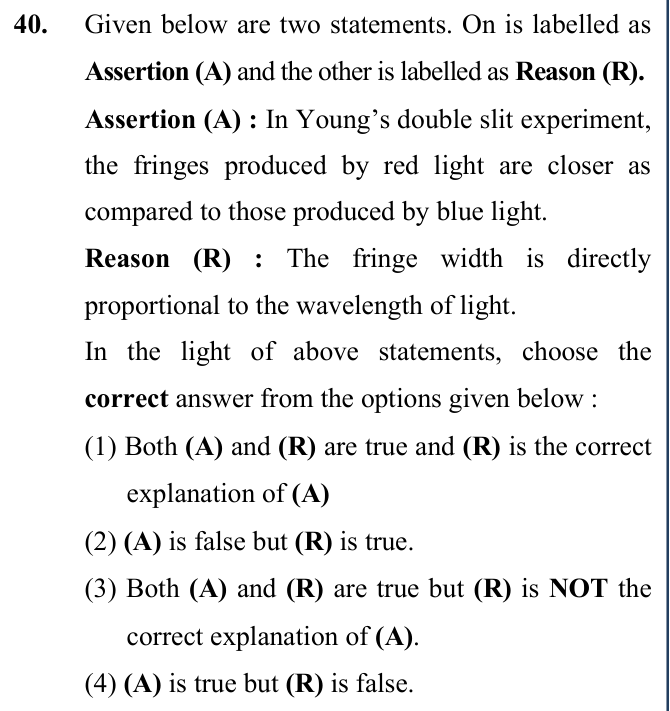
(1) Both (A) and (R) are true and (R) is the correct
explanation of (A)
(2) (A) is false but (R) is true.
(3) Both (A) and (R) are true but (R) is NOT the
correct explanation of (A).
(4) (A) is true but (R) is false.
D
d
λ
β=
&
R
b
λ>λ
∴
R
b
β>β
QUESTION 2
Wave Optics
SECTION A · MCQ (+4, -1)
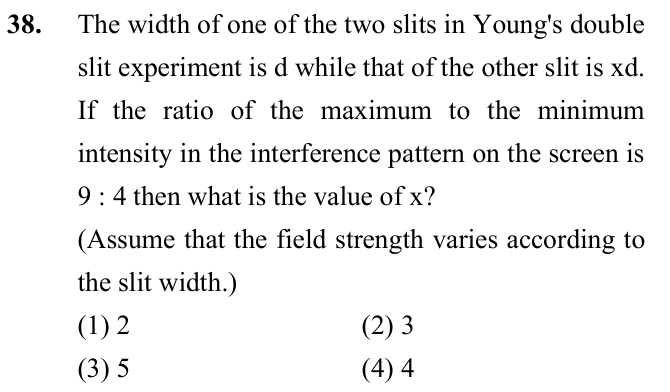
(1) 2
(2) 3
(3) 5
(4) 4
I ∝ (width)
2
) + =
(
( - [
)
2
1
2
1
2
I
I
9
4
I
I + = - 1
2
1
2
I
I
3
2
I
I + = - (x
1)d
3
(x
1)d
2
⇒3x – 3 = 2x + 2
x = 5
4
QUESTION 3
Wave Optics
SECTION A · MCQ (+4, -1)
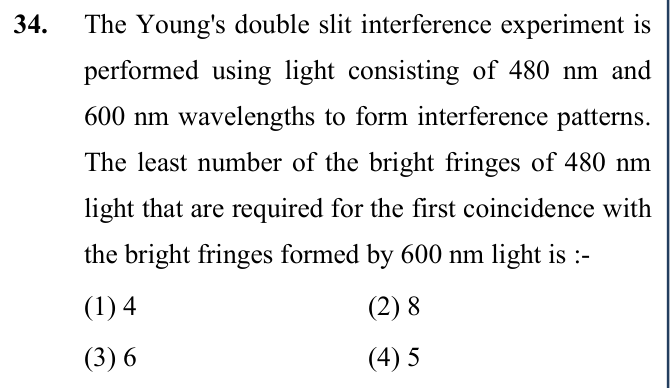
(1) 4
(2) 8
(3) 6
(4) 5
1
1
2
2
n
D
n
D
d
d
λ
λ = n 480 = m 600
nmin = 5
QUESTION 4
Wave Optics
SECTION A · MCQ (+4, -1)
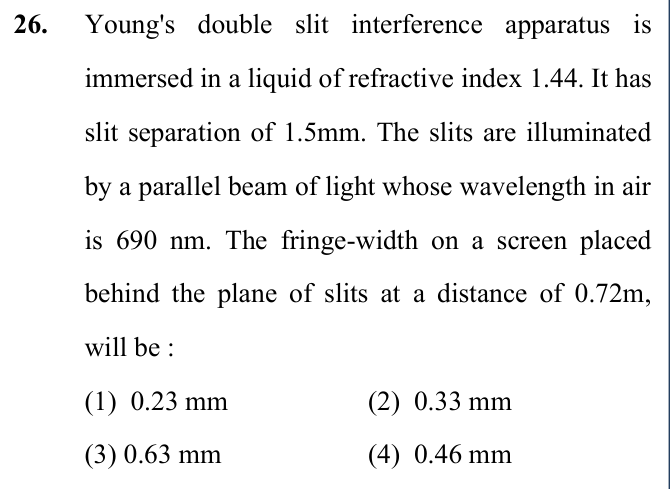
(1) 0.23 mm
(2) 0.33 mm
(3) 0.63 mm
(4) 0.46 mm
- - λ
) × ×
β= × =
(
μ × ×
[
)
9
0
3
D
690 10
0.72
d
1.44 1.5 10
= 0.23 mm
QUESTION 5
Wave Optics
SECTION A · MCQ (+4, -1)
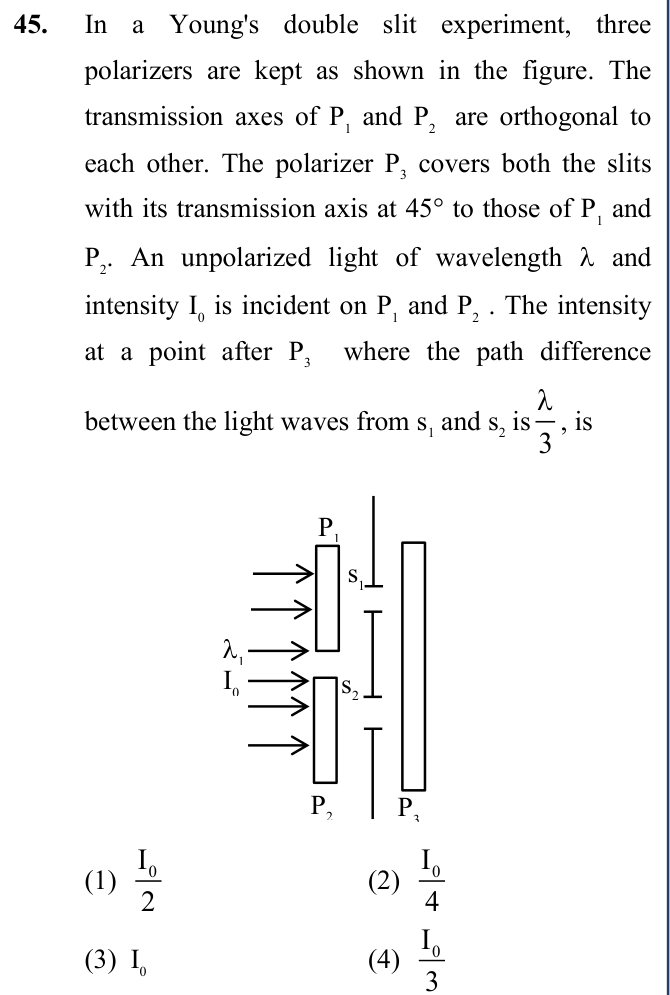
(1) 0I
2
(2) 0I
4
(3) I0
(4) 0I
3
cos245
cos245
(Unpolerised light)
(Polerised light)
after passing through third poleriser, Intensity of
both the waves must be
0I
4
now, at a point where path diff is λ
3 , phase
difference
Δφ =
Δ
π
)=
(
λ
[
)
x
2
2K
3
π
)
)
)
∴ = + + (
(
(
[
)
[
)
[
)
2
2
2
0
0
0
res
I
I
I
2
I
2
cos
4
4
4
3 = 0I
4
QUESTION 6
Wave Optics
SECTION B · NUMERICAL (+4, 0)
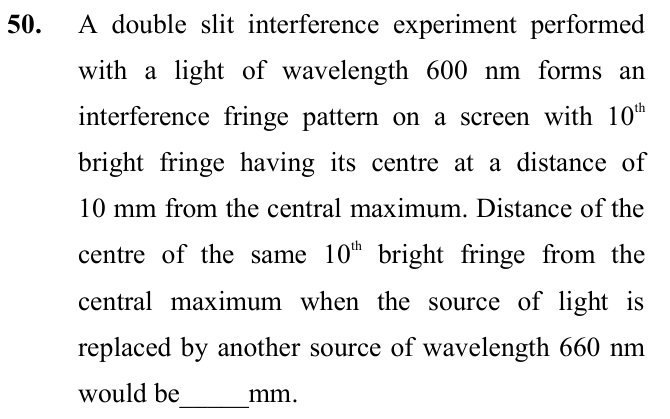
In case of YDSE the distance of n
th maxima from
central maxima is given by
Y = n D
d
λ
Here n , D & d are same
So, y × λ
⇒
2
2
2
1
1
y
y
660 nm
y
10 mm
600 nm
λ = ⇒ = λ
⇒ y2 = 11 mm
NTA Ans. (4)
1
JEE–MAIN EXAMINATION – JANUARY 2025
QUESTION 7
Wave Optics
SECTION A · MCQ (+4, -1)
The intensity of light received from a point source in free space varies with distance r from the source as:
(1) I ∝ 1/r²
(2) I ∝ 1/r
(3) I = constant
(4) I ∝ r
Energy from a point source spreads over the surface of a sphere (area 4 π r²). Since intensity is power per unit area, I ∝ 1/r².
QUESTION 8
Wave Optics
SECTION A · MCQ (+4, -1)
According to Huygens' principle, the new wavefront at a later instant is obtained by:
(1) Extending each ray forward by an amount equal to one wavelength.
(2) Joining all points of maximum amplitude on the previous wavefront.
(3) Drawing the backward tangent envelope of the secondary wavelets.
(4) Treating every point on the existing wavefront as a source of secondary wavelets and drawing the forward tangent envelope of those wavelets.
Huygens' two postulates are: (i) every point on a wavefront is a source of secondary wavelets, and (ii) the forward tangent envelope of these wavelets gives the new wavefront.
QUESTION 9
Wave Optics
SECTION A · MCQ (+4, -1)
The obliquity factor in the direction directly forward of a Huygens wavelet (θ = 0 degrees) has the value:
(1) 1/2
(2) 0
(3) 1
(4) √(2)/2
F(0 deg) = (1/2)(1 + cos 0 deg) = (1/2)(1 + 1) = 1, so wavelets are fully effective in the forward direction.
QUESTION 10
Wave Optics
SECTION A · MCQ (+4, -1)
Light of wavelength λ in vacuum enters a medium of refractive index n. Its wavelength in the medium is:
(1) n * λ
(2) λ / √(n)
(3) λ / n
(4) λ (unchanged)
Speed decreases to c/n while frequency stays constant, so λ' = (c/n)/f = λ / n.
QUESTION 11
Wave Optics
SECTION A · MCQ (+4, -1)
In Young's double-slit experiment, the fringe width β is given by:
(1) d D / λ
(2) λ d / D
(3) λ D / d
(4) D / (λ d)
Fringe width β = λ D / d, where λ is the wavelength, D the slit-to-screen distance, and d the slit separation.
QUESTION 12
Wave Optics
SECTION A · MCQ (+4, -1)
For a single slit of width a illuminated normally, the condition for the first diffraction minimum is:
(1) a sin θ = 2 λ
(2) a sin θ = n λ / 2 for integer n
(3) a sin θ = λ / 2
(4) a sin θ = λ
Single-slit minima occur at a sin θ = n λ (n = 1, 2, 3, ...); the first minimum corresponds to a sin θ = λ.
QUESTION 13
Wave Optics
SECTION A · MCQ (+4, -1)
In single-slit diffraction, the intensity of the first secondary maximum relative to the central maximum is approximately:
(1) I0 / 2 (50%)
(2) I0 / 10 (10%)
(3) I0 / 22 (about 4.5%)
(4) I0 / 4 (25%)
The first secondary maximum has intensity roughly I0/22 (about 4.5%) of the central maximum; the second is roughly I0/61 (about 1.6%).
QUESTION 14
Wave Optics
SECTION A · MCQ (+4, -1)
The phenomenon of polarisation of light provides direct evidence that light waves are:
(1) Transverse in nature
(2) Both transverse and longitudinal
(3) Mechanical waves
(4) Longitudinal in nature
Only transverse waves can be polarised; longitudinal waves (such as sound) vibrate along the propagation direction and cannot be polarised.
QUESTION 15
Wave Optics
SECTION A · MCQ (+4, -1)
At Brewster's angle i_p for a transparent medium of refractive index n, which relation holds?
(1) tan i_p = 1 / n
(2) tan i_p = n
(3) cos i_p = n
(4) sin i_p = n
Brewster's law states tan i_p = n; at this angle the reflected ray is completely plane-polarised.
QUESTION 16
Wave Optics
SECTION A · MCQ (+4, -1)
In wave optics, a surface of constant phase of a wave is called a
(1) photon
(2) ray
(3) wavelet
(4) wavefront
A wavefront is the locus of all points of equal phase.
QUESTION 17
Wave Optics
SECTION A · MCQ (+4, -1)
The wavelength of visible light is of the order of
(1) 10⁻¹⁴ m
(2) 10⁻³ m
(3) 10⁻⁷ m
(4) 10⁻¹⁰ m
Visible light wavelengths are about 400–700 nm, i.e. 10⁻⁷ m.
QUESTION 18
Wave Optics
SECTION A · MCQ (+4, -1)
According to Huygens' principle, every point on a wavefront acts as a source of
(1) primary photons
(2) secondary wavelets
(3) stationary nodes
(4) reflected rays
Each point of a wavefront is a source of secondary wavelets whose envelope is the new wavefront.
QUESTION 19
Wave Optics
SECTION A · MCQ (+4, -1)
Light of wavelength 600 nm travelling in vacuum has a frequency of about
(1) 5 × 10¹⁴ Hz
(2) 2 × 10¹⁴ Hz
(3) 5 × 10¹⁵ Hz
(4) 5 × 10⁸ Hz
f = c/λ = 3 × 10⁸ / (600 × 10⁻⁹) = 5 × 10¹⁴ Hz.
QUESTION 20
Wave Optics
SECTION A · MCQ (+4, -1)
Using Huygens' principle, refraction of a plane wave is explained by the fact that waves travel with different
(1) amplitudes in different media
(2) wavelengths in vacuum
(3) speeds in different media
(4) frequencies in different media
Refraction arises because the wave speed changes between media while the frequency stays constant.
QUESTION 21
Wave Optics
SECTION A · MCQ (+4, -1)
Light of wavelength 600 nm in air enters glass of refractive index 1.5. Its wavelength in glass is
(1) 900 nm
(2) 350 nm
(3) 600 nm
(4) 400 nm
λ' = λ/n = 600/1.5 = 400 nm.
QUESTION 22
Wave Optics
SECTION A · MCQ (+4, -1)
Two light waves are coherent if they maintain a constant
(1) speed difference
(2) amplitude
(3) wavelength ratio
(4) phase difference
Coherent sources keep a constant phase relationship (and the same frequency).
QUESTION 23
Wave Optics
SECTION A · MCQ (+4, -1)
In Young's double-slit experiment with λ = 500 nm, D = 1 m and slit separation d = 0.5 mm, the fringe width is
(1) 2 mm
(2) 10 mm
(3) 0.5 mm
(4) 1 mm
β = λD/d = (500 × 10⁻⁹ × 1)/(0.5 × 10⁻³) = 1 mm.
QUESTION 24
Wave Optics
SECTION A · MCQ (+4, -1)
Diffraction of light is most pronounced when the size of the obstacle or aperture is comparable to the
(1) intensity of light
(2) wavelength of light
(3) speed of light
(4) frequency of light
Diffraction is significant when the aperture size is comparable to the wavelength.
QUESTION 25
Wave Optics
SECTION A · MCQ (+4, -1)
In single-slit diffraction, the first minimum (n = 1) occurs at an angle θ given by
(1) a sin θ = 2λ
(2) a sin θ = λ
(3) a sin θ = λ/2
(4) a sin θ = λ/4
Minima occur at a sin θ = nλ, so the first minimum is a sin θ = λ.
QUESTION 26
Wave Optics
SECTION A · MCQ (+4, -1)
The phenomenon of polarisation conclusively demonstrates that light is
(1) a pressure wave
(2) transverse
(3) longitudinal
(4) a stream of particles
Only transverse waves can be polarised.
QUESTION 27
Wave Optics
SECTION A · MCQ (+4, -1)
The Brewster angle for a glass surface of refractive index 1.5 is about
(1) 56°
(2) 45°
(3) 42°
(4) 60°
tan θ_B = n = 1.5, giving θ_B ≈ 56°.