
⚡ OFFICIAL NTA ASSESSMENT GENERATOR & WORD (.DOCX) EXPORTER
Atoms · Practice Worksheet
JEE Main Physics · Curated Assessment Set Print directly or export as a beautifully formatted Microsoft Word document with embedded 180-DPI mathematical prompt clips and step-by-step derivations.
EDUPROD JEE MAIN TEST SERIES · NTA PATTERN
Atoms · Practice Worksheet
JEE Main Physics · Curated Assessment Set · Assessment Code: JEE-101
Total Marks: 80
Marking: +4 / -1 (Sec A) · +4 / 0 (Sec B)
QUESTION 1
PHYSICS · Atoms
SECTION A · MCQ (+4, -1)
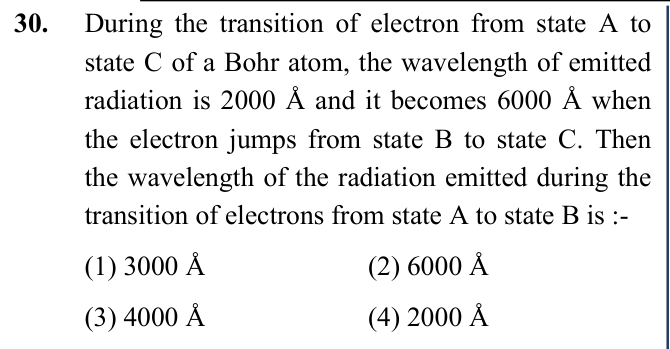
Candidate Response:
(1) (2) (3) (4)
⚡ OFFICIAL KEY: 1
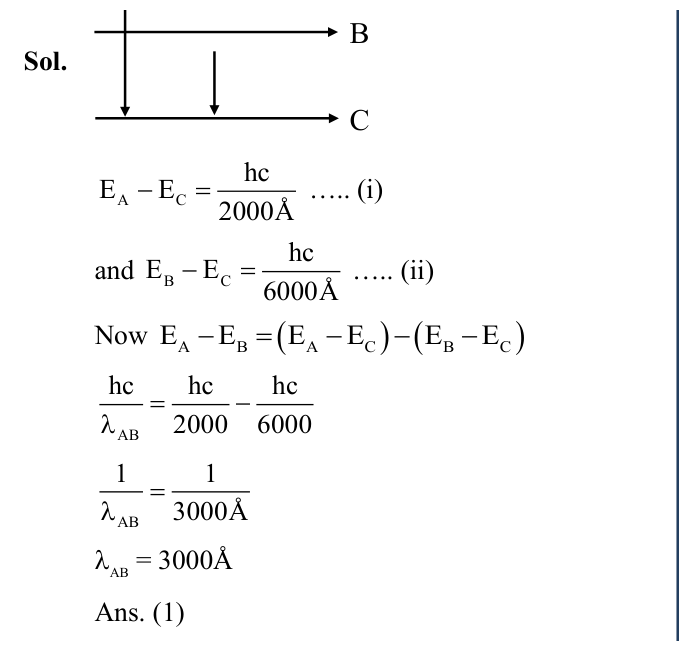
Step-by-Step Derivation
QUESTION 2
PHYSICS · Atoms
SECTION A · MCQ (+4, -1)
Which statement correctly contrasts Thomson's plum-pudding model with Rutherford's nuclear model of the atom?
(1) Thomson spread the positive charge uniformly through the atom with electrons embedded in it, whereas Rutherford concentrated the positive charge in a tiny dense nucleus around which electrons revolve.
(2) Rutherford's model requires the electrons to be embedded at rest inside a uniform sphere of positive charge.
(3) Thomson concentrated all the positive charge in a tiny central nucleus, while Rutherford spread it uniformly throughout the atom.
(4) Both models place electrons in fixed circular orbits around a central positively charged nucleus.
Candidate Response:
(1) (2) (3) (4)
⚡ OFFICIAL KEY: Thomson spread the positive charge uniformly through the atom with electrons embedded in it, whereas Rutherford concentrated the positive charge in a tiny dense nucleus around which electrons revolve.
Step-by-Step Derivation
Thomson's plum-pudding model distributes positive charge uniformly with electrons embedded like plums, while Rutherford's nuclear model concentrates all positive charge (+Ze) in a very small dense nucleus orbited by electrons. The large-angle scattering of α-particles could only be explained by a concentrated positive charge.
QUESTION 3
PHYSICS · Atoms
SECTION A · MCQ (+4, -1)
In Bohr's model, the angular momentum of an electron in an allowed orbit is quantised as:
(1) n²h/2π
(2) 2πn/h
(3) h/2π
(4) nh/2π
Candidate Response:
(1) (2) (3) (4)
⚡ OFFICIAL KEY: nh/2π
Step-by-Step Derivation
Bohr's quantisation condition is mvr = nh/2π.
QUESTION 4
PHYSICS · Atoms
SECTION A · MCQ (+4, -1)
The wavelength of the first (Hα) line of the Balmer series of hydrogen is about:
(1) 4861 Å
(2) 6563 Å
(3) 1216 Å
(4) 1026 Å
Candidate Response:
(1) (2) (3) (4)
⚡ OFFICIAL KEY: 6563 Å
Step-by-Step Derivation
The Hα line (red) of the Balmer series has λ ≈ 6563 Å.
QUESTION 5
PHYSICS · Atoms
SECTION A · MCQ (+4, -1)
Using the Rydberg formula 1/λ = R(1/n₁² − 1/n₂²) with R = 1.097 × 10⁷ m⁻¹, the wavelength of the first line (H_α) of the Balmer series (n₁ = 2) is approximately
(1) 121.6 nm
(2) 486.1 nm
(3) 656.3 nm
(4) 364.6 nm
Candidate Response:
(1) (2) (3) (4)
⚡ OFFICIAL KEY: 656.3 nm
Step-by-Step Derivation
For H_α, n₁ = 2 and n₂ = 3: 1/λ = R(1/2² − 1/3²) = R(1/4 − 1/9) = R(5/36). Thus λ = 36/(5R) = 36/(5 × 1.097 × 10⁷) = 6.56 × 10⁻⁷ m = 656.3 nm (red).
QUESTION 6
PHYSICS · Atoms
SECTION A · MCQ (+4, -1)
In Rutherford scattering, the number of α-particles scattered per unit area follows N(θ) ∝ 1/sin⁴(θ/2). The ratio of particles scattered at 60° to those scattered at 90° is
(1) 4
(2) 2
(3) 8
(4) 1
Candidate Response:
(1) (2) (3) (4)
⚡ OFFICIAL KEY: 4
Step-by-Step Derivation
N(60°)/N(90°) = [sin(90°/2)/sin(60°/2)]⁴ = [sin 45°/sin 30°]⁴ = [(1/√2)/(1/2)]⁴ = (√2)⁴ = 4.
QUESTION 7
PHYSICS · Atoms
SECTION A · MCQ (+4, -1)
The ground state energy of a hydrogen atom is −13.6 eV. The energy of the electron in the first excited state (n = 2) is
(1) −1.51 eV
(2) −6.8 eV
(3) −3.4 eV
(4) +3.4 eV
Candidate Response:
(1) (2) (3) (4)
⚡ OFFICIAL KEY: −3.4 eV
Step-by-Step Derivation
Bohr's energy levels are Eₙ = −13.6/n² eV. For n = 2, E₂ = −13.6/2² = −13.6/4 = −3.4 eV.
QUESTION 8
PHYSICS · Atoms
SECTION A · MCQ (+4, -1)
The value of Rydberg's constant (R) is approximately:
(1) 1.097 × 10⁷ m⁻¹
(2) 6.63 × 10⁻³⁴ J s
(3) 3 × 10⁸ m s⁻¹
(4) 1.097 × 10⁷ m
Candidate Response:
(1) (2) (3) (4)
⚡ OFFICIAL KEY: 1.097 × 10⁷ m⁻¹
Step-by-Step Derivation
Rydberg's constant R = 1.097 × 10⁷ m⁻¹.
QUESTION 9
PHYSICS · Atoms
SECTION A · MCQ (+4, -1)
The radius of the first Bohr orbit of hydrogen (Bohr radius) is:
(1) 0.53 Å
(2) 53 Å
(3) 5.3 Å
(4) 0.53 nm
Candidate Response:
(1) (2) (3) (4)
⚡ OFFICIAL KEY: 0.53 Å
Step-by-Step Derivation
The Bohr radius a₀ = 0.53 Å = 0.53 × 10⁻¹⁰ m.
QUESTION 10
PHYSICS · Atoms
SECTION A · MCQ (+4, -1)
In the Geiger–Marsden α-particle scattering experiment, what was the key observation that led Rutherford to propose the nuclear model of the atom?
(1) All the α-particles were absorbed by the thin gold foil.
(2) Most α-particles passed through undeflected, while a very few were deflected through large angles.
(3) Every α-particle was deflected back by exactly 90°.
(4) The α-particles produced a continuous spectrum on striking the screen.
Candidate Response:
(1) (2) (3) (4)
⚡ OFFICIAL KEY: Most α-particles passed through undeflected, while a very few were deflected through large angles.
Step-by-Step Derivation
Rutherford's Geiger–Marsden experiment showed that most α-particles passed straight through the gold foil with little deviation, but about 1 in 8000 was deflected through a large angle, and some even rebounded. This was possible only if the positive charge and nearly all the mass were concentrated in a tiny nucleus.
QUESTION 11
PHYSICS · Atoms
SECTION A · MCQ (+4, -1)
Thomson's atomic model describes the atom as:
(1) A hollow shell of electrons only
(2) A tiny dense positive nucleus with orbiting electrons
(3) A sphere of positive charge with electrons embedded in it
(4) A solid indivisible sphere
Candidate Response:
(1) (2) (3) (4)
⚡ OFFICIAL KEY: A sphere of positive charge with electrons embedded in it
Step-by-Step Derivation
Thomson's 'plum-pudding' model has electrons embedded in a positive sphere.
QUESTION 12
PHYSICS · Atoms
SECTION A · MCQ (+4, -1)
An electron in a hydrogen atom is excited to the n = 5 energy level. How many spectral lines are emitted as it de-excites to the ground state?
(1) 15
(2) 8
(3) 10
(4) 6
Candidate Response:
(1) (2) (3) (4)
⚡ OFFICIAL KEY: 10
Step-by-Step Derivation
The number of possible transitions when an electron de-excites from level n to the ground state is N = n(n − 1)/2. For n = 5, N = 5 × 4 / 2 = 10.
QUESTION 13
PHYSICS · Atoms
SECTION A · MCQ (+4, -1)
Which spectral series of the hydrogen atom lies in the ultraviolet region and corresponds to transitions ending at the level n₁ = 1?
(1) Brackett
(2) Balmer
(3) Paschen
(4) Lyman
Candidate Response:
(1) (2) (3) (4)
⚡ OFFICIAL KEY: Lyman
Step-by-Step Derivation
The Lyman series (n₁ = 1) lies in the ultraviolet region. Balmer (n₁ = 2) is in the visible/near-UV, Paschen (n₁ = 3) in the near-IR, and Brackett (n₁ = 4) in the infrared.
QUESTION 14
PHYSICS · Atoms
SECTION A · MCQ (+4, -1)
The Balmer series of the hydrogen spectrum corresponds to transitions ending at which energy level?
(1) n = 4
(2) n = 2
(3) n = 1
(4) n = 3
Candidate Response:
(1) (2) (3) (4)
⚡ OFFICIAL KEY: n = 2
Step-by-Step Derivation
Balmer lines arise from transitions to n = 2 (visible region).
QUESTION 15
PHYSICS · Atoms
SECTION A · MCQ (+4, -1)
The emission spectrum of a gaseous atom consists of:
(1) A continuous band of colours
(2) A single bright line only
(3) Continuous dark bands only
(4) Discrete bright lines on a dark background
Candidate Response:
(1) (2) (3) (4)
⚡ OFFICIAL KEY: Discrete bright lines on a dark background
Step-by-Step Derivation
Atoms emit light only at specific wavelengths, giving a line spectrum.
QUESTION 16
PHYSICS · Atoms
SECTION A · MCQ (+4, -1)
The typical size (radius) of an atom is of the order of:
(1) 10⁻¹⁵ m
(2) 10⁻⁶ m
(3) 10⁻¹⁰ m
(4) 10⁻¹⁸ m
Candidate Response:
(1) (2) (3) (4)
⚡ OFFICIAL KEY: 10⁻¹⁰ m
Step-by-Step Derivation
Atoms are about 10⁻¹⁰ m (1 Å) in size.
QUESTION 17
PHYSICS · Atoms
SECTION A · MCQ (+4, -1)
Rutherford's α-particle scattering experiment established that the atom contains:
(1) A uniform sphere of positive charge
(2) An indivisible solid mass
(3) Electrons in fixed circular orbits
(4) A tiny, dense, positively charged nucleus
Candidate Response:
(1) (2) (3) (4)
⚡ OFFICIAL KEY: A tiny, dense, positively charged nucleus
Step-by-Step Derivation
The rare large-angle deflections revealed a small, dense, positive nucleus.
QUESTION 18
PHYSICS · Atoms
SECTION A · MCQ (+4, -1)
A dark-line absorption spectrum is produced when
(1) a hot gas at low pressure emits light directly
(2) light from a hot incandescent solid or liquid is analysed directly
(3) a laser emits monochromatic light of a single wavelength
(4) a cool gas is placed between a continuous-spectrum source and the observer
Candidate Response:
(1) (2) (3) (4)
⚡ OFFICIAL KEY: a cool gas is placed between a continuous-spectrum source and the observer
Step-by-Step Derivation
A continuous spectrum comes from incandescent solids/liquids, an emission line spectrum from a hot excited gas, and an absorption (dark-line) spectrum when a cool gas absorbs specific resonant wavelengths from an underlying continuous source.
QUESTION 19
PHYSICS · Atoms
SECTION A · MCQ (+4, -1)
The charge on an α particle used in Rutherford's scattering experiment is:
(1) −e
(2) +e
(3) +2e
(4) −2e
Candidate Response:
(1) (2) (3) (4)
⚡ OFFICIAL KEY: +2e
Step-by-Step Derivation
An α particle is a helium nucleus with charge +2e.
QUESTION 20
PHYSICS · Atoms
SECTION A · MCQ (+4, -1)
Which of the following is NOT one of Bohr's postulates for the hydrogen atom?
(1) The electron may occupy any circular orbit of arbitrary radius without restriction.
(2) The orbital angular momentum is quantized as mvr = nh/2π.
(3) The electron revolves in certain stable orbits without radiating energy.
(4) Radiation is emitted or absorbed only when the electron jumps between orbits, with ΔE = hν.
Candidate Response:
(1) (2) (3) (4)
⚡ OFFICIAL KEY: The electron may occupy any circular orbit of arbitrary radius without restriction.
Step-by-Step Derivation
Bohr's postulates are: (1) stationary non-radiating orbits, (2) angular momentum quantization mvr = nh/2π = nħ, and (3) the frequency condition ΔE = Eᵢ − E_f = hν. Only discrete, quantized orbits are allowed, so arbitrary radii are excluded.