
✎ ANSWER ONLINE · EVERY MISTAKE LINKS BACK TO THE CONCEPT
Atoms · Practice Worksheet
Answer each question here and it marks straight away, with the derivation and a link to the exact micro-concept to revisit.
2 questions from this set could not be marked online — a
bonus or dual-key question, which has no single defensible answer. The print and
.docx versions still include them.
// CONCEPT AUDIT RESULT
Everything you missed has been added to your Error Arena — retest them blind there, and a concept clears once you get it right.
QUESTION 1
Atoms
SECTION A · MCQ (+4, -1)
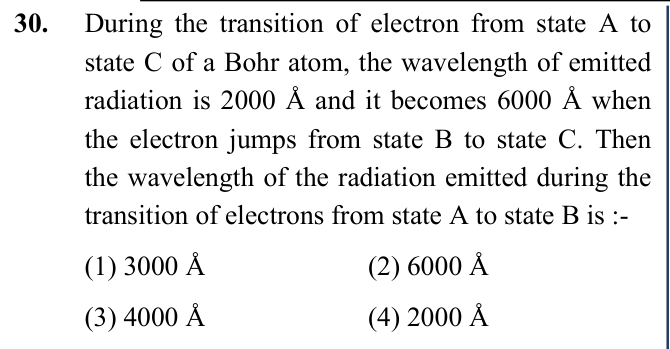
(1) 3000 Å
(2) 6000 Å
(3) 4000 Å
(4) 2000 Å
A
B
C
A
C
hc
E
E
2000Å - =
….. (i)
and
B
C
hc
E
E
6000Å - =
….. (ii)
Now
(
)(
)
A
B
A
C
B
C
E
E
E
E
E
E - = - - - AB
hc
hc
hc
2000
6000 = -
λ
AB
1
1
3000Å = λ
λAB = 3000Å
QUESTION 2
Atoms
SECTION A · MCQ (+4, -1)
In Bohr's model, the angular momentum of an electron in an allowed orbit is quantised as:
(1) n²h/2π
(2) 2πn/h
(3) h/2π
(4) nh/2π
Bohr's quantisation condition is mvr = nh/2π.
QUESTION 3
Atoms
SECTION A · MCQ (+4, -1)
The wavelength of the first (Hα) line of the Balmer series of hydrogen is about:
(1) 4861 Å
(2) 6563 Å
(3) 1216 Å
(4) 1026 Å
The Hα line (red) of the Balmer series has λ ≈ 6563 Å.
QUESTION 4
Atoms
SECTION A · MCQ (+4, -1)
Using the Rydberg formula 1/λ = R(1/n₁² − 1/n₂²) with R = 1.097 × 10⁷ m⁻¹, the wavelength of the first line (H_α) of the Balmer series (n₁ = 2) is approximately
(1) 121.6 nm
(2) 486.1 nm
(3) 656.3 nm
(4) 364.6 nm
For H_α, n₁ = 2 and n₂ = 3: 1/λ = R(1/2² − 1/3²) = R(1/4 − 1/9) = R(5/36). Thus λ = 36/(5R) = 36/(5 × 1.097 × 10⁷) = 6.56 × 10⁻⁷ m = 656.3 nm (red).
QUESTION 5
Atoms
SECTION A · MCQ (+4, -1)
In Rutherford scattering, the number of α-particles scattered per unit area follows N(θ) ∝ 1/sin⁴(θ/2). The ratio of particles scattered at 60° to those scattered at 90° is
(1) 4
(2) 2
(3) 8
(4) 1
N(60°)/N(90°) = [sin(90°/2)/sin(60°/2)]⁴ = [sin 45°/sin 30°]⁴ = [(1/√2)/(1/2)]⁴ = (√2)⁴ = 4.
QUESTION 6
Atoms
SECTION A · MCQ (+4, -1)
The ground state energy of a hydrogen atom is −13.6 eV. The energy of the electron in the first excited state (n = 2) is
(1) −1.51 eV
(2) −6.8 eV
(3) −3.4 eV
(4) +3.4 eV
Bohr's energy levels are Eₙ = −13.6/n² eV. For n = 2, E₂ = −13.6/2² = −13.6/4 = −3.4 eV.
QUESTION 7
Atoms
SECTION A · MCQ (+4, -1)
The value of Rydberg's constant (R) is approximately:
(1) 1.097 × 10⁷ m⁻¹
(2) 6.63 × 10⁻³⁴ J s
(3) 3 × 10⁸ m s⁻¹
(4) 1.097 × 10⁷ m
Rydberg's constant R = 1.097 × 10⁷ m⁻¹.
QUESTION 8
Atoms
SECTION A · MCQ (+4, -1)
The radius of the first Bohr orbit of hydrogen (Bohr radius) is:
(1) 0.53 Å
(2) 53 Å
(3) 5.3 Å
(4) 0.53 nm
The Bohr radius a₀ = 0.53 Å = 0.53 × 10⁻¹⁰ m.
QUESTION 9
Atoms
SECTION A · MCQ (+4, -1)
Thomson's atomic model describes the atom as:
(1) A hollow shell of electrons only
(2) A tiny dense positive nucleus with orbiting electrons
(3) A sphere of positive charge with electrons embedded in it
(4) A solid indivisible sphere
Thomson's 'plum-pudding' model has electrons embedded in a positive sphere.
QUESTION 10
Atoms
SECTION A · MCQ (+4, -1)
An electron in a hydrogen atom is excited to the n = 5 energy level. How many spectral lines are emitted as it de-excites to the ground state?
(1) 15
(2) 8
(3) 10
(4) 6
The number of possible transitions when an electron de-excites from level n to the ground state is N = n(n − 1)/2. For n = 5, N = 5 × 4 / 2 = 10.
QUESTION 11
Atoms
SECTION A · MCQ (+4, -1)
Which spectral series of the hydrogen atom lies in the ultraviolet region and corresponds to transitions ending at the level n₁ = 1?
(1) Brackett
(2) Balmer
(3) Paschen
(4) Lyman
The Lyman series (n₁ = 1) lies in the ultraviolet region. Balmer (n₁ = 2) is in the visible/near-UV, Paschen (n₁ = 3) in the near-IR, and Brackett (n₁ = 4) in the infrared.
QUESTION 12
Atoms
SECTION A · MCQ (+4, -1)
The Balmer series of the hydrogen spectrum corresponds to transitions ending at which energy level?
(1) n = 4
(2) n = 2
(3) n = 1
(4) n = 3
Balmer lines arise from transitions to n = 2 (visible region).
QUESTION 13
Atoms
SECTION A · MCQ (+4, -1)
The emission spectrum of a gaseous atom consists of:
(1) A continuous band of colours
(2) A single bright line only
(3) Continuous dark bands only
(4) Discrete bright lines on a dark background
Atoms emit light only at specific wavelengths, giving a line spectrum.