
⚡ OFFICIAL NTA ASSESSMENT GENERATOR & WORD (.DOCX) EXPORTER
Nuclei · Practice Worksheet
JEE Main Physics · Curated Assessment Set Print directly or export as a beautifully formatted Microsoft Word document with embedded 180-DPI mathematical prompt clips and step-by-step derivations.
EDUPROD JEE MAIN TEST SERIES · NTA PATTERN
Nuclei · Practice Worksheet
JEE Main Physics · Curated Assessment Set · Assessment Code: JEE-101
Total Marks: 120
Marking: +4 / -1 (Sec A) · +4 / 0 (Sec B)
QUESTION 1
PHYSICS · Nuclei
SECTION A · MCQ (+4, -1)
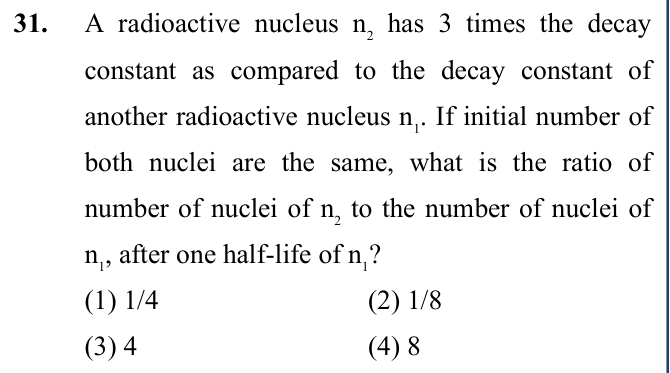
Candidate Response:
(1) (2) (3) (4)
QUESTION 2
PHYSICS · Nuclei
SECTION A · MCQ (+4, -1)
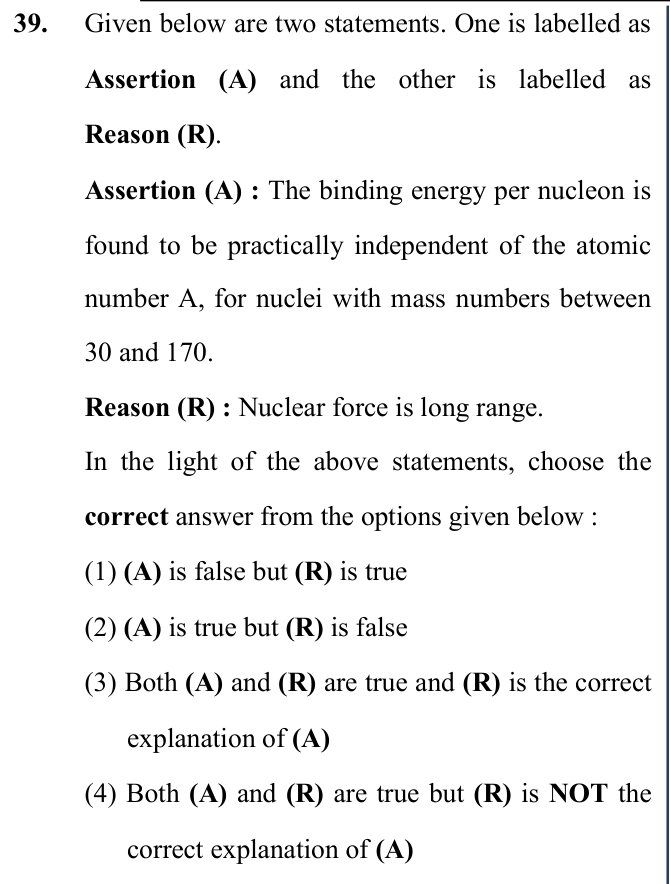
Candidate Response:
(1) (2) (3) (4)
QUESTION 3
PHYSICS · Nuclei
SECTION A · MCQ (+4, -1)
In 1932, Chadwick bombarded a beryllium target with α-particles and detected a highly penetrating neutral radiation. The nuclear reaction that produces a neutron from this bombardment is:
(1) ⁹₄Be + ¹₀n → ¹²₆C + ⁴₂He
(2) ⁹₄Be + ⁴₂He → ¹²₆C + ¹₀n
(3) ⁹₄Be + ⁴₂He → ¹²₆C + ¹₁H
(4) ⁹₄Be + ⁴₂He → ¹³₆C + ⁰₋₁e
Candidate Response:
(1) (2) (3) (4)
QUESTION 4
PHYSICS · Nuclei
SECTION A · MCQ (+4, -1)
Chadwick determined the neutron mass by comparing the recoil velocities of protons (m_p ≈ 1 u) and nitrogen nuclei (m_N ≈ 14 u) struck by the same neutral radiation. Using v_p/v_N = (m_n + m_N)/(m_n + m_p), the velocity ratio is approximately:
(1) 2
(2) 14
(3) 7.5
(4) 1
Candidate Response:
(1) (2) (3) (4)
QUESTION 5
PHYSICS · Nuclei
SECTION A · MCQ (+4, -1)
Which of the following pairs of nuclides are isotones (nuclides with the same number of neutrons)?
(1) ¹⁴₆C and ¹⁴₇N
(2) ¹⁴₆C and ¹⁵₇N
(3) ¹₅₇N and ¹₅₈O
(4) ¹²₆C and ¹⁴₆C
Candidate Response:
(1) (2) (3) (4)
QUESTION 6
PHYSICS · Nuclei
SECTION A · MCQ (+4, -1)
Chlorine has two stable isotopes: ³⁵Cl with abundance 75.8% and ³⁷Cl with abundance 24.2%. The average atomic mass of chlorine is approximately:
(1) 35.0 u
(2) 37.0 u
(3) 36.5 u
(4) 35.5 u
Candidate Response:
(1) (2) (3) (4)
QUESTION 7
PHYSICS · Nuclei
SECTION A · MCQ (+4, -1)
The radius of a nucleus scales with mass number A as R = R₀ A^(1/3). The ratio of the radii of a nucleus with A = 64 to one with A = 8 is:
(1) 2
(2) 8
(3) 4
(4) 3
Candidate Response:
(1) (2) (3) (4)
QUESTION 8
PHYSICS · Nuclei
SECTION A · MCQ (+4, -1)
Using R = R₀ A^(1/3) with R₀ = 1.2 fm, the radius of a ²⁷₁₃Al nucleus (A = 27) is approximately:
(1) 27 fm
(2) 1.2 fm
(3) 32.4 fm
(4) 3.6 fm
Candidate Response:
(1) (2) (3) (4)
QUESTION 9
PHYSICS · Nuclei
SECTION A · MCQ (+4, -1)
For a nucleus with Z protons and (A − Z) neutrons, the mass defect Δm is correctly expressed as:
(1) M_nucleus − [Z·m_p + (A − Z)·m_n]
(2) [Z·m_p + (A − Z)·m_n] − M_nucleus
(3) Z·m_p + (A − Z)·m_n + M_nucleus
(4) (A − Z)·m_p + Z·m_n − M_nucleus
Candidate Response:
(1) (2) (3) (4)
QUESTION 10
PHYSICS · Nuclei
SECTION A · MCQ (+4, -1)
The mass of a ⁴₂He nucleus is 4.0015 u. Given m_p = 1.00728 u and m_n = 1.00866 u, the binding energy of the helium nucleus is approximately:
(1) 931.5 MeV
(2) 0.03 MeV
(3) 28.3 MeV
(4) 7.1 MeV
Candidate Response:
(1) (2) (3) (4)
QUESTION 11
PHYSICS · Nuclei
SECTION A · MCQ (+4, -1)
Which statement correctly describes the nuclear force?
(1) It is long-range and obeys the inverse-square law, like the Coulomb force.
(2) It is weaker than the electromagnetic force and acts over infinite range.
(3) It acts only between protons and is always repulsive.
(4) It is the strongest fundamental force, is charge-independent, has a very short range (~1–2 fm), and does not obey the inverse-square law.
Candidate Response:
(1) (2) (3) (4)
QUESTION 12
PHYSICS · Nuclei
SECTION A · MCQ (+4, -1)
The nucleon–nucleon potential V(r) has its minimum (≈ −100 MeV) at r₀ ≈ 0.8 fm. For r₀ < r < 2.5 fm the potential increases with r. In this region the nuclear force is:
(1) repulsive, because the potential is increasing
(2) unrelated to the slope of the potential
(3) attractive, because F = −dV/dr is negative
(4) zero, because the potential is negative
Candidate Response:
(1) (2) (3) (4)
QUESTION 13
PHYSICS · Nuclei
SECTION A · MCQ (+4, -1)
A radioactive sample has a half-life T_½. After a time equal to three half-lives, the fraction of the original sample that remains undecayed is:
(1) 1/8
(2) 1/6
(3) 1/3
(4) 2/3
Candidate Response:
(1) (2) (3) (4)
QUESTION 14
PHYSICS · Nuclei
SECTION A · MCQ (+4, -1)
The half-life of a radioactive isotope is 10 days. Its decay constant λ is approximately:
(1) 0.693 day⁻¹
(2) 0.00693 day⁻¹
(3) 6.93 day⁻¹
(4) 0.0693 day⁻¹
Candidate Response:
(1) (2) (3) (4)
QUESTION 15
PHYSICS · Nuclei
SECTION A · MCQ (+4, -1)
In the thermal-neutron fission of ²³⁵U, one possible reaction is ²³⁵₉₂U + ¹₀n → ¹⁴⁴₅₆Ba + ⁸⁹₃₆Kr + 3¹₀n + Q. The energy Q released is approximately:
(1) 931.5 MeV
(2) 200 MeV
(3) 1 MeV
(4) 26.7 MeV
Candidate Response:
(1) (2) (3) (4)
QUESTION 16
PHYSICS · Nuclei
SECTION A · MCQ (+4, -1)
The proton–proton fusion chain in the Sun is summarised as 4¹₁H + 2e⁻ → ⁴₂He + 2ν_e + 6γ, releasing about 26.7 MeV. The energy released per nucleon is approximately:
(1) 26.7 MeV
(2) 0.85 MeV
(3) 6.7 MeV
(4) 4 MeV
Candidate Response:
(1) (2) (3) (4)
QUESTION 17
PHYSICS · Nuclei
SECTION A · MCQ (+4, -1)
The nucleus of an atom is composed of which particles (nucleons)?
(1) Protons and electrons
(2) Neutrons and electrons
(3) Protons, neutrons, and electrons
(4) Protons and neutrons
Candidate Response:
(1) (2) (3) (4)
QUESTION 18
PHYSICS · Nuclei
SECTION A · MCQ (+4, -1)
The number of neutrons in a ²³⁵U nucleus (atomic number Z = 92) is:
(1) 235
(2) 327
(3) 143
(4) 92
Candidate Response:
(1) (2) (3) (4)
QUESTION 19
PHYSICS · Nuclei
SECTION A · MCQ (+4, -1)
One atomic mass unit (1 u) is defined as:
(1) 1/16 of the mass of an oxygen-16 atom
(2) 1/12 of the mass of a carbon-12 atom
(3) The mass of a hydrogen atom
(4) 1/12 of the mass of an oxygen-16 atom
Candidate Response:
(1) (2) (3) (4)
QUESTION 20
PHYSICS · Nuclei
SECTION A · MCQ (+4, -1)
The energy equivalent of one atomic mass unit (1 u) is approximately:
(1) 931.5 eV
(2) 1.6 × 10⁻¹⁹ MeV
(3) 13.6 MeV
(4) 931.5 MeV
Candidate Response:
(1) (2) (3) (4)
QUESTION 21
PHYSICS · Nuclei
SECTION A · MCQ (+4, -1)
The radius of a nucleus varies with mass number A as:
(1) A^(1/2)
(2) A⁻¹
(3) A²
(4) A^(1/3)
Candidate Response:
(1) (2) (3) (4)
QUESTION 22
PHYSICS · Nuclei
SECTION A · MCQ (+4, -1)
The value of the constant R₀ in the nuclear radius formula R = R₀A^(1/3) is:
(1) 0.53 × 10⁻¹⁰ m
(2) 6.6 × 10⁻³⁴ m
(3) 1.2 × 10⁻¹⁵ m
(4) 1.2 × 10⁻¹⁰ m
Candidate Response:
(1) (2) (3) (4)
QUESTION 23
PHYSICS · Nuclei
SECTION A · MCQ (+4, -1)
The mass defect of a nucleus is the difference between:
(1) The sum of the masses of its nucleons and the mass of the nucleus
(2) The atomic mass and the electron mass
(3) The neutron mass and the proton mass
(4) The mass of the nucleus and the mass of its electrons
Candidate Response:
(1) (2) (3) (4)
QUESTION 24
PHYSICS · Nuclei
SECTION A · MCQ (+4, -1)
The mass defect of a nucleus is 0.1 u. Its binding energy is (1 u = 931.5 MeV):
(1) 931.5 MeV
(2) 93.15 MeV
(3) 9315 MeV
(4) 9.315 MeV
Candidate Response:
(1) (2) (3) (4)
QUESTION 25
PHYSICS · Nuclei
SECTION A · MCQ (+4, -1)
The nuclear force between two nucleons is:
(1) Short-ranged and charge-independent
(2) Long-ranged and charge-dependent
(3) Long-ranged and purely gravitational
(4) Short-ranged and always repulsive
Candidate Response:
(1) (2) (3) (4)
QUESTION 26
PHYSICS · Nuclei
SECTION A · MCQ (+4, -1)
The range of the nuclear force is of the order of:
(1) 10⁻² m
(2) 10⁻¹⁵ m
(3) 10⁻⁶ m
(4) 10⁻¹⁰ m
Candidate Response:
(1) (2) (3) (4)
QUESTION 27
PHYSICS · Nuclei
SECTION A · MCQ (+4, -1)
Radioactivity is a phenomenon associated with which part of the atom?
(1) The outermost shell
(2) The electron orbits
(3) The chemical bonds
(4) The nucleus
Candidate Response:
(1) (2) (3) (4)
QUESTION 28
PHYSICS · Nuclei
SECTION A · MCQ (+4, -1)
After three half-lives, the fraction of a radioactive sample remaining undecayed is:
(1) 1/6
(2) 1/4
(3) 1/8
(4) 1/3
Candidate Response:
(1) (2) (3) (4)
QUESTION 29
PHYSICS · Nuclei
SECTION A · MCQ (+4, -1)
Nuclear fission is the process in which:
(1) Two light nuclei combine into a heavier nucleus
(2) A heavy nucleus splits into two lighter nuclei
(3) A nucleus emits an α particle
(4) Electrons are ejected from an atom
Candidate Response:
(1) (2) (3) (4)
QUESTION 30
PHYSICS · Nuclei
SECTION A · MCQ (+4, -1)
The energy released in the fission of one uranium-235 nucleus is approximately:
(1) 931.5 MeV
(2) 200 MeV
(3) 2 MeV
(4) 200 eV
Candidate Response:
(1) (2) (3) (4)