
⚡ OFFICIAL NTA ASSESSMENT GENERATOR & WORD (.DOCX) EXPORTER
Nuclei · Practice Worksheet
JEE Main Physics · Curated Assessment Set Print directly or export as a beautifully formatted Microsoft Word document with embedded 180-DPI mathematical prompt clips and step-by-step derivations.
EDUPROD JEE MAIN TEST SERIES · NTA PATTERN
Nuclei · Practice Worksheet
JEE Main Physics · Curated Assessment Set · Assessment Code: JEE-101
Total Marks: 40
Marking: +4 / -1 (Sec A) · +4 / 0 (Sec B)
QUESTION 1
PHYSICS · Nuclei
SECTION A · MCQ (+4, -1)
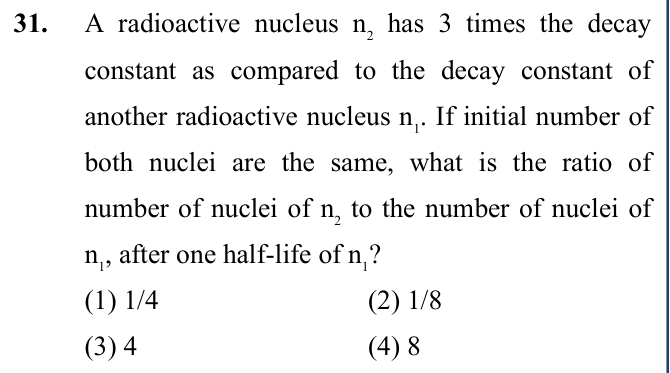
Candidate Response:
(1) (2) (3) (4)
⚡ OFFICIAL KEY: 1
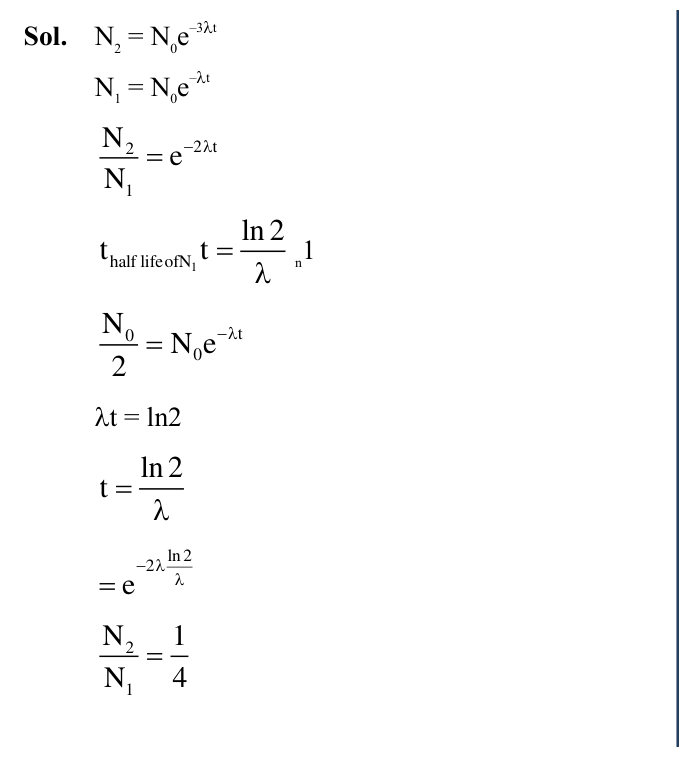
Step-by-Step Derivation
QUESTION 2
PHYSICS · Nuclei
SECTION A · MCQ (+4, -1)
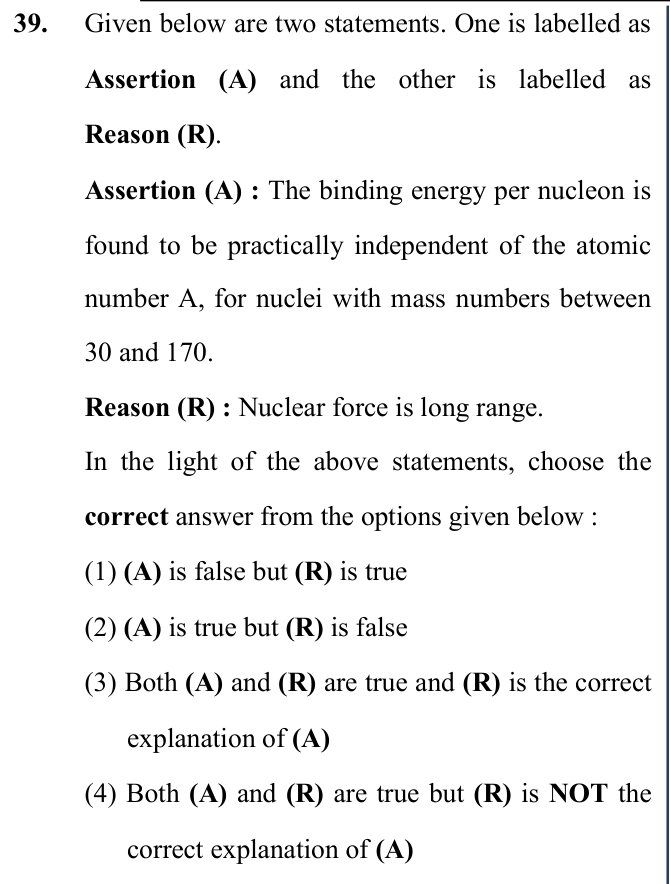
Candidate Response:
(1) (2) (3) (4)
⚡ OFFICIAL KEY: 2
Step-by-Step Derivation

QUESTION 3
PHYSICS · Nuclei
SECTION A · MCQ (+4, -1)
The energy released in the fission of one uranium-235 nucleus is approximately:
(1) 931.5 MeV
(2) 200 MeV
(3) 2 MeV
(4) 200 eV
Candidate Response:
(1) (2) (3) (4)
⚡ OFFICIAL KEY: 200 MeV
Step-by-Step Derivation
Each ²³⁵U fission releases about 200 MeV.
QUESTION 4
PHYSICS · Nuclei
SECTION A · MCQ (+4, -1)
In the thermal-neutron fission of ²³⁵U, one possible reaction is ²³⁵₉₂U + ¹₀n → ¹⁴⁴₅₆Ba + ⁸⁹₃₆Kr + 3¹₀n + Q. The energy Q released is approximately:
(1) 931.5 MeV
(2) 200 MeV
(3) 1 MeV
(4) 26.7 MeV
Candidate Response:
(1) (2) (3) (4)
⚡ OFFICIAL KEY: 200 MeV
Step-by-Step Derivation
Each ²³⁵U fission event releases about 200 MeV, shared as kinetic energy of the fission fragments and neutrons plus radiation. This corresponds to a mass conversion of Δm ≈ 200/931.5 ≈ 0.215 u, about 0.1% of the uranium mass.
QUESTION 5
PHYSICS · Nuclei
SECTION A · MCQ (+4, -1)
The radius of a nucleus varies with mass number A as:
(1) A^(1/2)
(2) A⁻¹
(3) A²
(4) A^(1/3)
Candidate Response:
(1) (2) (3) (4)
⚡ OFFICIAL KEY: A^(1/3)
Step-by-Step Derivation
Nuclear radius R = R₀A^(1/3).
QUESTION 6
PHYSICS · Nuclei
SECTION A · MCQ (+4, -1)
In 1932, Chadwick bombarded a beryllium target with α-particles and detected a highly penetrating neutral radiation. The nuclear reaction that produces a neutron from this bombardment is:
(1) ⁹₄Be + ¹₀n → ¹²₆C + ⁴₂He
(2) ⁹₄Be + ⁴₂He → ¹²₆C + ¹₀n
(3) ⁹₄Be + ⁴₂He → ¹²₆C + ¹₁H
(4) ⁹₄Be + ⁴₂He → ¹³₆C + ⁰₋₁e
Candidate Response:
(1) (2) (3) (4)
⚡ OFFICIAL KEY: ⁹₄Be + ⁴₂He → ¹²₆C + ¹₀n
Step-by-Step Derivation
Bombarding ⁹₄Be with α-particles (⁴₂He) fuses them into a ¹²₆C nucleus and releases one free neutron (¹₀n). Nucleon number (4 + 9 = 12 + 1) and charge (2 + 4 = 6 + 0) are both conserved.
QUESTION 7
PHYSICS · Nuclei
SECTION A · MCQ (+4, -1)
The half-life of a radioactive isotope is 10 days. Its decay constant λ is approximately:
(1) 0.693 day⁻¹
(2) 0.00693 day⁻¹
(3) 6.93 day⁻¹
(4) 0.0693 day⁻¹
Candidate Response:
(1) (2) (3) (4)
⚡ OFFICIAL KEY: 0.0693 day⁻¹
Step-by-Step Derivation
λ = ln2/T_½ = 0.693/10 days = 0.0693 day⁻¹. The decay constant has units of inverse time and is the probability of decay per unit time.
QUESTION 8
PHYSICS · Nuclei
SECTION A · MCQ (+4, -1)
The mass of a ⁴₂He nucleus is 4.0015 u. Given m_p = 1.00728 u and m_n = 1.00866 u, the binding energy of the helium nucleus is approximately:
(1) 931.5 MeV
(2) 0.03 MeV
(3) 28.3 MeV
(4) 7.1 MeV
Candidate Response:
(1) (2) (3) (4)
⚡ OFFICIAL KEY: 28.3 MeV
Step-by-Step Derivation
Δm = (2 × 1.00728 + 2 × 1.00866) − 4.0015 = 4.03188 − 4.0015 = 0.03038 u. E_b = 0.03038 × 931.5 MeV ≈ 28.3 MeV. The binding energy per nucleon is 28.3/4 ≈ 7.1 MeV.
QUESTION 9
PHYSICS · Nuclei
SECTION A · MCQ (+4, -1)
A radioactive sample has a half-life T_½. After a time equal to three half-lives, the fraction of the original sample that remains undecayed is:
(1) 1/8
(2) 1/6
(3) 1/3
(4) 2/3
Candidate Response:
(1) (2) (3) (4)
⚡ OFFICIAL KEY: 1/8
Step-by-Step Derivation
After n half-lives the fraction remaining is (1/2)^n. For n = 3, (1/2)³ = 1/8. The fraction that has decayed is 1 − 1/8 = 7/8.
QUESTION 10
PHYSICS · Nuclei
SECTION A · MCQ (+4, -1)
Using R = R₀ A^(1/3) with R₀ = 1.2 fm, the radius of a ²⁷₁₃Al nucleus (A = 27) is approximately:
(1) 27 fm
(2) 1.2 fm
(3) 32.4 fm
(4) 3.6 fm
Candidate Response:
(1) (2) (3) (4)
⚡ OFFICIAL KEY: 3.6 fm
Step-by-Step Derivation
R = 1.2 fm × 27^(1/3) = 1.2 fm × 3 = 3.6 fm. Nuclear radii are of the order of a few femtometres (1 fm = 10⁻¹⁵ m).