
✎ ANSWER ONLINE · EVERY MISTAKE LINKS BACK TO THE CONCEPT
Nuclei · Practice Worksheet
Answer each question here and it marks straight away, with the derivation and a link to the exact micro-concept to revisit.
// CONCEPT AUDIT RESULT
Everything you missed has been added to your Error Arena — retest them blind there, and a concept clears once you get it right.
QUESTION 1
Nuclei
SECTION A · MCQ (+4, -1)
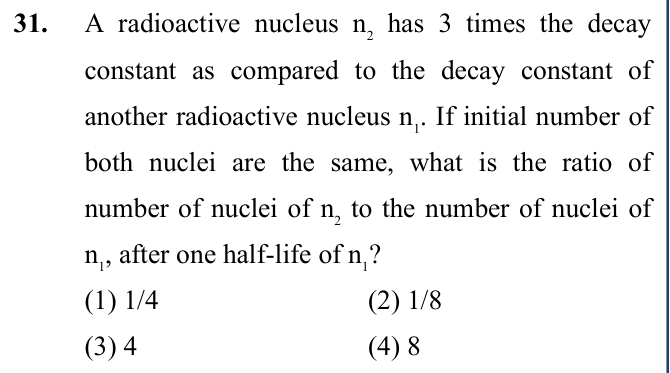
(1) 1/4
(2) 1/8
(3) 4
(4) 8
N2 = N0e
–3λt
N1 = N0e
–λt
2 t
2
1
N
e
N
-λ = 1
half lifeofN
ln 2
t
t =λ
n1
t
0
0
N
N e
2
-λ = λt = ln2
ln 2
t =λ
ln2
2
e
-λλ = 2
1
N
1
N
4
=
QUESTION 2
Nuclei
SECTION A · MCQ (+4, -1)
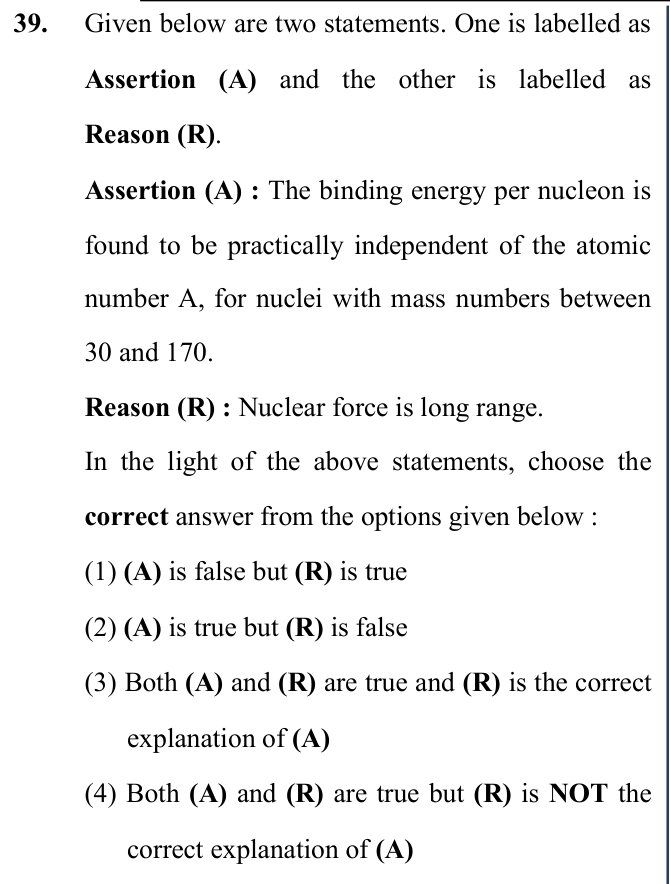
(1) (A) is false but (R) is true
(2) (A) is true but (R) is false
(3) Both (A) and (R) are true and (R) is the correct
explanation of (A)
(4) Both (A) and (R) are true but (R) is NOT the
correct explanation of (A)
Conceptual
QUESTION 3
Nuclei
SECTION A · MCQ (+4, -1)
The energy released in the fission of one uranium-235 nucleus is approximately:
(1) 931.5 MeV
(2) 200 MeV
(3) 2 MeV
(4) 200 eV
Each ²³⁵U fission releases about 200 MeV.
QUESTION 4
Nuclei
SECTION A · MCQ (+4, -1)
In the thermal-neutron fission of ²³⁵U, one possible reaction is ²³⁵₉₂U + ¹₀n → ¹⁴⁴₅₆Ba + ⁸⁹₃₆Kr + 3¹₀n + Q. The energy Q released is approximately:
(1) 931.5 MeV
(2) 200 MeV
(3) 1 MeV
(4) 26.7 MeV
Each ²³⁵U fission event releases about 200 MeV, shared as kinetic energy of the fission fragments and neutrons plus radiation. This corresponds to a mass conversion of Δm ≈ 200/931.5 ≈ 0.215 u, about 0.1% of the uranium mass.
QUESTION 5
Nuclei
SECTION A · MCQ (+4, -1)
The radius of a nucleus varies with mass number A as:
(1) A^(1/2)
(2) A⁻¹
(3) A²
(4) A^(1/3)
Nuclear radius R = R₀A^(1/3).
QUESTION 6
Nuclei
SECTION A · MCQ (+4, -1)
In 1932, Chadwick bombarded a beryllium target with α-particles and detected a highly penetrating neutral radiation. The nuclear reaction that produces a neutron from this bombardment is:
(1) ⁹₄Be + ¹₀n → ¹²₆C + ⁴₂He
(2) ⁹₄Be + ⁴₂He → ¹²₆C + ¹₀n
(3) ⁹₄Be + ⁴₂He → ¹²₆C + ¹₁H
(4) ⁹₄Be + ⁴₂He → ¹³₆C + ⁰₋₁e
Bombarding ⁹₄Be with α-particles (⁴₂He) fuses them into a ¹²₆C nucleus and releases one free neutron (¹₀n). Nucleon number (4 + 9 = 12 + 1) and charge (2 + 4 = 6 + 0) are both conserved.
QUESTION 7
Nuclei
SECTION A · MCQ (+4, -1)
The half-life of a radioactive isotope is 10 days. Its decay constant λ is approximately:
(1) 0.693 day⁻¹
(2) 0.00693 day⁻¹
(3) 6.93 day⁻¹
(4) 0.0693 day⁻¹
λ = ln2/T_½ = 0.693/10 days = 0.0693 day⁻¹. The decay constant has units of inverse time and is the probability of decay per unit time.
QUESTION 8
Nuclei
SECTION A · MCQ (+4, -1)
The mass of a ⁴₂He nucleus is 4.0015 u. Given m_p = 1.00728 u and m_n = 1.00866 u, the binding energy of the helium nucleus is approximately:
(1) 931.5 MeV
(2) 0.03 MeV
(3) 28.3 MeV
(4) 7.1 MeV
Δm = (2 × 1.00728 + 2 × 1.00866) − 4.0015 = 4.03188 − 4.0015 = 0.03038 u. E_b = 0.03038 × 931.5 MeV ≈ 28.3 MeV. The binding energy per nucleon is 28.3/4 ≈ 7.1 MeV.
QUESTION 9
Nuclei
SECTION A · MCQ (+4, -1)
A radioactive sample has a half-life T_½. After a time equal to three half-lives, the fraction of the original sample that remains undecayed is:
(1) 1/8
(2) 1/6
(3) 1/3
(4) 2/3
After n half-lives the fraction remaining is (1/2)^n. For n = 3, (1/2)³ = 1/8. The fraction that has decayed is 1 − 1/8 = 7/8.
QUESTION 10
Nuclei
SECTION A · MCQ (+4, -1)
Using R = R₀ A^(1/3) with R₀ = 1.2 fm, the radius of a ²⁷₁₃Al nucleus (A = 27) is approximately:
(1) 27 fm
(2) 1.2 fm
(3) 32.4 fm
(4) 3.6 fm
R = 1.2 fm × 27^(1/3) = 1.2 fm × 3 = 3.6 fm. Nuclear radii are of the order of a few femtometres (1 fm = 10⁻¹⁵ m).