
✎ ANSWER ONLINE · EVERY MISTAKE LINKS BACK TO THE CONCEPT
Chemical Thermodynamics · Practice Worksheet
Answer each question here and it marks straight away, with the derivation and a link to the exact micro-concept to revisit.
2 questions from this set could not be marked online — a
bonus or dual-key question, which has no single defensible answer. The print and
.docx versions still include them.
// CONCEPT AUDIT RESULT
Everything you missed has been added to your Error Arena — retest them blind there, and a concept clears once you get it right.
QUESTION 1
Thermodynamics
SECTION B · NUMERICAL (+4, 0)
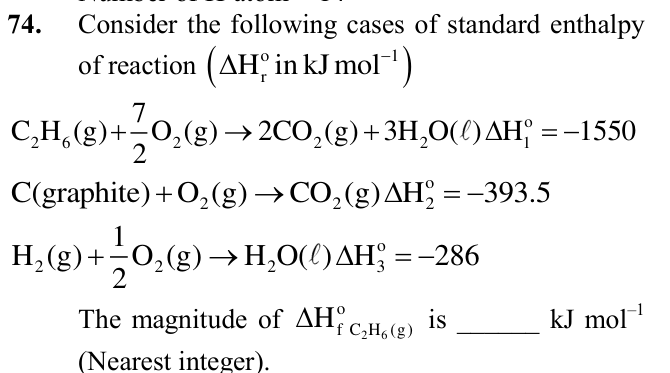
2C(graphite) + 3H2(g) → C2H6(g) ΔHf = ?
C2H6(g) + 7
2 O2(g) → 2CO2(g) + 3H2O(l)
ΔH1 = – 1550
C(graphite) + O2(g) → CO2(g) ΔH2 = – 393.5
H2(g) + 1
2 O2(g) → H2O(/) ΔH3 = – 286
ΔHf = 2ΔH2 + 3ΔH3 – ΔH1
= 95 kJ/mole.
QUESTION 2
Thermodynamics
SECTION B · NUMERICAL (+4, 0)
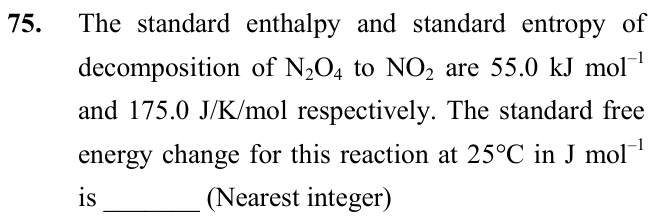
(2850)
o
rxn
H
Δ
= 55 kJ/mol,
T = 298 K
o
rxn
S
Δ
= 175 J/mol
o
o
o
rxn
rxn
rxn
G
H
T S
Δ
=Δ
-Δ
⇒
o
rxn
G
Δ
= 55000 J/mol – 298 × 175 J/mol
⇒
o
rxn
G
Δ
= 55000 – 52150
⇒
o
rxn
G
Δ
= 2850 J/mol
QUESTION 3
Thermodynamics
SECTION A · MCQ (+4, -1)
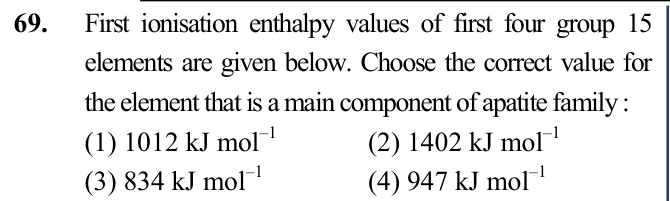
(1) 1012 kJ mol–1
(2) 1402 kJ mol–1
(3) 834 kJ mol–1
(4) 947 kJ mol–1
QUESTION 4
Thermodynamics
SECTION A · MCQ (+4, -1)
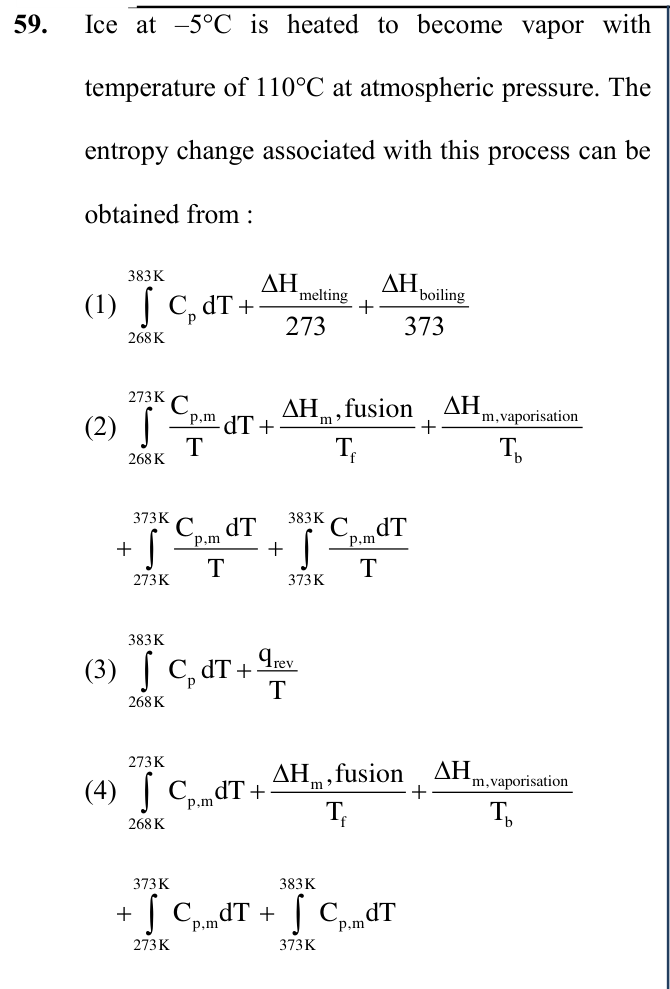
(1) 383K
melting
boiling
p
268K
H
H
C dT
273
373
Δ
Δ + +
∫
(2) 273K
p,m
m,vaporisation
m
f
b
268K
C
H
H ,fusion
dT
T
T
T
Δ
Δ + +
∫
373K
383K
p,m
p,m
273K
373K
C
dT
C
dT
T
T + +
∫
∫
(3) 383K
rev
p
268K
q
C dT
T + ∫
(4) 273K
m,vaporisation
m
p,m
f
b
268K
H
H ,fusion
C
dT
T
T
Δ
Δ + +
∫
373K
383K
p,m
p,m
273K
373K
C
dT
C
dT + +
∫
∫
(2)
Ice → Ice
Water → Water
Water → Water
vapour
vapour
268 K 273 K
273 K
273 K
373 K
383 K
(1)
(2)
(3)
(4)
(5)
ΔSoverall = ΔS1 + ΔS2 + ΔS3 + ΔS4 + ΔS5
m fusion
2
H
S
273
Δ
Δ = Tf = 273 'K'
373
p,m
3
273
C
dT
S
T
Δ
=∫
m vaporisation
4
H
S
373
Δ
Δ = Tb = 373 'K'
383
p,m
5
373
C
dT
S
T
Δ
=∫
Answer = (2)
QUESTION 5
Thermodynamics
SECTION A · MCQ (+4, -1)
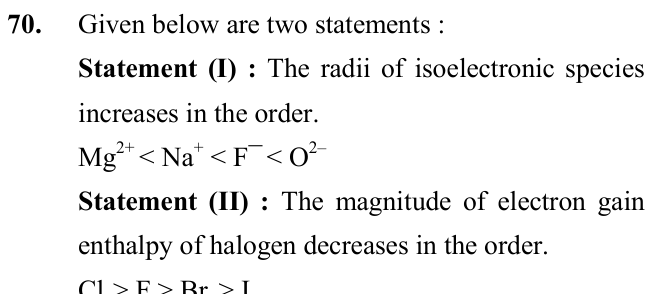
(1) Statement I is incorrect but Statement II is correct
(2) Both Statement I and Statement II are incorrect
(3) Statement I is correct but Statement II is incorrect
(4) Both Statement I and Statement II are correct
(i) For isoelectronic species –ve charge increases,
radii increases.
(ii) Magnitude of E.G.E : Cl > F > Br > I
SECTION-B
QUESTION 6
Thermodynamics
SECTION B · NUMERICAL (+4, 0)
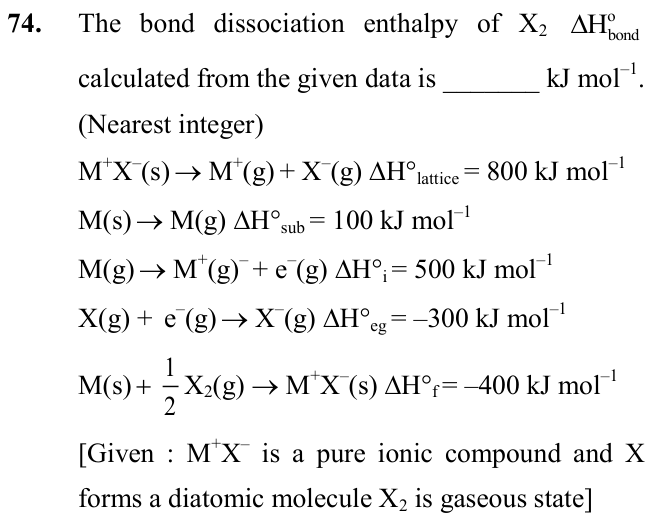
M(s) + X2(g) —→ M⊕Xψ(s)
1
2
→
→
M(g)
X(g)
→
→
M+
(g)
X–
(g) + ∴
f
sub
1
H (MX)
H
(M)
I.E.(M)
[B.E.(X – X)]
2
Δ
=Δ + +
+ EG(X) + L.E.(MX)
– 400 = (100) + (500) + 1
2 (B.E.) + (–300) + (–800)
∴B.E. = 200 kJ mole–1
7
QUESTION 7
Thermodynamics
SECTION B · NUMERICAL (+4, 0)
→
2(g)
1 H
H(g)
2
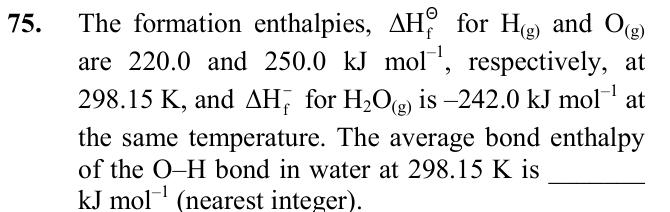
; ΔfH(H(g)) = 220 KJ/mol
→
2(g)
1 O
O(g)
2
; ΔfH(O(g)) = 250 KJ/mol
ΔfH(H2O(g)) = –242 KJ/mol
2H(g) + O(g)
250
2×220
–2(BE(O–H)
ΔHf (H2O(l)) = –242 = 440 + 250 – 2(B.E.(O–H)) = BE(O – H)
466 KJ / mol
QUESTION 8
Thermodynamics
SECTION A · MCQ (+4, -1)
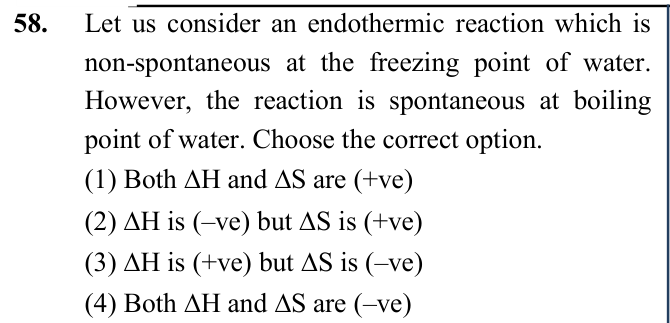
(1) Both ΔH and ΔS are (+ve)
(2) ΔH is (–ve) but ΔS is (+ve)
(3) ΔH is (+ve) but ΔS is (–ve)
(4) Both ΔH and ΔS are (–ve)
Reaction is spontaneous at relatively high
temperature
and
non-spontaneous
at
low
temperature ΔG = ΔH – TΔS
It is only possible when ΔH and ΔS both are
positive.
Option (1)
QUESTION 9
Chemical Thermodynamics
SECTION A · MCQ (+4, -1)
Which of the following is a path function?
(1) entropy
(2) internal energy
(3) work
(4) enthalpy
Work (like heat) depends on the path, unlike state functions such as U, H, and S.
QUESTION 10
Chemical Thermodynamics
SECTION A · MCQ (+4, -1)
The enthalpy of fusion of ice is 6.0 kJ/mol at its melting point, 273.15 K. What is the entropy of fusion?
(1) 0.022 J mol⁻¹ K⁻¹
(2) 88 J mol⁻¹ K⁻¹
(3) 21.97 J mol⁻¹ K⁻¹
(4) 45.5 J mol⁻¹ K⁻¹
At the equilibrium phase-transition temperature ΔS_trans = ΔH_trans / T_trans. ΔS_fus = 6000 J / 273.15 K = 21.97 J mol⁻¹ K⁻¹.
QUESTION 11
Chemical Thermodynamics
SECTION A · MCQ (+4, -1)
For a gaseous reaction, the relation between enthalpy change and internal energy change is
(1) ΔH = ΔU - ΔngRT
(2) ΔH = ΔU/ΔngRT
(3) ΔU = ΔH + ΔngRT
(4) ΔH = ΔU + ΔngRT
ΔH = ΔU + ΔngRT, where Δng is the change in moles of gas.
QUESTION 12
Chemical Thermodynamics
SECTION A · MCQ (+4, -1)
The calculated (localized Kekulé) heat of formation of benzene is +230 kJ/mol, while its experimental heat of formation is +83 kJ/mol. What is the resonance energy of benzene?
(1) −147 kJ/mol
(2) 147 kJ/mol
(3) 313 kJ/mol
(4) −313 kJ/mol
Resonance energy = Calculated Δ_f H° − Experimental Δ_f H° = 230 − 83 = 147 kJ/mol. This positive value is the extra stabilization from π-electron delocalization.
QUESTION 13
Chemical Thermodynamics
SECTION A · MCQ (+4, -1)
At 300 K, the equilibrium constant of a reaction is K = 1. What is Δ_r G°?
(1) Cannot be determined without ΔH
(2) 0 kJ/mol
(3) −8.314 kJ/mol
(4) +8.314 kJ/mol
Δ_r G° = −RT ln K. Since ln(1) = 0, Δ_r G° = 0 kJ/mol. K = 1 means products and reactants are equally favored at equilibrium.
QUESTION 14
Chemical Thermodynamics
SECTION A · MCQ (+4, -1)
The enthalpy of neutralisation of a weak acid with a strong base is less negative than -57.1 kJ/mol because some energy is used for
(1) dilution
(2) ionisation of the weak acid
(3) hydration of ions
(4) bond formation
Part of the heat goes to ionising the weak acid, lowering the observed value.
QUESTION 15
Chemical Thermodynamics
SECTION A · MCQ (+4, -1)
Using mean bond enthalpies, the reaction enthalpy is calculated as
(1) the average of bonds broken and formed
(2) (bonds broken) - (bonds formed)
(3) the sum of all bond enthalpies
(4) (bonds formed) - (bonds broken)
ΔH = Σ(bond enthalpies broken) - Σ(bond enthalpies formed).
QUESTION 16
Chemical Thermodynamics
SECTION A · MCQ (+4, -1)
The standard enthalpy of formation of an element in its standard state is
(1) zero
(2) different for each element
(3) negative
(4) positive
Elements in their standard (reference) state are assigned a formation enthalpy of zero.
QUESTION 17
Chemical Thermodynamics
SECTION A · MCQ (+4, -1)
0.5 mole of HNO₃ is mixed with 0.2 mole of KOH in a dilute aqueous solution. How much heat is evolved? (Enthalpy of neutralization = 57.1 kJ per equivalent)
(1) 57.1 kJ
(2) 5.71 kJ
(3) 11.42 kJ
(4) 28.55 kJ
KOH is the limiting reagent (0.2 equivalents). Heat evolved = equivalents of the limiting reagent × 57.1 kJ/equivalent = 0.2 × 57.1 = 11.42 kJ. The excess HNO₃ remains unreacted.
QUESTION 18
Chemical Thermodynamics
SECTION A · MCQ (+4, -1)
The standard Gibbs energy change is related to the equilibrium constant K by
(1) ΔG° = -RT/K
(2) ΔG° = K/RT
(3) ΔG° = RT ln K
(4) ΔG° = -RT ln K
ΔG° = -RT ln K links standard free energy to the equilibrium constant.
QUESTION 19
Chemical Thermodynamics
SECTION A · MCQ (+4, -1)
For the reaction N₂(g) + 3 H₂(g) → 2 NH₃(g) at constant temperature, how do ΔH and ΔU compare?
(1) Cannot be determined
(2) ΔH < ΔU
(3) ΔH > ΔU
(4) ΔH = ΔU
Δn_g = moles of gaseous products − moles of gaseous reactants = 2 − (1 + 3) = −2. Since ΔH = ΔU + Δn_g RT, a negative Δn_g gives ΔH = ΔU − 2RT, so ΔH < ΔU.
QUESTION 20
Chemical Thermodynamics
SECTION A · MCQ (+4, -1)
For a reaction, ΔH = −10 kJ/mol and ΔS = −20 J mol⁻¹ K⁻¹. Below which temperature is the reaction spontaneous?
(1) 200 K
(2) 0.5 K
(3) 500 K
(4) 1000 K
The reaction is spontaneous when ΔG = ΔH − TΔS < 0, i.e. T < ΔH/ΔS. Using consistent units, T < (−10000 J)/(−20 J K⁻¹) = 500 K. Spontaneous below 500 K.
QUESTION 21
Chemical Thermodynamics
SECTION A · MCQ (+4, -1)
According to the second law of thermodynamics, a process is spontaneous when the total entropy of the universe
(1) remains constant
(2) decreases
(3) increases
(4) becomes zero
Spontaneity requires ΔS(universe) > 0.
QUESTION 22
Chemical Thermodynamics
SECTION A · MCQ (+4, -1)
An ideal gas has a heat capacity ratio γ = C_p / C_v = 1.40. What is its molar heat capacity at constant volume, C_v?
(1) 3.5 R
(2) 1.5 R
(3) 4.5 R
(4) 2.5 R
Using Mayer's relation C_p = C_v + R: γ = C_p/C_v = (C_v + R)/C_v = 1 + R/C_v. Setting 1 + R/C_v = 1.40 gives R/C_v = 0.40, so C_v = 2.5 R (a diatomic rigid-rotor gas).
QUESTION 23
Chemical Thermodynamics
SECTION A · MCQ (+4, -1)
At 298 K and 1 bar, which of the following substances has a standard enthalpy of formation (Δ_f H°) equal to zero?
(1) Br₂(g)
(2) O₃(g)
(3) I₂(g)
(4) Br₂(l)
Δ_f H° = 0 only for an element in its most stable reference state. Bromine is a liquid at 298 K and 1 bar, so Br₂(l) has zero enthalpy of formation. Gaseous Br₂(g) and I₂(g), and ozone O₃(g), all have non-zero values.
QUESTION 24
Chemical Thermodynamics
SECTION A · MCQ (+4, -1)
According to Mayer's relation, for one mole of an ideal gas, Cp - Cv equals
(1) zero
(2) R/2
(3) R
(4) 2R
Mayer's relation is Cp - Cv = R for an ideal gas.
QUESTION 25
Chemical Thermodynamics
SECTION A · MCQ (+4, -1)
Maximum work is obtained when a gas expands
(1) irreversibly
(2) adiabatically
(3) freely into vacuum
(4) reversibly and isothermally
A reversible isothermal expansion yields the maximum possible work.
QUESTION 26
Chemical Thermodynamics
SECTION A · MCQ (+4, -1)
Given bond dissociation enthalpies: H–H = 436 kJ/mol, N≡N = 946 kJ/mol, N–H = 391 kJ/mol. Calculate Δ_r H° for N₂(g) + 3 H₂(g) → 2 NH₃(g).
(1) −92 kJ
(2) +92 kJ
(3) −46 kJ
(4) +46 kJ
Δ_r H° = Σ BDE(reactants) − Σ BDE(products) = [BDE(N≡N) + 3 × BDE(H–H)] − [6 × BDE(N–H)] = [946 + 3(436)] − [6(391)] = 2254 − 2346 = −92 kJ.
QUESTION 27
Chemical Thermodynamics
SECTION A · MCQ (+4, -1)
According to Trouton's rule, the molar entropy of vaporisation of most liquids at their boiling point is approximately
(1) 85 J K-1 mol-1
(2) 850 J K-1 mol-1
(3) 0.85 J K-1 mol-1
(4) 8.5 J K-1 mol-1
Trouton's rule gives ΔSvap ≈ 85 J K-1 mol-1 for many liquids.
QUESTION 28
Chemical Thermodynamics
SECTION A · MCQ (+4, -1)
Thermochemically, resonance energy is the difference between the calculated and the experimental
(1) bond length
(2) ionisation energy
(3) bond angle
(4) enthalpy of formation
Resonance energy = (calculated ΔfH from bond energies) - (experimental ΔfH).