
✎ ANSWER ONLINE · EVERY MISTAKE LINKS BACK TO THE CONCEPT
Organic Chemistry - Some Basic Principles and Techniques · Practice Worksheet
Answer each question here and it marks straight away, with the derivation and a link to the exact micro-concept to revisit.
// CONCEPT AUDIT RESULT
Everything you missed has been added to your Error Arena — retest them blind there, and a concept clears once you get it right.
QUESTION 1
Organic Chemistry: Basic Principles
SECTION A · MCQ (+4, -1)
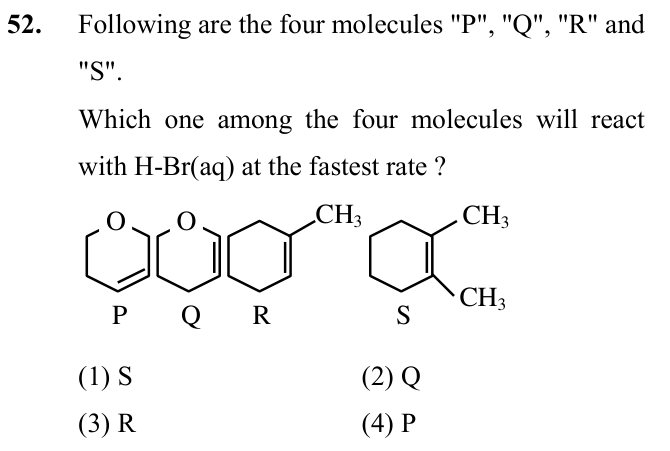
(1) S
(2) Q
(3) R
(4) P
Addition of H-Br(aq) to alkene follows electrophilic
addition mechanism. In the rate determining step a
carbocation intermediate is formed. Among P, Q,
R & S compound Q will form most stable
carbocation intermediate since it is resonance
stabilized.
O
H⊕
O ⊕
O
⊕
QUESTION 2
Organic Chemistry: Basic Principles
SECTION A · MCQ (+4, -1)
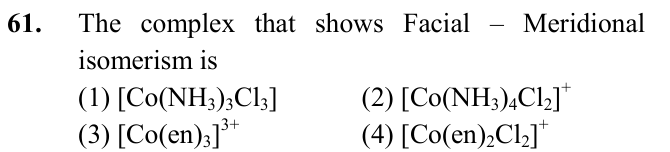
(1) [Co(NH3)3Cl3]
(2) [Co(NH3)4Cl2]+
(3) [Co(en)3]3+
(4) [Co(en)2Cl2]+
(1)
Ma3b3 type complexes show Facial - Meridional
isomerism
(i) [Co(NH3)3Cl3] ⇒ Ma3b3
(ii) [Co(NH3)4Cl2]+ ⇒ Ma4b2
(iii) [Co(en)3]3+
⇒ M(AA)3
(iv) [Co(en)2Cl2]+ ⇒ M(AA)2b2
a, b, = NH3, Cl–
AA = en
QUESTION 3
Organic Chemistry: Basic Principles
SECTION A · MCQ (+4, -1)
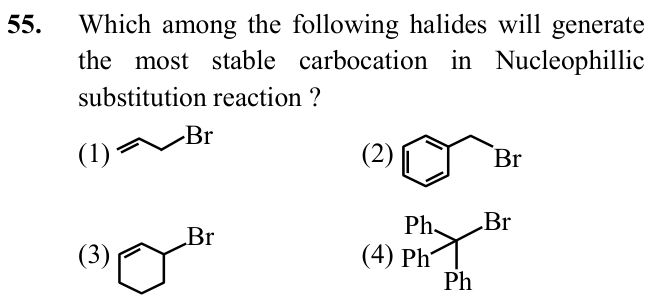
(1) Br
(2) Br
(3) Br
(4) Br
Ph
Ph
Ph
Stability order of carbocation
Ph
Ph
Ph
⊕
>
⊕
>
⊕
>
⊕
QUESTION 4
Organic Chemistry: Basic Principles
SECTION A · MCQ (+4, -1)
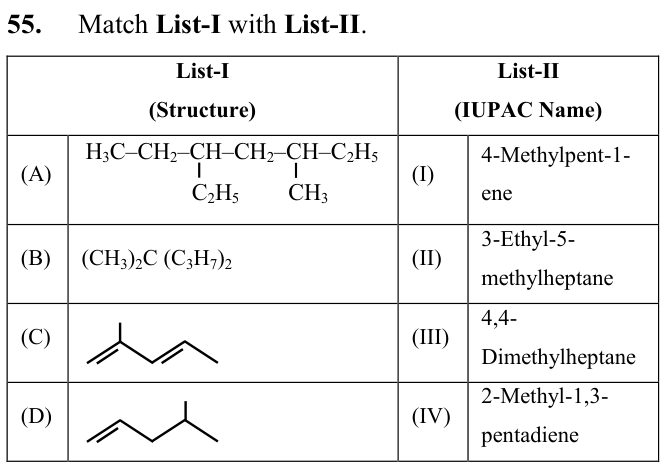
(1) (A)-(III), (B)-(II), (C)-(IV), (D)-(I)
(2) (A)-(III), (B)-(II), (C)-(I), (D)-(IV)
(3) (A)-(II), (B)-(III), (C)-(IV), (D)-(I)
(4) (A)-(II), (B)-(III), (C)-(I), (D)-(IV)
(A)
CH3–CH2–CH–CH2–CH–CH2–CH3
CH2–CH3 CH3
1
2
3
4
5
6
7
3-Ethyl-5-methylheptane
(B) (CH3)2C (C3H7)2
CH3–C–CH2–CH2–CH3
CH3
CH2–CH2–CH3
1
2
3
4
5
6
7
4, 4-Dimethylheptane
(C)
1
2
3
4
5
2-Methyl-1, 3-pentadiene
(D)
1
2
3
4
5
4-Methylpent-1-ene
QUESTION 5
Organic Chemistry: Basic Principles
SECTION A · MCQ (+4, -1)
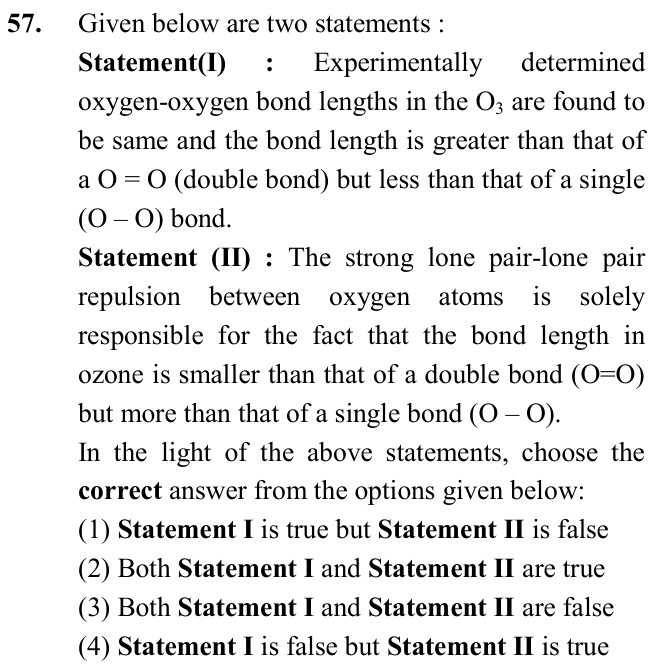
(1) Statement I is true but Statement II is false
(2) Both Statement I and Statement II are true
(3) Both Statement I and Statement II are false
(4) Statement I is false but Statement II is true
Due to resonance bond length is identical in ozone.
Therefore statement I is true and statement II is
false
3
QUESTION 6
Organic Chemistry: Basic Principles
SECTION A · MCQ (+4, -1)
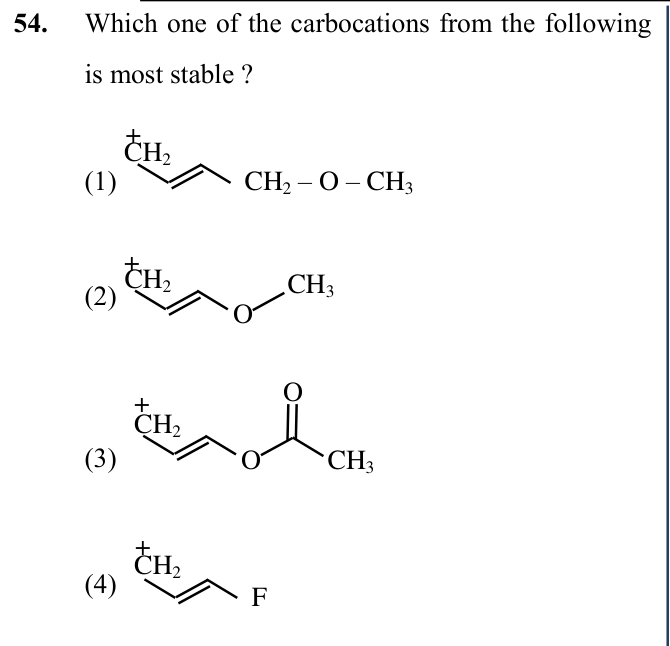
(1) CH2 + CH2 – O – CH3
(2) CH2 + O
CH3
(3) CH2 + O
CH3
O
(4) CH2 + F
Carbocation intermediate is stabilised by +I, +M &
hyperconjugation effect. Since in option 2
carbocation is in conjugation with stronger +M
group –OCH3 hence it will be most stable.
QUESTION 7
Organic Chemistry: Basic Principles
SECTION A · MCQ (+4, -1)
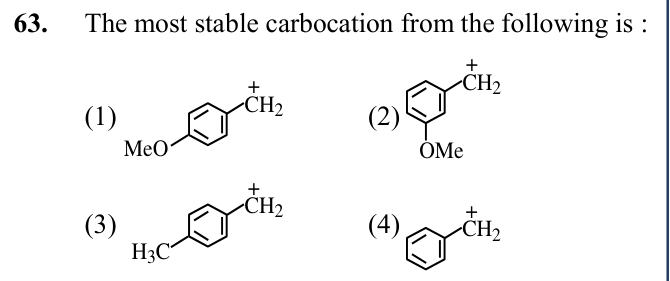
(1) CH2
MeO
+
(2) CH2
OMe
+
(3) CH2
H3C
+
(4) CH2
+
CH2 + MeO
. .
. .
+M
>
CH2 + H3C
+H
>
CH2 + >
CH2 + OCH3
–I
Due to +M effect of –OMe at para position
CH2 + CH3O..
..
Will be most stable among these
QUESTION 8
Organic Chemistry: Basic Principles
SECTION A · MCQ (+4, -1)
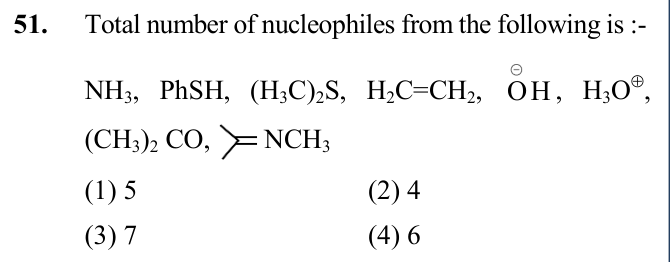
(1) 5
(2) 4
(3) 7
(4) 6
Total five nucleophiles are present
NH3, PhSH, (H3C)2S, CH2=CH2, OH
QUESTION 9
Organic Chemistry: Basic Principles
SECTION A · MCQ (+4, -1)
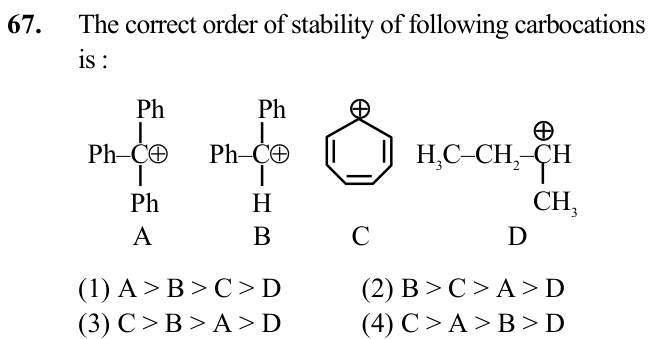
(1) A > B > C > D
(2) B > C > A > D
(3) C > B > A > D
(4) C > A > B > D
Ph–C
Ph
Ph
⊕
Ph–C
Ph
H
⊕
⊕
H3C–CH2–CH–CH3
⊕
A)
B)
C)
D)
Solution :-
C is aromatic due to ⊕ve charge hence it is most
stable
A have more resonance structure
B have less resonance structure
D have only hyper conjugation
Consider First Aromaticity > Resonance > Hyper
conjugation
Ans. D < B < A < C
6
QUESTION 10
Organic Chemistry - Some Basic Principles and Techniques
SECTION A · MCQ (+4, -1)
The reaction of methane with chlorine in the presence of sunlight proceeds via which type of bond cleavage?
(1) Heterolytic cleavage
(2) Both homolytic and heterolytic
(3) Homolytic cleavage
(4) No bond cleavage occurs
UV light (hν) induces homolysis of the Cl–Cl bond into two chlorine radicals (Cl•), initiating a free-radical substitution.