
⚡ OFFICIAL NTA ASSESSMENT GENERATOR & WORD (.DOCX) EXPORTER
Solutions · Practice Worksheet
JEE Main Chemistry · Curated Assessment Set Print directly or export as a beautifully formatted Microsoft Word document with embedded 180-DPI mathematical prompt clips and step-by-step derivations.
EDUPROD JEE MAIN TEST SERIES · NTA PATTERN
Solutions · Practice Worksheet
JEE Main Chemistry · Curated Assessment Set · Assessment Code: JEE-101
Total Marks: 60
Marking: +4 / -1 (Sec A) · +4 / 0 (Sec B)
QUESTION 1
CHEMISTRY · Solutions
SECTION A · MCQ (+4, -1)
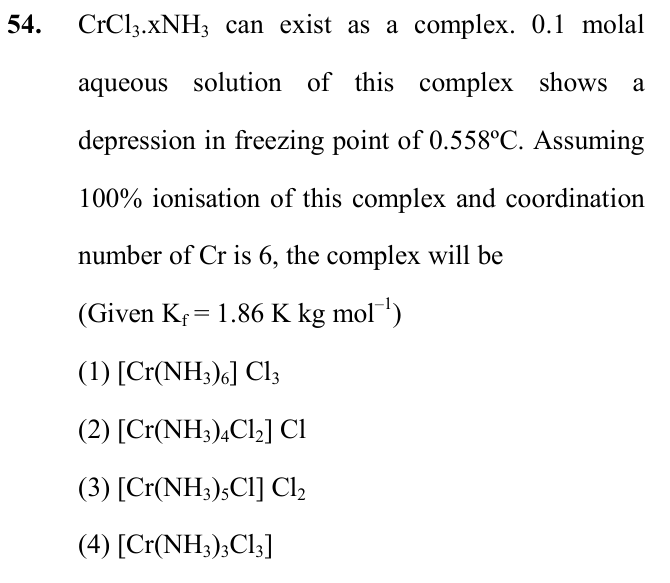
Candidate Response:
(1) (2) (3) (4)
QUESTION 2
CHEMISTRY · Solutions
SECTION A · MCQ (+4, -1)
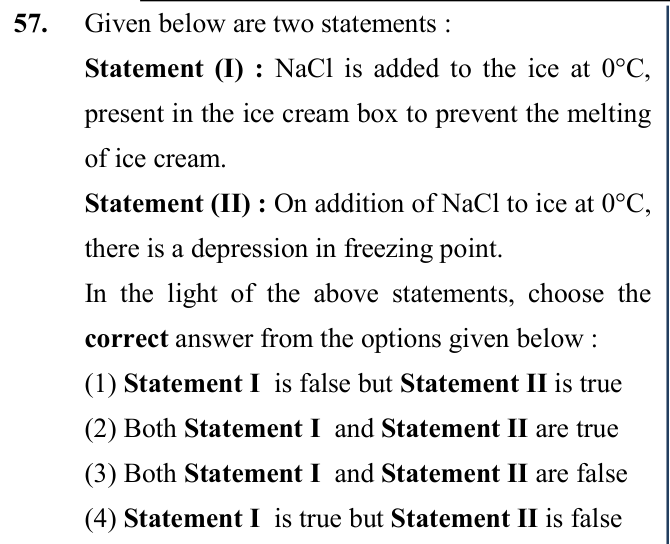
Candidate Response:
(1) (2) (3) (4)
QUESTION 3
CHEMISTRY · Solutions
SECTION A · MCQ (+4, -1)
A student heats an aqueous NaCl solution from 25 °C to 60 °C. Which of the following concentration terms remains unchanged?
(1) Molarity
(2) Molality
(3) Normality
(4) Percent weight/volume (%w/v)
Candidate Response:
(1) (2) (3) (4)
QUESTION 4
CHEMISTRY · Solutions
SECTION A · MCQ (+4, -1)
In a 10% (w/w) aqueous glucose solution, how many grams of water are present alongside 10 g of glucose?
(1) 100 g
(2) 90 g
(3) 10 g
(4) 110 g
Candidate Response:
(1) (2) (3) (4)
QUESTION 5
CHEMISTRY · Solutions
SECTION A · MCQ (+4, -1)
When benzoic acid dimerizes in benzene, its observed molar mass is how related to the normal value?
(1) Zero
(2) Lower than normal
(3) Higher than normal
(4) Equal to normal
Candidate Response:
(1) (2) (3) (4)
QUESTION 6
CHEMISTRY · Solutions
SECTION A · MCQ (+4, -1)
A solution that obeys Raoult's law at all concentrations with zero enthalpy of mixing is called what?
(1) Ideal solution
(2) Non-ideal solution
(3) Saturated solution
(4) Azeotrope
Candidate Response:
(1) (2) (3) (4)
QUESTION 7
CHEMISTRY · Solutions
SECTION A · MCQ (+4, -1)
The sum of the mole fractions of all components in a solution is equal to what?
(1) 0
(2) 1
(3) 6.022 × 10²³
(4) 100
Candidate Response:
(1) (2) (3) (4)
QUESTION 8
CHEMISTRY · Solutions
SECTION A · MCQ (+4, -1)
For a dilute solution of a non-volatile solute, the relative lowering of vapour pressure (P₁° − P₁)/P₁° equals which quantity?
(1) The mole fraction of the solute, χ₂
(2) The mole fraction of the solvent, χ₁
(3) The total pressure of the solution
(4) The molality of the solution
Candidate Response:
(1) (2) (3) (4)
QUESTION 9
CHEMISTRY · Solutions
SECTION A · MCQ (+4, -1)
According to Raoult's law, the partial vapour pressure of a volatile component is directly proportional to what?
(1) Its mole fraction
(2) The total pressure
(3) The temperature
(4) Its molar mass
Candidate Response:
(1) (2) (3) (4)
QUESTION 10
CHEMISTRY · Solutions
SECTION A · MCQ (+4, -1)
Osmotic pressure is the preferred colligative property for determining the molar mass of which type of solute?
(1) Dilute ionic salts
(2) Polymers and biomolecules
(3) Volatile liquids
(4) Gases
Candidate Response:
(1) (2) (3) (4)
QUESTION 11
CHEMISTRY · Solutions
SECTION A · MCQ (+4, -1)
For complete dissociation of NaCl in water, the van 't Hoff factor (i) is equal to what?
(1) 1
(2) 0.5
(3) 2
(4) 3
Candidate Response:
(1) (2) (3) (4)
QUESTION 12
CHEMISTRY · Solutions
SECTION A · MCQ (+4, -1)
A mixture showing a positive deviation from Raoult's law forms which type of azeotrope?
(1) A maximum-boiling azeotrope
(2) An ideal azeotrope
(3) A minimum-boiling azeotrope
(4) No azeotrope
Candidate Response:
(1) (2) (3) (4)
QUESTION 13
CHEMISTRY · Solutions
SECTION A · MCQ (+4, -1)
A constant-boiling mixture that cannot be separated into its components by fractional distillation is called what?
(1) Isotope
(2) Allotrope
(3) Isomer
(4) Azeotrope
Candidate Response:
(1) (2) (3) (4)
QUESTION 14
CHEMISTRY · Solutions
SECTION A · MCQ (+4, -1)
The relative lowering of vapour pressure of a solution containing a non-volatile solute equals which quantity?
(1) Mole fraction of the solute
(2) Molarity of the solute
(3) Mole fraction of the solvent
(4) Molality of the solvent
Candidate Response:
(1) (2) (3) (4)
QUESTION 15
CHEMISTRY · Solutions
SECTION A · MCQ (+4, -1)
Why does a cold bottle of soda retain more dissolved CO₂ than a warm one?
(1) Cooling raises the partial pressure of CO₂
(2) Cooling increases K_H, trapping more gas
(3) Gas dissolution is endothermic, so cooling releases CO₂
(4) Gas dissolution is exothermic, so cooling shifts equilibrium toward more dissolved gas
Candidate Response:
(1) (2) (3) (4)