
✎ ANSWER ONLINE · EVERY MISTAKE LINKS BACK TO THE CONCEPT
Solutions · Practice Worksheet
Answer each question here and it marks straight away, with the derivation and a link to the exact micro-concept to revisit.
2 questions from this set could not be marked online — a
bonus or dual-key question, which has no single defensible answer. The print and
.docx versions still include them.
// CONCEPT AUDIT RESULT
Everything you missed has been added to your Error Arena — retest them blind there, and a concept clears once you get it right.
QUESTION 1
Solutions
SECTION A · MCQ (+4, -1)
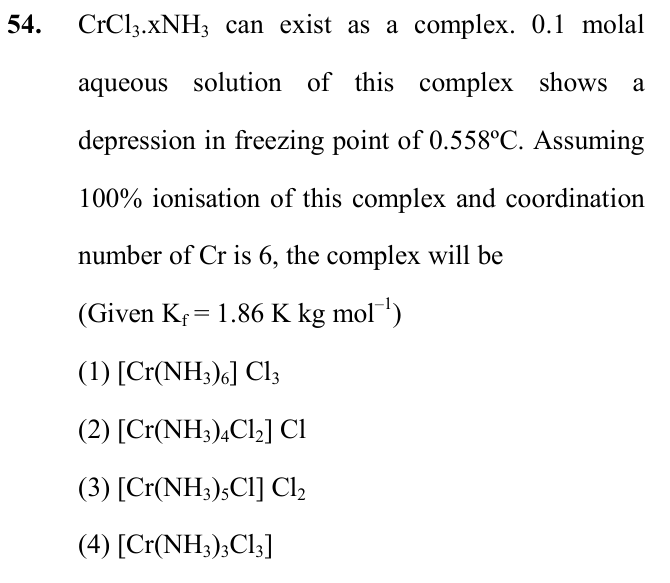
(1) [Cr(NH3)6] Cl3
(2) [Cr(NH3)4Cl2] Cl
(3) [Cr(NH3)5Cl] Cl2
(4) [Cr(NH3)3Cl3]
(3)
Given : ΔTf = 0.558°C
f
K
kg
k
1.86 mol × =
0.1 m aq. sol.
⇒ ΔTf = i × kf × m
⇒ 0.558 = i × 1.86 × 0.1
⇒ i = 3
2
QUESTION 2
Solutions
SECTION A · MCQ (+4, -1)
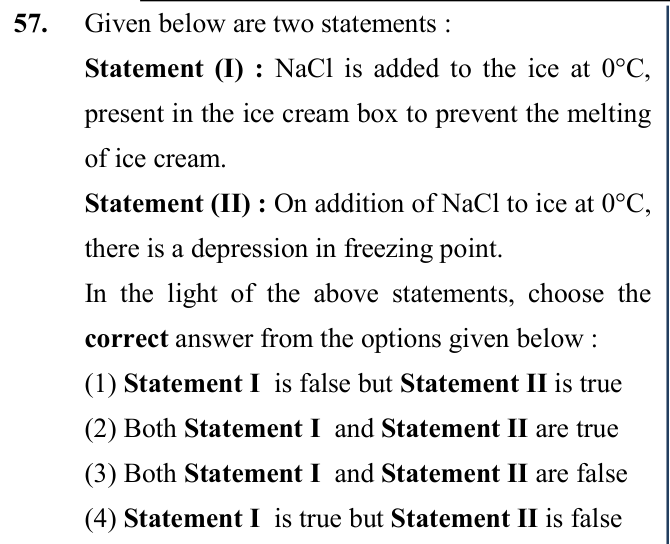
(1) Statement I is false but Statement II is true
(2) Both Statement I and Statement II are true
(3) Both Statement I and Statement II are false
(4) Statement I is true but Statement II is false
QUESTION 3
Solutions
SECTION A · MCQ (+4, -1)
A student heats an aqueous NaCl solution from 25 °C to 60 °C. Which of the following concentration terms remains unchanged?
(1) Molarity
(2) Molality
(3) Normality
(4) Percent weight/volume (%w/v)
Molality is moles of solute per kilogram of solvent, a mass-based quantity unaffected by thermal expansion. Molarity, normality and %w/v all depend on solution volume, which increases on heating, so they all decrease.
QUESTION 4
Solutions
SECTION A · MCQ (+4, -1)
In a 10% (w/w) aqueous glucose solution, how many grams of water are present alongside 10 g of glucose?
(1) 100 g
(2) 90 g
(3) 10 g
(4) 110 g
10% (w/w) means 10 g glucose per 100 g of solution. Since solution mass = solute + solvent, the mass of water is 100 − 10 = 90 g.
QUESTION 5
Solutions
SECTION A · MCQ (+4, -1)
When benzoic acid dimerizes in benzene, its observed molar mass is how related to the normal value?
(1) Zero
(2) Lower than normal
(3) Higher than normal
(4) Equal to normal
Association (dimerization) gives an abnormally high molar mass.
QUESTION 6
Solutions
SECTION A · MCQ (+4, -1)
A solution that obeys Raoult's law at all concentrations with zero enthalpy of mixing is called what?
(1) Ideal solution
(2) Non-ideal solution
(3) Saturated solution
(4) Azeotrope
Ideal solutions obey Raoult's law with ΔH_mix = 0 and ΔV_mix = 0.
QUESTION 7
Solutions
SECTION A · MCQ (+4, -1)
The sum of the mole fractions of all components in a solution is equal to what?
(1) 0
(2) 1
(3) 6.022 × 10²³
(4) 100
Mole fractions of all components always add up to unity.
QUESTION 8
Solutions
SECTION A · MCQ (+4, -1)
According to Raoult's law, the partial vapour pressure of a volatile component is directly proportional to what?
(1) Its mole fraction
(2) The total pressure
(3) The temperature
(4) Its molar mass
Raoult's law: p = p° × mole fraction of the component.
QUESTION 9
Solutions
SECTION A · MCQ (+4, -1)
Osmotic pressure is the preferred colligative property for determining the molar mass of which type of solute?
(1) Dilute ionic salts
(2) Polymers and biomolecules
(3) Volatile liquids
(4) Gases
Osmotic pressure is large and easily measured for macromolecules like proteins.
QUESTION 10
Solutions
SECTION A · MCQ (+4, -1)
For complete dissociation of NaCl in water, the van 't Hoff factor (i) is equal to what?
(1) 1
(2) 0.5
(3) 2
(4) 3
NaCl dissociates into Na⁺ and Cl⁻, giving i = 2.
QUESTION 11
Solutions
SECTION A · MCQ (+4, -1)
A mixture showing a positive deviation from Raoult's law forms which type of azeotrope?
(1) A maximum-boiling azeotrope
(2) An ideal azeotrope
(3) A minimum-boiling azeotrope
(4) No azeotrope
Positive deviation means vapour pressure is higher than ideal, so the mixture boils at a lower temperature; the azeotrope there is a minimum-boiling azeotrope (e.g. 95.4% ethanol/water). Negative deviation gives a maximum-boiling azeotrope.
QUESTION 12
Solutions
SECTION A · MCQ (+4, -1)
A constant-boiling mixture that cannot be separated into its components by fractional distillation is called what?
(1) Isotope
(2) Allotrope
(3) Isomer
(4) Azeotrope
An azeotrope boils at a constant temperature with unchanged composition.
QUESTION 13
Solutions
SECTION A · MCQ (+4, -1)
The relative lowering of vapour pressure of a solution containing a non-volatile solute equals which quantity?
(1) Mole fraction of the solute
(2) Molarity of the solute
(3) Mole fraction of the solvent
(4) Molality of the solvent
(p° − p)/p° equals the mole fraction of the non-volatile solute.