
⚡ OFFICIAL NTA ASSESSMENT GENERATOR & WORD (.DOCX) EXPORTER
Electrochemistry · Practice Worksheet
JEE Main Chemistry · Curated Assessment Set Print directly or export as a beautifully formatted Microsoft Word document with embedded 180-DPI mathematical prompt clips and step-by-step derivations.
EDUPROD JEE MAIN TEST SERIES · NTA PATTERN
Electrochemistry · Practice Worksheet
JEE Main Chemistry · Curated Assessment Set · Assessment Code: JEE-101
Total Marks: 40
Marking: +4 / -1 (Sec A) · +4 / 0 (Sec B)
QUESTION 1
CHEMISTRY · Electrochemistry
SECTION A · MCQ (+4, -1)
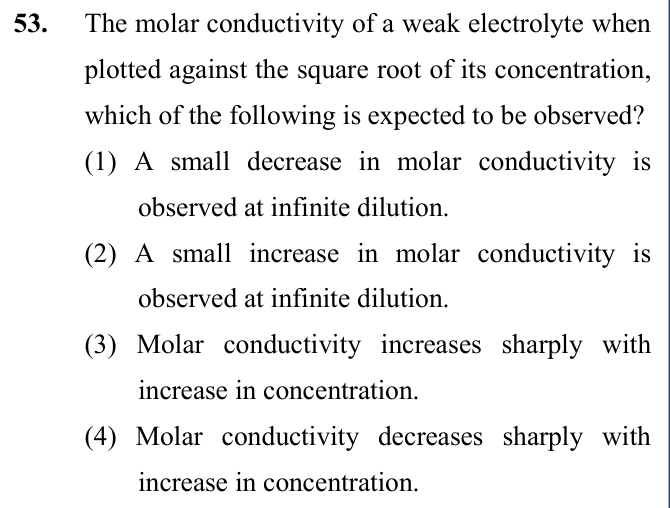
Candidate Response:
(1) (2) (3) (4)
⚡ OFFICIAL KEY: 4
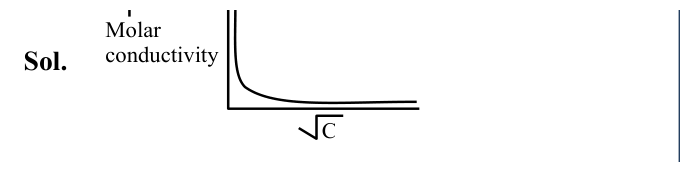
Step-by-Step Derivation
QUESTION 2
CHEMISTRY · Electrochemistry
SECTION A · MCQ (+4, -1)
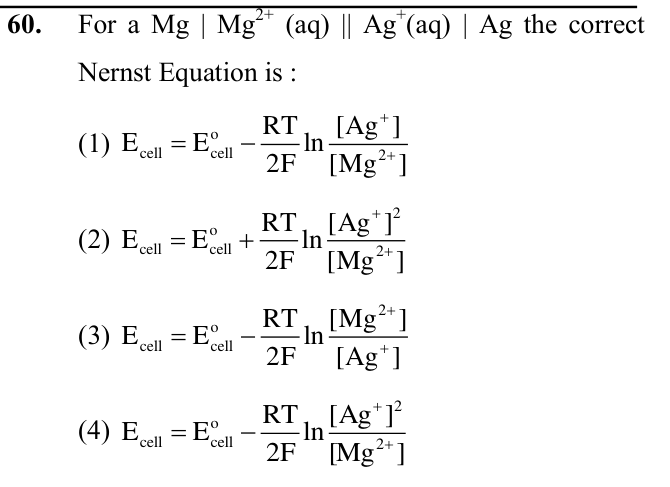
Candidate Response:
(1) (2) (3) (4)
⚡ OFFICIAL KEY: 2
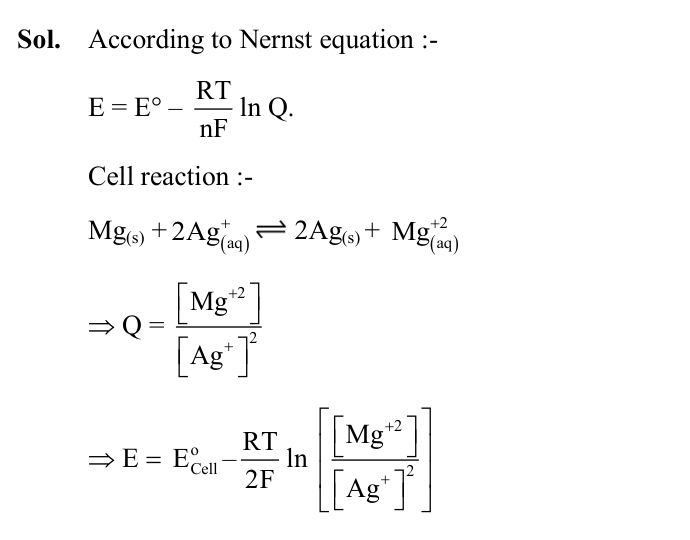
Step-by-Step Derivation
QUESTION 3
CHEMISTRY · Electrochemistry
SECTION A · MCQ (+4, -1)
Candidate Response:
(1) (2) (3) (4)
⚡ OFFICIAL KEY: 1
Step-by-Step Derivation
QUESTION 4
CHEMISTRY · Electrochemistry
SECTION B · NUMERICAL (+4, 0)
Numerical Value:
[ ]
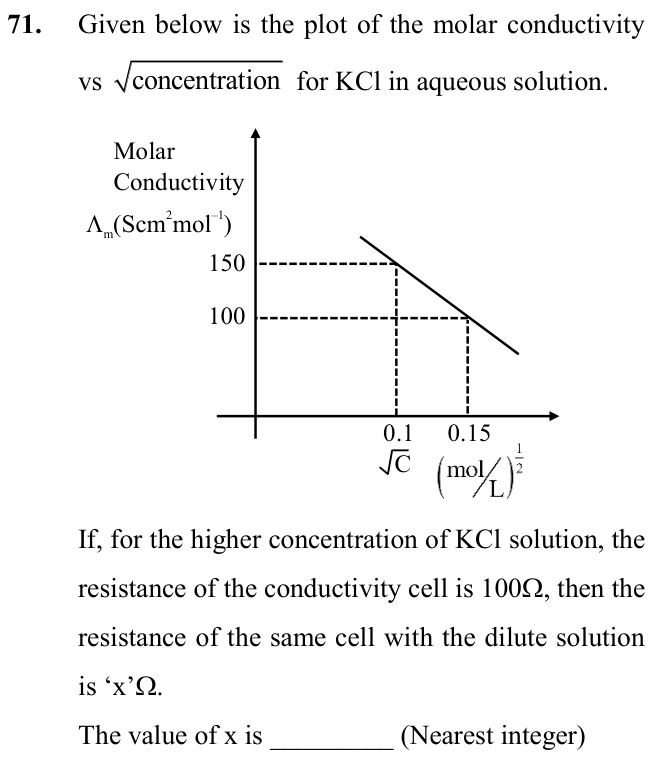
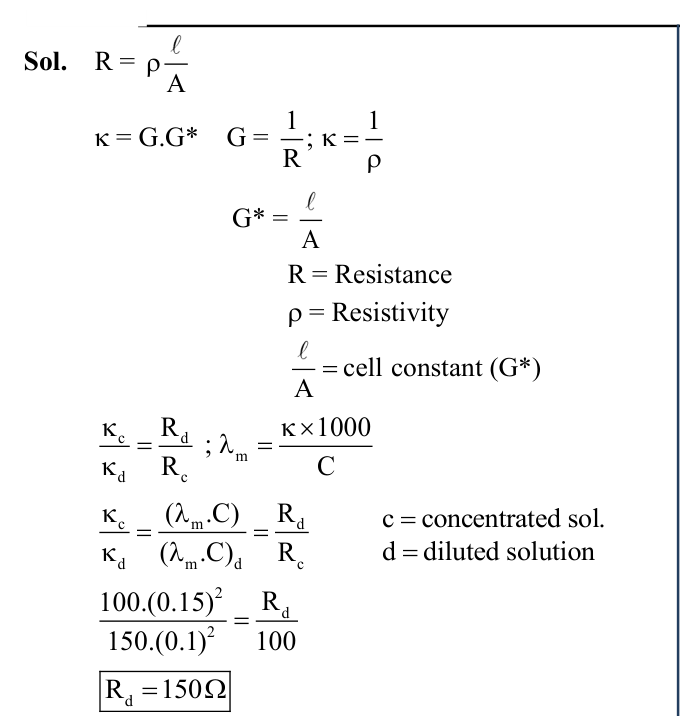
⚡ OFFICIAL KEY: 150
Step-by-Step Derivation
QUESTION 5
CHEMISTRY · Electrochemistry
SECTION A · MCQ (+4, -1)
Candidate Response:
(1) (2) (3) (4)
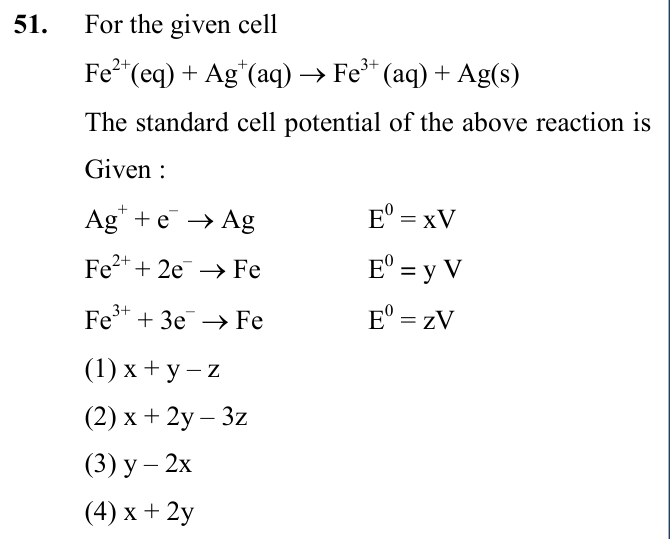
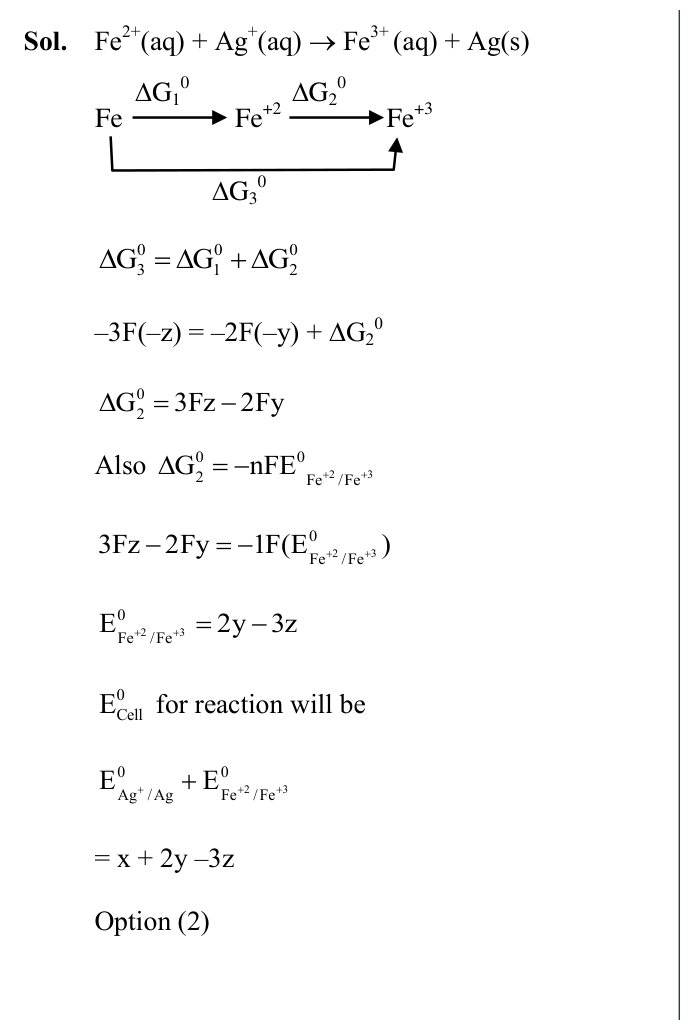
⚡ OFFICIAL KEY: 2
Step-by-Step Derivation
QUESTION 6
CHEMISTRY · Electrochemistry
SECTION A · MCQ (+4, -1)
Candidate Response:
(1) (2) (3) (4)
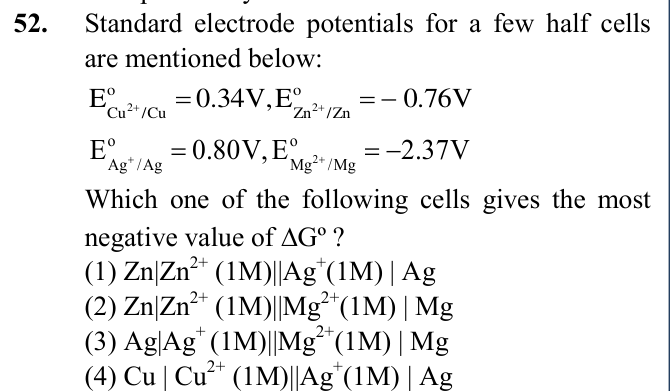
⚡ OFFICIAL KEY: 1
Step-by-Step Derivation

QUESTION 7
CHEMISTRY · Electrochemistry
SECTION A · MCQ (+4, -1)
Candidate Response:
(1) (2) (3) (4)
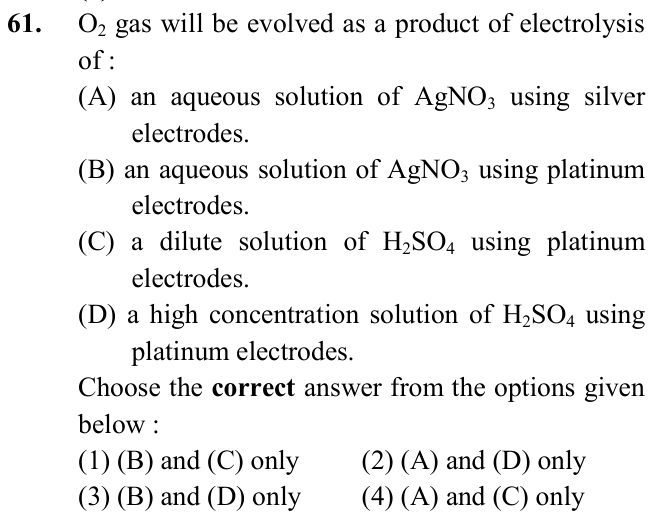
⚡ OFFICIAL KEY: 1
Step-by-Step Derivation

QUESTION 8
CHEMISTRY · Electrochemistry
SECTION A · MCQ (+4, -1)
Why must the cations and anions of a salt bridge have nearly equal mobility (transport numbers)?
(1) To make the salt bridge chemically inert toward both electrodes
(2) To avoid net charge separation that would create a liquid junction potential
(3) To raise the temperature of the two half-cells
(4) To increase the total conductivity of the salt bridge
Candidate Response:
(1) (2) (3) (4)
⚡ OFFICIAL KEY: To avoid net charge separation that would create a liquid junction potential
Step-by-Step Derivation
If the salt-bridge ions migrated at unequal speeds, charge would separate across the junction, producing a liquid junction potential (LJP) that subtracts from the true cell EMF. Equal mobilities (e.g. u_K⁺ ≈ u_Cl⁻) prevent this.
QUESTION 9
CHEMISTRY · Electrochemistry
SECTION A · MCQ (+4, -1)
Why does galvanised (zinc-coated) iron resist rusting even when the coating is scratched?
(1) Zinc acts as a sacrificial anode and oxidises in place of iron
(2) Zinc raises the reduction potential of iron
(3) Zinc forms an impermeable oxide that seals the scratch
(4) Zinc converts iron into stainless steel
Candidate Response:
(1) (2) (3) (4)
⚡ OFFICIAL KEY: Zinc acts as a sacrificial anode and oxidises in place of iron
Step-by-Step Derivation
Zinc (E° = −0.76 V) is a stronger reducing agent than iron (E° = −0.44 V), so even where the iron is exposed, zinc oxidises preferentially as a sacrificial anode and protects the iron.
QUESTION 10
CHEMISTRY · Electrochemistry
SECTION A · MCQ (+4, -1)
A cell whose two electrodes are the same metal but whose electrolyte concentrations differ is called what?
(1) Concentration cell
(2) Electrolytic cell
(3) Fuel cell
(4) Daniell cell
Candidate Response:
(1) (2) (3) (4)
⚡ OFFICIAL KEY: Concentration cell
Step-by-Step Derivation
In a concentration cell, EMF arises from a concentration difference.