
✎ ANSWER ONLINE · EVERY MISTAKE LINKS BACK TO THE CONCEPT
Electrochemistry · Practice Worksheet
Answer each question here and it marks straight away, with the derivation and a link to the exact micro-concept to revisit.
3 questions from this set could not be marked online — a
bonus or dual-key question, which has no single defensible answer. The print and
.docx versions still include them.
// CONCEPT AUDIT RESULT
Everything you missed has been added to your Error Arena — retest them blind there, and a concept clears once you get it right.
QUESTION 1
Electrochemistry
SECTION A · MCQ (+4, -1)
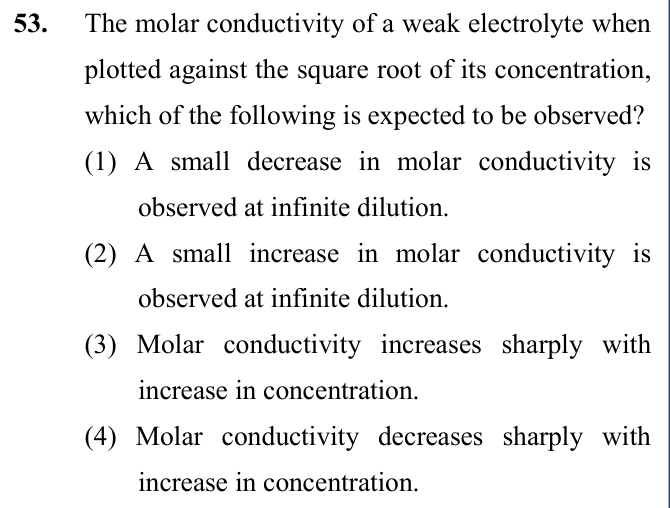
(1) A small decrease in molar conductivity is
observed at infinite dilution.
(2) A small increase in molar conductivity is
observed at infinite dilution.
(3) Molar conductivity increases sharply with
increase in concentration.
(4) Molar conductivity decreases sharply with
increase in concentration.
Molar
conductivity
C
QUESTION 2
Electrochemistry
SECTION A · MCQ (+4, -1)
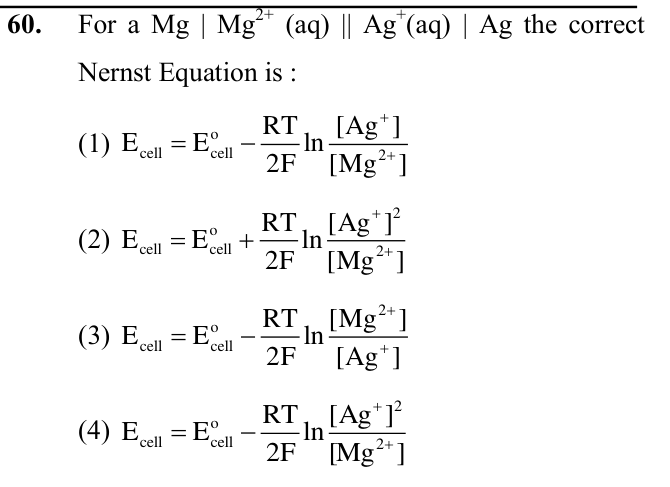
(1) o
cell
cell
2
RT
[Ag ]
E
E
ln
2F
[Mg
] + + = -
(2) 2
o
cell
cell
2
RT
[Ag ]
E
E
ln
2F
[Mg
] + + = +
(3) 2
o
cell
cell
RT
[Mg
]
E
E
ln
2F
[Ag ] + + = -
(4) 2
o
cell
cell
2
RT
[Ag ]
E
E
ln
2F
[Mg ] + + = -
According to Nernst equation :-
E = E° – RT
nF ln Q.
Cell reaction :-
Mg(s) +
(
)
aq
2Ag+
2Ag(s) +
(
)
2
aq
Mg+
⇒ Q =
2
2
Mg
Ag + +
]
{
}
]
{
}
⇒ Ε =
o
Cell
E
– RT
2F ln
2
2
Mg
Ag + +
]
]
{
}
[
]
[
]
]
{
}
{
}
QUESTION 3
Electrochemistry
SECTION A · MCQ (+4, -1)
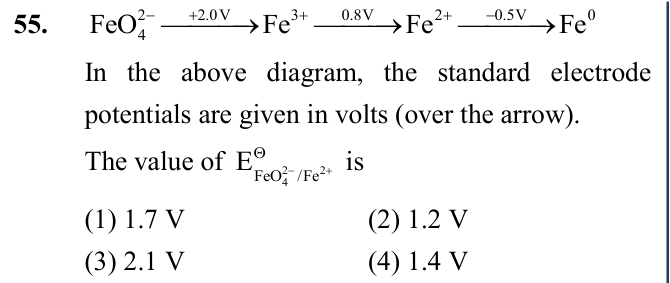
(1) 1.7 V
(2) 1.2 V
(3) 2.1 V
(4) 1.4 V
(1)
o
o
o
4
1
2
G
G
G
Δ
=Δ
+Δ
⇒
o
0
o
4
4
1
1
2
2
n FE
n FE
n FE - =- - ⇒
o
4
4E
3 2
(1 0.8) + =×+ × ⇒
o
4
6.8
E
V
4 = ⇒
o
4
E
1.7V
=
QUESTION 4
Electrochemistry
SECTION B · NUMERICAL (+4, 0)
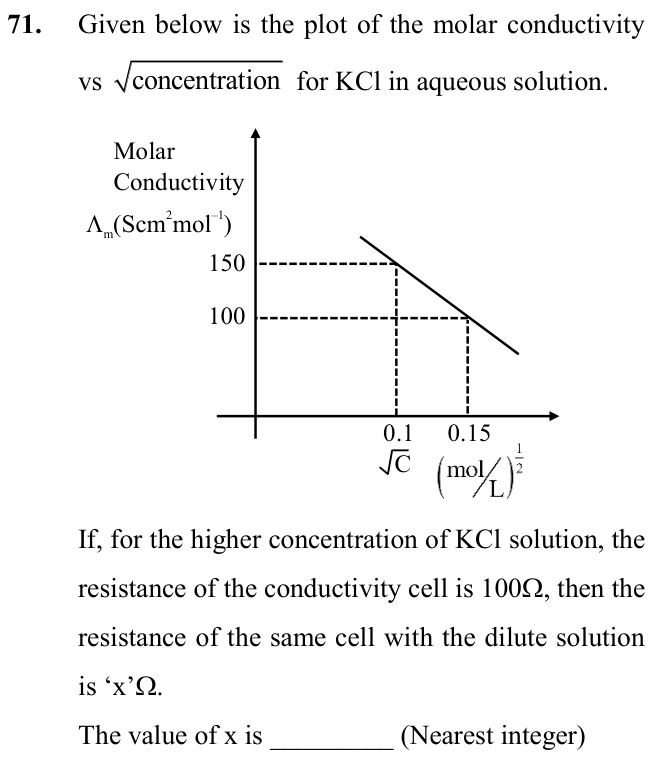
R = ρA
κ= G.G* G =
κ=ρ
1
1
;
R
G* =
A
R = Resistance
ρ= Resistivity
=cell constant (G*)
A
κ
κ× = λ = κ
c
d
m
d
c
R
1000
;
R
C
κ
λ = =
κ
λ
c
d
m
d
m
d
c
R
(
.C)
(
.C)
R = =
c
concentrated sol.
d
diluted solution = 2
d
2
R
100.(0.15)
150.(0.1)
100 = Ω
d
R
150
QUESTION 5
Electrochemistry
SECTION A · MCQ (+4, -1)
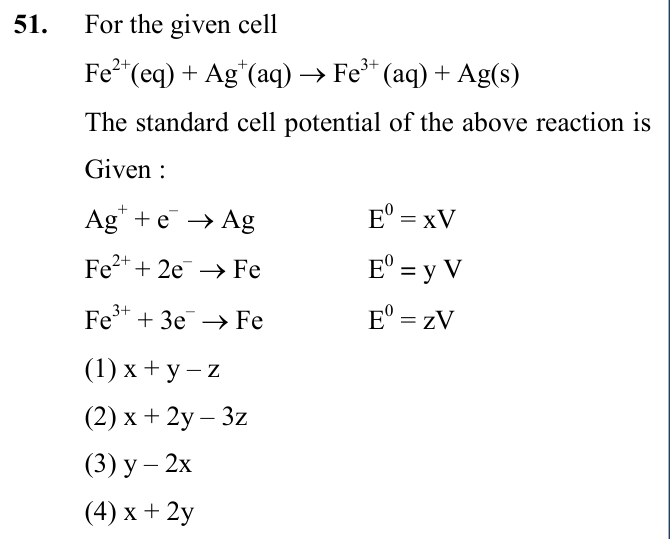
(1) x + y – z
(2) x + 2y – 3z
(3) y – 2x
(4) x + 2y
Fe2+(aq) + Ag+(aq) → Fe3+ (aq) + Ag(s)
Fe
ΔG1
0
Fe+2
ΔG2
0
Fe+3
ΔG3
0
0
0
0
3
1
2
G
G
G
Δ
=Δ
+Δ
–3F(–z) = –2F(–y) + ΔG2
0
0
2
G
3Fz
2Fy
Δ = -
Also
2
3
0
0
2
Fe
/Fe
G
nFE + +
Δ
=-
2
3
0
Fe
/Fe
3Fz
2Fy
1F(E
) + + - =-
2
3
0
Fe
/Fe
E
2y
3z + += - 0
Cell
E
for reaction will be
2
3
0
0
Ag /Ag
Fe
/Fe
E
E + + + +
= x + 2y –3z
Option (2)
QUESTION 6
Electrochemistry
SECTION A · MCQ (+4, -1)
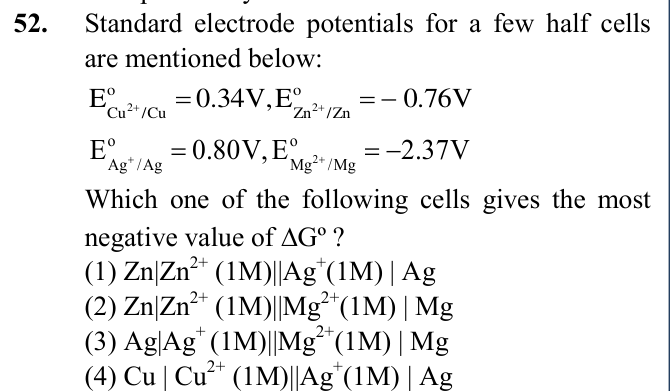
(1) Zn|Zn2+ (1M)||Ag+(1M) | Ag
(2) Zn|Zn2+ (1M)||Mg2+(1M) | Mg
(3) Ag|Ag+ (1M)||Mg2+(1M) | Mg
(4) Cu | Cu2+ (1M)||Ag+(1M) | Ag
ΔG° = –nFE°
Option (1) E° = 0.8 + 0.76
= 1.56 V
∴ΔG° = –2 × F × 1.56
= –3.12 V
Option (2) E° = –2.37+ 0.76
= –1.61 V
∴ΔG° = –2 × F × (–1.61)
= +3.22 V
Option (3) E° = –2.37– 0.8
= –3.17 V
∴ΔG° = –2 × F × (–3.17)
= +6.34
Option (4) E° = 0.8 – 0.34
= 0.46 V
ΔG° = –2 × F × 0.46
= – 0.92 V
QUESTION 7
Electrochemistry
SECTION A · MCQ (+4, -1)
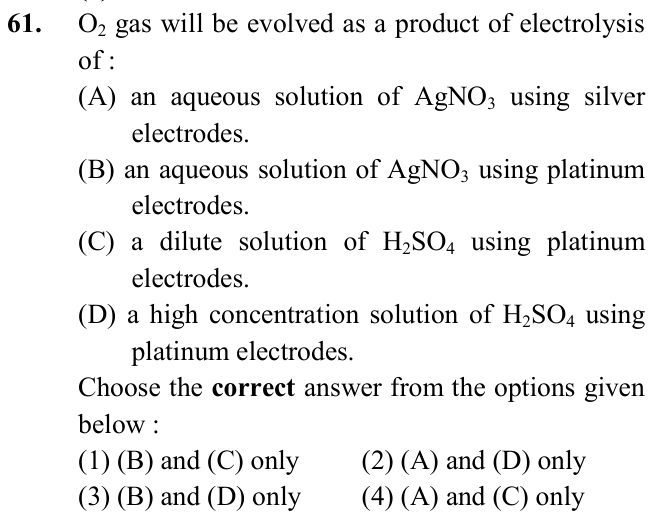
(1) (B) and (C) only
(2) (A) and (D) only
(3) (B) and (D) only
(4) (A) and (C) only
QUESTION 8
Electrochemistry
SECTION A · MCQ (+4, -1)
Why must the cations and anions of a salt bridge have nearly equal mobility (transport numbers)?
(1) To make the salt bridge chemically inert toward both electrodes
(2) To avoid net charge separation that would create a liquid junction potential
(3) To raise the temperature of the two half-cells
(4) To increase the total conductivity of the salt bridge
If the salt-bridge ions migrated at unequal speeds, charge would separate across the junction, producing a liquid junction potential (LJP) that subtracts from the true cell EMF. Equal mobilities (e.g. u_K⁺ ≈ u_Cl⁻) prevent this.
QUESTION 9
Electrochemistry
SECTION A · MCQ (+4, -1)
Why does galvanised (zinc-coated) iron resist rusting even when the coating is scratched?
(1) Zinc acts as a sacrificial anode and oxidises in place of iron
(2) Zinc raises the reduction potential of iron
(3) Zinc forms an impermeable oxide that seals the scratch
(4) Zinc converts iron into stainless steel
Zinc (E° = −0.76 V) is a stronger reducing agent than iron (E° = −0.44 V), so even where the iron is exposed, zinc oxidises preferentially as a sacrificial anode and protects the iron.
QUESTION 10
Electrochemistry
SECTION A · MCQ (+4, -1)
A cell whose two electrodes are the same metal but whose electrolyte concentrations differ is called what?
(1) Concentration cell
(2) Electrolytic cell
(3) Fuel cell
(4) Daniell cell
In a concentration cell, EMF arises from a concentration difference.
QUESTION 11
Electrochemistry
SECTION A · MCQ (+4, -1)
In a hydrogen-oxygen fuel cell, which gas is reduced at the cathode?
(1) Nitrogen
(2) Hydrogen
(3) Carbon monoxide
(4) Oxygen
O2 is reduced to water at the cathode; H2 is oxidised at the anode.
QUESTION 12
Electrochemistry
SECTION A · MCQ (+4, -1)
Why must the resistance of an electrolyte solution be measured with alternating current (AC) rather than direct current (DC)?
(1) DC is absorbed by the ions in solution
(2) DC is too weak to pass through an ionic solution
(3) DC changes the cell constant during measurement
(4) DC causes electrolysis and electrode polarisation
Direct current would electrolyse the solution and polarise the electrodes, changing the measured resistance. AC reverses the current rapidly (audio frequency), preventing chemical change.
QUESTION 13
Electrochemistry
SECTION A · MCQ (+4, -1)
During electrolysis of aqueous NaCl, which gas is liberated at the anode?
(1) Hydrogen
(2) Chlorine
(3) Oxygen
(4) Nitrogen
The high overpotential of oxygen favours Cl⁻ discharge to Cl2 at the anode.
QUESTION 14
Electrochemistry
SECTION A · MCQ (+4, -1)
A cell's EMF increases as the temperature rises. What does this imply about the entropy change ΔS of the cell reaction?
(1) ΔS cannot be determined from temperature alone
(2) ΔS is negative
(3) ΔS is positive
(4) ΔS is zero
ΔS = nF(∂E/∂T)_p, so a positive temperature coefficient of EMF means a positive entropy change for the cell reaction.
QUESTION 15
Electrochemistry
SECTION A · MCQ (+4, -1)
How many coulombs are required to deposit one mole of Al³⁺ as aluminium metal? (F = 96500 C mol⁻¹)
(1) 96500 C
(2) 193000 C
(3) 289500 C
(4) 48250 C
Al³⁺ + 3e⁻ → Al requires 3 moles of electrons per mole of aluminium, i.e. 3 F = 3 × 96500 = 289500 C.
QUESTION 16
Electrochemistry
SECTION A · MCQ (+4, -1)
A lead-acid storage battery is which type of cell?
(1) Concentration cell
(2) Secondary (rechargeable) cell
(3) Fuel cell
(4) Primary cell
Lead-acid batteries are rechargeable, so they are secondary cells.
QUESTION 17
Electrochemistry
SECTION A · MCQ (+4, -1)
The Gibbs free energy change (ΔG) of a galvanic cell is related to its EMF (E) by which expression?
(1) ΔG = −E/nF
(2) ΔG = nFE
(3) ΔG = nF/E
(4) ΔG = −nFE
ΔG = −nFE links cell potential to maximum useful work.
QUESTION 18
Electrochemistry
SECTION A · MCQ (+4, -1)
In a Daniell cell, which metal is oxidised at the anode?
(1) Copper
(2) Zinc
(3) Hydrogen
(4) Silver
Zn is oxidised to Zn²⁺ at the anode of a Daniell cell.
QUESTION 19
Electrochemistry
SECTION A · MCQ (+4, -1)
One faraday of charge is equal to how many coulombs?
(1) 9.65 C
(2) 9650 C
(3) 96500 C
(4) 965 C
1 F ≈ 96500 C, the charge on one mole of electrons.
QUESTION 20
Electrochemistry
SECTION A · MCQ (+4, -1)
How is the limiting molar conductivity Λ°m of the weak acid CH₃COOH determined?
(1) By direct measurement at infinite dilution
(2) Λ°m(CH₃COONa) + Λ°m(HCl) − Λ°m(NaCl)
(3) Λ°m(CH₃COONa) − Λ°m(HCl) + Λ°m(NaCl)
(4) Λ°m(CH₃COONa) × Λ°m(HCl) / Λ°m(NaCl)
A weak acid never fully dissociates, so its Λ°m cannot be measured directly. Kohlrausch's law of independent migration lets us obtain it from strong electrolytes: Λ°m(CH₃COOH) = Λ°m(CH₃COONa) + Λ°m(HCl) − Λ°m(NaCl).
QUESTION 21
Electrochemistry
SECTION A · MCQ (+4, -1)
The ratio of the distance between electrodes to the cross-sectional area of the electrodes is called what?
(1) Conductance
(2) Molar conductivity
(3) Resistivity
(4) Cell constant
Cell constant = l/A, used to convert conductance to conductivity.
QUESTION 22
Electrochemistry
SECTION A · MCQ (+4, -1)
The primary function of the salt bridge in a galvanic cell is to do what?
(1) Maintain electrical neutrality of the two half-cells
(2) Increase the cell EMF
(3) Catalyse the redox reaction
(4) Transfer electrons between electrodes
The salt bridge completes the circuit by balancing ion charges.
QUESTION 23
Electrochemistry
SECTION A · MCQ (+4, -1)
In a working Daniell cell, in which direction do electrons flow through the external wire?
(1) From the salt bridge to the zinc electrode
(2) From the copper electrode to the zinc electrode
(3) From the CuSO4 solution to the ZnSO4 solution
(4) From the zinc electrode to the copper electrode
Zinc is oxidised at the anode (Zn → Zn²⁺ + 2e⁻), releasing electrons that travel through the external wire to the copper cathode, where Cu²⁺ is reduced. Electrons therefore flow Zn → Cu.
QUESTION 24
Electrochemistry
SECTION A · MCQ (+4, -1)
Kohlrausch's law states that the limiting molar conductivity of an electrolyte equals the sum of the limiting molar conductivities of what?
(1) The solvent molecules
(2) Its electrodes
(3) Its constituent ions
(4) Its neutral molecules
At infinite dilution, ions migrate independently (Kohlrausch's law).
QUESTION 25
Electrochemistry
SECTION A · MCQ (+4, -1)
In the Nernst equation, the concentration of each species is raised to the power of its what?
(1) Charge
(2) Stoichiometric coefficient
(3) Atomic number
(4) Oxidation state
Concentrations in the reaction quotient carry their stoichiometric coefficients as exponents.
QUESTION 26
Electrochemistry
SECTION A · MCQ (+4, -1)
For the cell Ni(s) | Ni²⁺(aq) || Ag⁺(aq) | Ag(s) with cell reaction Ni + 2Ag⁺ → Ni²⁺ + 2Ag, what is the correct reaction quotient Q?
(1) [Ni²⁺]/[Ag⁺]
(2) [Ag⁺]²/[Ni²⁺]
(3) [Ni²⁺]·[Ag⁺]
(4) [Ni²⁺]/[Ag⁺]²
Q is written as products over reactants, each concentration raised to its stoichiometric coefficient: Q = [Ni²⁺]/[Ag⁺]². The '2' in front of Ag⁺ becomes the exponent on [Ag⁺].
QUESTION 27
Electrochemistry
SECTION A · MCQ (+4, -1)
For a galvanic cell, the entropy change ΔS equals nF multiplied by which quantity?
(1) ∂E/∂P
(2) ∂E/∂T (temperature coefficient of EMF)
(3) The cell constant
(4) ∂T/∂E
ΔS = nF(∂E/∂T) from the temperature dependence of the EMF.