
⚡ OFFICIAL NTA ASSESSMENT GENERATOR & WORD (.DOCX) EXPORTER
Linear Inequalities · Practice Worksheet
JEE Main Mathematics · Curated Assessment Set Print directly or export as a beautifully formatted Microsoft Word document with embedded 180-DPI mathematical prompt clips and step-by-step derivations.
EDUPROD JEE MAIN TEST SERIES · NTA PATTERN
Linear Inequalities · Practice Worksheet
JEE Main Mathematics · Curated Assessment Set · Assessment Code: JEE-101
Total Marks: 44
Marking: +4 / -1 (Sec A) · +4 / 0 (Sec B)
QUESTION 1
MATHEMATICS · Complex Numbers
SECTION A · MCQ (+4, -1)
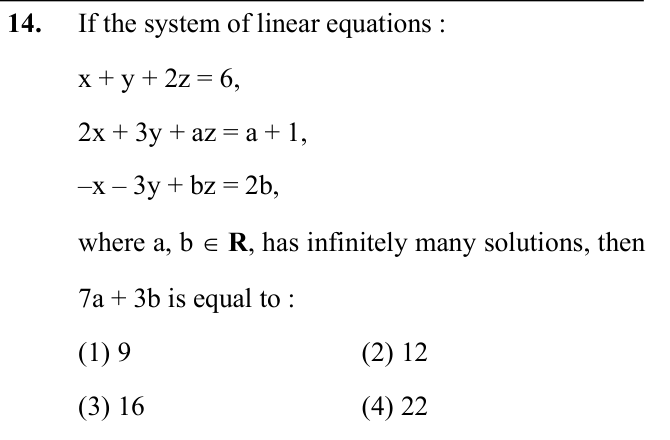
Candidate Response:
(1) (2) (3) (4)
QUESTION 2
MATHEMATICS · Linear Inequalities
SECTION A · MCQ (+4, -1)
Solve the inequality: (5 - 2x) / 3 <= x/6 - 5.
(1) Multiply by 6 (positive, no flip): 2(5 - 2x) <= x - 30 => 10 - 4x <= x - 30 => -5x <= -40. Divide by -5 (flip sign!): x >= 8. Solution: (8, ∞).
(2) (-5, 7]
(3) Multiply by 6 (positive, no flip): 2(5 - 2x) <= x - 30 => 10 - 4x <= x - 30 => -5x <= -40. Divide by -5 (flip sign!): x >= 8. Solution: [8, ∞).
(4) Multiply by 6 (positive, no flip): 2(5 + 2x) <= x + 30 => 10 + 4x <= x + 30 => +5x <= +40. Divide by +5 (flip sign!): x >= 8. Solution: [8, ∞).
Candidate Response:
(1) (2) (3) (4)
QUESTION 3
MATHEMATICS · Linear Inequalities
SECTION A · MCQ (+4, -1)
Represent the set {x in R : -3 <= x < 7} in interval notation and describe its graphical number line nodes.
(1) Interval notation: [+3, 7). On the number line, it is represented by a solid node at +3, a hollow node at 7, and a shaded line between them.
(2) (-5, 7]
(3) Interval notation: [-3, 7). On the number line, it is represented by a solid node at -3, a hollow node at 7, and a shaded line between them.
(4) Interval notation: (-3, 7). On the number line, it is represented by a solid node at -3, a hollow node at 7, and a shaded line between them.
Candidate Response:
(1) (2) (3) (4)
QUESTION 4
MATHEMATICS · Linear Inequalities
SECTION A · MCQ (+4, -1)
Find the solution set of the system: 3x - 7 < 5 + x and 11 - 5x <= 1.
(1) First: 3x - x < 5 + 7 => 2x < 12 => x < 6 => S1 = (-∞, 6). Second: -5x <= -10 => x >= 2 => S2 = [2, ∞). Common solution: S = S1 ∩ S2 = [2, 6).
(2) (-5, 7]
(3) First: 3x - x < 5 + 7 => 2x < 12 => x < 6 => S1 = (-∞, 6). Second: -5x <= -10 => x >= 2 => S2 = (2, ∞). Common solution: S = S1 ∩ S2 = (2, 6).
(4) First: 3x + x < 5 + 7 => 2x < 12 => x < 6 => S1 = (+∞, 6). Second: +5x <= +10 => x >= 2 => S2 = [2, ∞). Common solution: S = S1 ∩ S2 = [2, 6).
Candidate Response:
(1) (2) (3) (4)
QUESTION 5
MATHEMATICS · Linear Inequalities
SECTION A · MCQ (+4, -1)
A student needs an average of at least 60 marks in 5 exams. If scores in the first 4 exams are 55, 62, 70, and 65, what is the minimum score needed in the 5th exam?
(1) (55 + 62 + 70 + 65 + x) / 5 >= 60 => (252 + x) >= 300 => x >= 48. The student must score at least 48 marks.
(2) (-∞, (55 + 62 + 70 + 65 + x) / 5 >= 60 => (252 + x) >= 300 => x >= 48. The student must score at least 48 marks.)
(3) [-5, 7)
(4) Undefined under standard Linear Inequalities axioms.
Candidate Response:
(1) (2) (3) (4)
QUESTION 6
MATHEMATICS · Linear Inequalities
SECTION A · MCQ (+4, -1)
Is the boundary line for 3x - 4y >= 12 drawn solid or dashed? What are its coordinate intercepts?
(1) Drawn SOLID because of the slack inequality (>=). x-intercept is (4, 0); y-intercept is (0, -3).
(2) Drawn SOLID because of the slack inequality (>=). x+intercept is (4, 0); y+intercept is (0, +3).
(3) [-5, 7)
(4) Undefined under standard Linear Inequalities axioms.
Candidate Response:
(1) (2) (3) (4)
QUESTION 7
MATHEMATICS · Linear Inequalities
SECTION A · MCQ (+4, -1)
Which half-plane represents the solution of y >= 2x? Describe how to test it.
(1) The line y = 2x passes through (0, 0), so test (1, 0): 0 >= 2(1) => 0 >= 2 (False!). The solution is the upper half+plane that does NOT contain (1, 0).
(2) Undefined under standard Linear Inequalities axioms.
(3) [-5, 7)
(4) The line y = 2x passes through (0, 0), so test (1, 0): 0 >= 2(1) => 0 >= 2 (False!). The solution is the upper half-plane that does NOT contain (1, 0).
Candidate Response:
(1) (2) (3) (4)
QUESTION 8
MATHEMATICS · Linear Inequalities
SECTION A · MCQ (+4, -1)
What geometric shape is the feasible region of the system: x <= 3, y <= 2, x >= 0, y >= 0?
(1) Undefined under standard Linear Inequalities axioms.
(2) (-∞, A rectangle with vertices (0, 0), (3, 0), (3, 2), and (0, 2).)
(3) A rectangle with vertices (0, 0), (3, 0), (3, 2), and (0, 2).
(4) [-5, 7)
Candidate Response:
(1) (2) (3) (4)
QUESTION 9
MATHEMATICS · Linear Inequalities
SECTION A · MCQ (+4, -1)
Find the point of intersection of the boundary lines x + y = 6 and 2x + y = 8.
(1) Undefined under standard Linear Inequalities axioms.
(2) Subtracting the first equation from the second: (2x + y) - (x + y) = 8 - 6 => x = 2. Substituting into first: 2 + y = 6 => y = 4. The vertex is (2, 4).
(3) [-5, 7)
(4) Subtracting the first equation from the second: (2x + y) + (x + y) = 8 + 6 => x = 2. Substituting into first: 2 + y = 6 => y = 4. The vertex is (2, 4).
Candidate Response:
(1) (2) (3) (4)
QUESTION 10
MATHEMATICS · Linear Inequalities
SECTION A · MCQ (+4, -1)
Solve the inequality: |3x - 2| >= 7.
(1) 3x - 2 >= 7 => 3x >= 9 => x >= 3, or 3x - 2 <= -7 => 3x <= -5 => x <= -5/3. Solution: (-∞, -5/3) ∪ (3, ∞).
(2) 3x - 2 >= 7 => 3x >= 9 => x >= 3, or 3x - 2 <= -7 => 3x <= -5 => x <= -5/3. Solution: (-∞, -5/3] ∪ [3, ∞).
(3) 3x + 2 >= 7 => 3x >= 9 => x >= 3, or 3x + 2 <= +7 => 3x <= +5 => x <= +5/3. Solution: (+∞, +5/3] ∪ [3, ∞).
(4) (-5, 7]
Candidate Response:
(1) (2) (3) (4)
QUESTION 11
MATHEMATICS · Linear Inequalities
SECTION A · MCQ (+4, -1)
Solve for real x: (x - 3) / (x + 4) >= 0.
(1) Critical points: +4 (denominator, hollow) and 3 (numerator, solid). Far right (>3) is (+). Region (+4, 3) is (+). Region (<+4) is (+). We want >= 0, so solution is (+∞, +4) ∪ [3, ∞).
(2) Critical points: -4 (denominator, hollow) and 3 (numerator, solid). Far right (>3) is (+). Region (-4, 3) is (-). Region (<-4) is (+). We want >= 0, so solution is (-∞, -4) ∪ (3, ∞).
(3) Critical points: -4 (denominator, hollow) and 3 (numerator, solid). Far right (>3) is (+). Region (-4, 3) is (-). Region (<-4) is (+). We want >= 0, so solution is (-∞, -4) ∪ [3, ∞).
(4) (-5, 7]
Candidate Response:
(1) (2) (3) (4)