
⚡ OFFICIAL NTA ASSESSMENT GENERATOR & WORD (.DOCX) EXPORTER
Binomial Theorem · Practice Worksheet
JEE Main Mathematics · Curated Assessment Set Print directly or export as a beautifully formatted Microsoft Word document with embedded 180-DPI mathematical prompt clips and step-by-step derivations.
EDUPROD JEE MAIN TEST SERIES · NTA PATTERN
Binomial Theorem · Practice Worksheet
JEE Main Mathematics · Curated Assessment Set · Assessment Code: JEE-101
Total Marks: 60
Marking: +4 / -1 (Sec A) · +4 / 0 (Sec B)
QUESTION 1
MATHEMATICS · Binomial Theorem
SECTION A · MCQ (+4, -1)
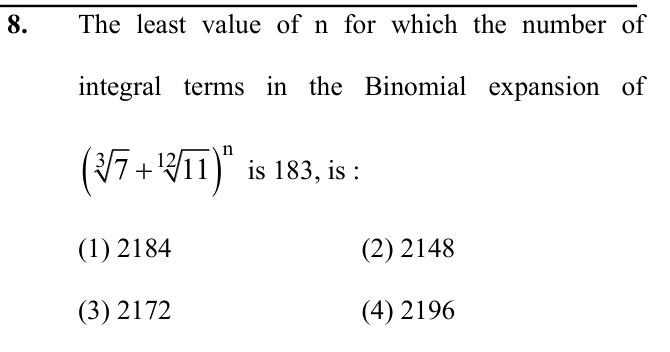
Candidate Response:
(1) (2) (3) (4)
QUESTION 2
MATHEMATICS · Binomial Theorem
SECTION A · MCQ (+4, -1)
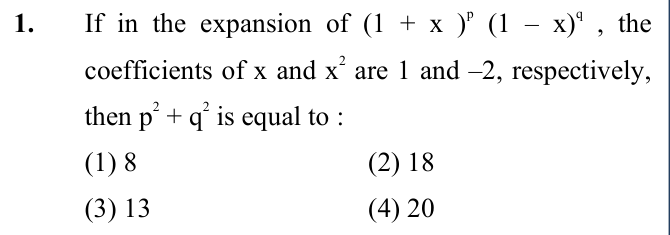
Candidate Response:
(1) (2) (3) (4)
QUESTION 3
MATHEMATICS · Binomial Theorem
SECTION A · MCQ (+4, -1)
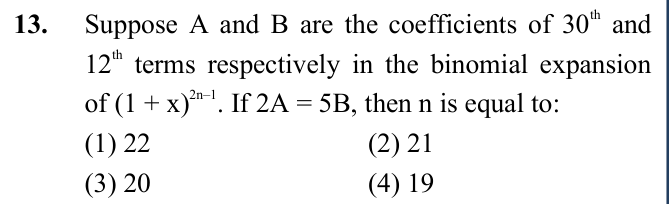
Candidate Response:
(1) (2) (3) (4)
QUESTION 4
MATHEMATICS · Binomial Theorem
SECTION A · MCQ (+4, -1)
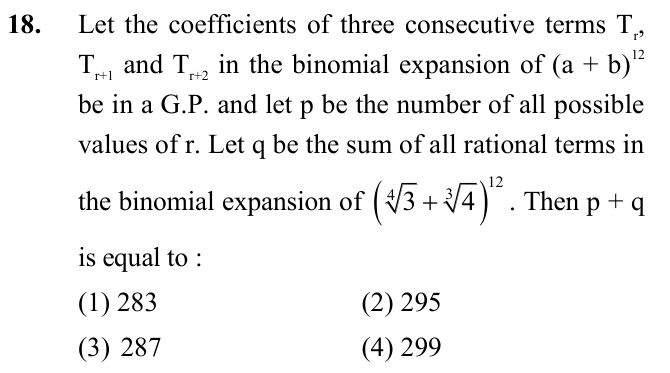
Candidate Response:
(1) (2) (3) (4)
QUESTION 5
MATHEMATICS · Binomial Theorem
SECTION A · MCQ (+4, -1)
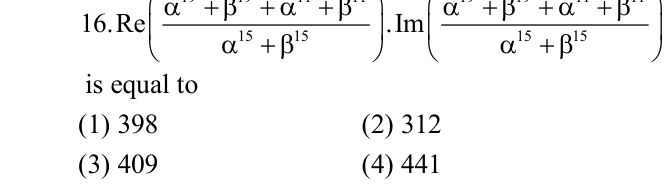
Candidate Response:
(1) (2) (3) (4)
QUESTION 6
MATHEMATICS · Binomial Theorem
SECTION B · NUMERICAL (+4, 0)

Numerical Value:
[ ]
QUESTION 7
MATHEMATICS · Binomial Theorem
SECTION A · MCQ (+4, -1)
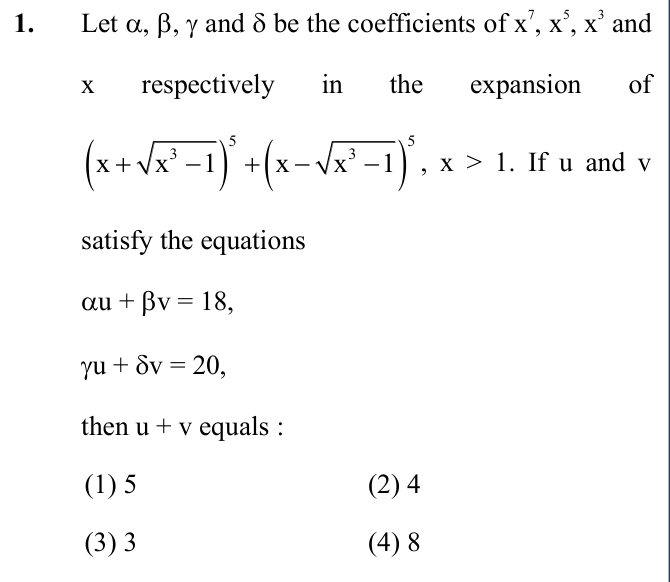
Candidate Response:
(1) (2) (3) (4)
QUESTION 8
MATHEMATICS · Binomial Theorem
SECTION A · MCQ (+4, -1)
If the coefficients of three consecutive terms in the expansion of (1 + x)^n are in the ratio 182 : 84 : 30, find the value of n and the position of these terms.
(1) n = 18, and the terms are the 13th, 14th, and 15th terms.
(2) Requires uniform continuity across the entire open interval $(a, b)$.
(3) Valid only when elements belong strictly to the non-negative real domain $\mathbb{R}^+$.
(4) Contradicted by boundary limit constraints under standard Cartesian mapping.
Candidate Response:
(1) (2) (3) (4)
QUESTION 9
MATHEMATICS · Binomial Theorem
SECTION A · MCQ (+4, -1)
Find the ratio of the 5th term from the beginning to the 5th term from the end in the expansion of (2^(1/3) + 1/(2 · 3^(1/3)))^10.
(1) [-5, 7)
(2) (-∞, 4 · 6^(2/3) (or 4 · 36^(1/3) : 1).)
(3) 4 · 6^(2/3) (or 4 · 36^(1/3) : 1).
(4) Undefined under standard Binomial Theorem axioms.
Candidate Response:
(1) (2) (3) (4)
QUESTION 10
MATHEMATICS · Binomial Theorem
SECTION A · MCQ (+4, -1)
Find the value of the sum: S = C(10, 0) C(15, 5) + C(10, 1) C(15, 4) + C(10, 2) C(15, 3) + ... + C(10, 5) C(15, 0).
(1) Undefined under standard Binomial Theorem axioms.
(2) (-∞, C(25, 5) = 53,130.)
(3) [-5, 7)
(4) C(25, 5) = 53,130.
Candidate Response:
(1) (2) (3) (4)
QUESTION 11
MATHEMATICS · Binomial Theorem
SECTION A · MCQ (+4, -1)
Evaluate the double summation: S = sum_{0 <= i < j <= n} (i · j) C_i C_j, where C_r = ^n C_r.
(1) (-5, 7]
(2) (n^2 / 2) [ 2^(2n+2) + C(2n+2, n+1) ].
(3) (n^2 / 2) ( 2^(2n-2) - C(2n-2, n-1) ).
(4) (n^2 / 2) [ 2^(2n-2) - C(2n-2, n-1) ].
Candidate Response:
(1) (2) (3) (4)
QUESTION 12
MATHEMATICS · Binomial Theorem
SECTION A · MCQ (+4, -1)
Prove that: C_1/2 + C_3/4 + C_5/6 + ... = (2^n - 1) / (n + 1), where C_r = ^n C_r.
(1) We need the sum of terms C_r / (r + 1) where r is ODD (r = 1, 3, 5, ...). Recall the two fundamental integration results
(2) Undefined under standard Binomial Theorem axioms.
(3) [-5, 7)
(4) (-∞, We need the sum of terms C_r / (r + 1) where r is ODD (r = 1, 3, 5, ...). Recall the two fundamental integration results)
Candidate Response:
(1) (2) (3) (4)
QUESTION 13
MATHEMATICS · Binomial Theorem
SECTION A · MCQ (+4, -1)
Find the value of the term independent of x in the expansion of ((x + 1)/(x^(2/3) - x^(1/3) + 1) - (x - 1)/(x - x^(1/2)))^10.
(1) 210.
(2) Requires uniform continuity across the entire open interval $(a, b)$.
(3) Valid only when elements belong strictly to the non-negative real domain $\mathbb{R}^+$.
(4) Contradicted by boundary limit constraints under standard Cartesian mapping.
Candidate Response:
(1) (2) (3) (4)
QUESTION 14
MATHEMATICS · Binomial Theorem
SECTION A · MCQ (+4, -1)
Find the sum of the infinite series: S = 1 + 1/4 + (1 · 3)/(4 · 8) + (1 · 3 · 5)/(4 · 8 · 12) + ...
(1) [-5, 7)
(2) sqrt(2).
(3) Undefined under standard Binomial Theorem axioms.
(4) (-∞, sqrt(2).)
Candidate Response:
(1) (2) (3) (4)
QUESTION 15
MATHEMATICS · Binomial Theorem
SECTION A · MCQ (+4, -1)
In Binomial Theorem, what is the governing mathematical principle of 'Terms from the End & Sum of All Numerical Coefficients'?
(1) Requires uniform continuity across the entire open interval $(a, b)$.
(2) Contradicted by boundary limit constraints under standard Cartesian mapping.
(3) Valid only when elements belong strictly to the non-negative real domain $\mathbb{R}^+$.
(4) Symmetry allows inverting the binomial; setting variables to 1 sums all pure coefficients.
Candidate Response:
(1) (2) (3) (4)