
⚡ OFFICIAL NTA ASSESSMENT GENERATOR & WORD (.DOCX) EXPORTER
Sequences and Series · Practice Worksheet
JEE Main Mathematics · Curated Assessment Set Print directly or export as a beautifully formatted Microsoft Word document with embedded 180-DPI mathematical prompt clips and step-by-step derivations.
EDUPROD JEE MAIN TEST SERIES · NTA PATTERN
Sequences and Series · Practice Worksheet
JEE Main Mathematics · Curated Assessment Set · Assessment Code: JEE-101
Total Marks: 60
Marking: +4 / -1 (Sec A) · +4 / 0 (Sec B)
QUESTION 1
MATHEMATICS · Sequences and Series
SECTION A · MCQ (+4, -1)
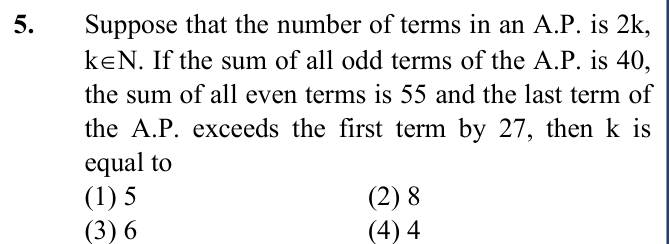
Candidate Response:
(1) (2) (3) (4)
QUESTION 2
MATHEMATICS · Sequences and Series
SECTION B · NUMERICAL (+4, 0)
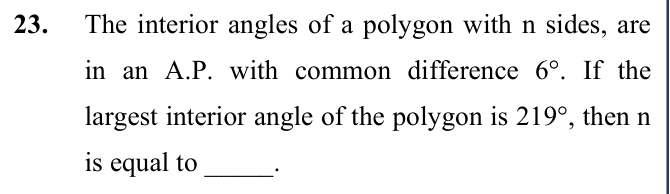
Numerical Value:
[ ]
QUESTION 3
MATHEMATICS · Sequences and Series
SECTION A · MCQ (+4, -1)
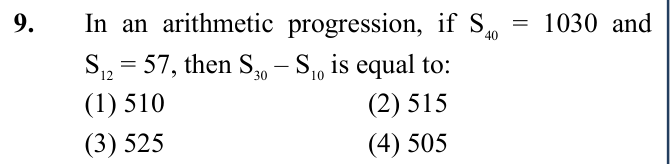
Candidate Response:
(1) (2) (3) (4)
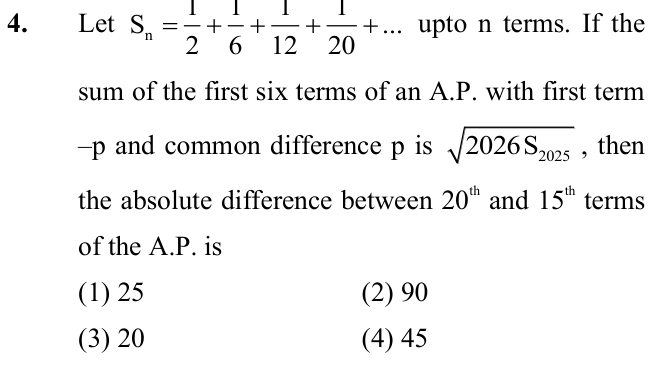
QUESTION 4
MATHEMATICS · Sequences and Series
SECTION A · MCQ (+4, -1)
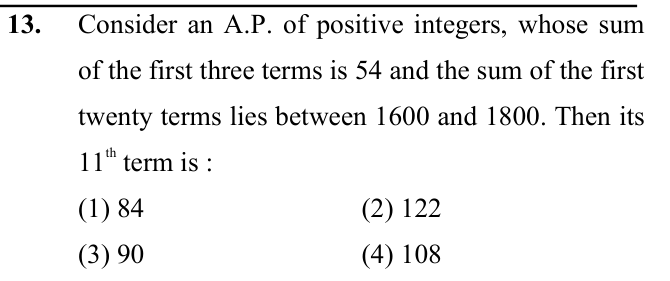
Candidate Response:
(1) (2) (3) (4)
QUESTION 5
MATHEMATICS · Sequences and Series
SECTION A · MCQ (+4, -1)
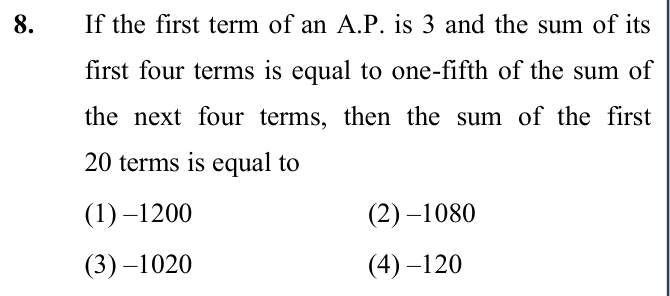
Candidate Response:
(1) (2) (3) (4)
QUESTION 6
MATHEMATICS · Sequences and Series
SECTION A · MCQ (+4, -1)
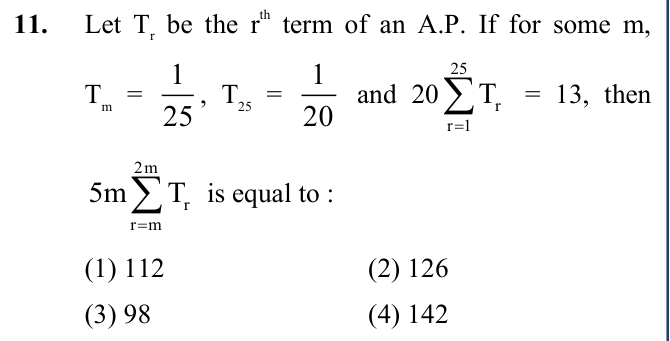
Candidate Response:
(1) (2) (3) (4)
QUESTION 7
MATHEMATICS · Sequences and Series
SECTION B · NUMERICAL (+4, 0)
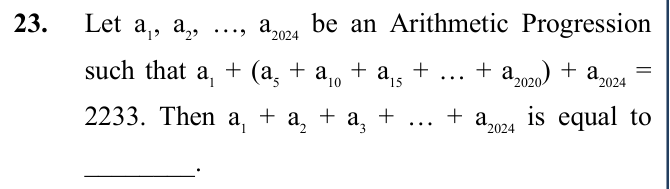
Numerical Value:
[ ]
QUESTION 8
MATHEMATICS · Sequences and Series
SECTION B · NUMERICAL (+4, 0)
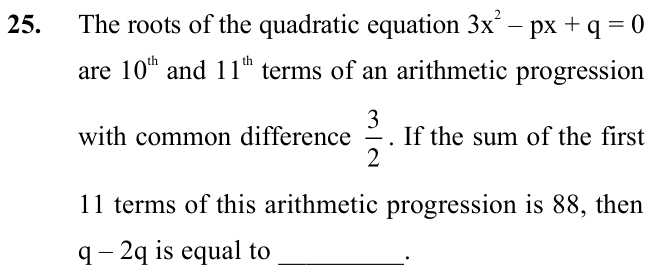
Numerical Value:
[ ]
QUESTION 9
MATHEMATICS · Sequences and Series
SECTION A · MCQ (+4, -1)
Candidate Response:
(1) (2) (3) (4)
QUESTION 10
MATHEMATICS · Sequences and Series
SECTION A · MCQ (+4, -1)
Evaluate the sum: S = sum_{n=1}^infty tan^(-1)( 2 / (n^2 + n + 2) ).
(1) Valid only when elements belong strictly to the non-negative real domain $\mathbb{R}^+$.
(2) Contradicted by boundary limit constraints under standard Cartesian mapping.
(3) pi/4.
(4) Requires uniform continuity across the entire open interval $(a, b)$.
Candidate Response:
(1) (2) (3) (4)
QUESTION 11
MATHEMATICS · Sequences and Series
SECTION A · MCQ (+4, -1)
If the sum of the first 2n terms of the A.P. 2, 5, 8, ... is equal to the sum of the first n terms of the A.P. 57, 59, 61, ..., find the value of n.
(1) Contradicted by boundary limit constraints under standard Cartesian mapping.
(2) n = 11.
(3) Valid only when elements belong strictly to the non-negative real domain $\mathbb{R}^+$.
(4) Requires uniform continuity across the entire open interval $(a, b)$.
Candidate Response:
(1) (2) (3) (4)
QUESTION 12
MATHEMATICS · Sequences and Series
SECTION A · MCQ (+4, -1)
Find the minimum value of f(x, y, z) = x^2/y + y^2/z + z^2/x for strictly positive real numbers x, y, z such that x + y + z = 1.
(1) 1.
(2) Contradicted by boundary limit constraints under standard Cartesian mapping.
(3) Valid only when elements belong strictly to the non-negative real domain $\mathbb{R}^+$.
(4) Requires uniform continuity across the entire open interval $(a, b)$.
Candidate Response:
(1) (2) (3) (4)
QUESTION 13
MATHEMATICS · Sequences and Series
SECTION A · MCQ (+4, -1)
In Sequences and Series, what is the governing mathematical principle of 'Insertion of n Arithmetic Means & Total Sum Theorem'?
(1) The sum of n inserted A.M.s is n times the single arithmetic mean between the endpoints.
(2) Valid only when elements belong strictly to the non-negative real domain $\mathbb{R}^+$.
(3) Contradicted by boundary limit constraints under standard Cartesian mapping.
(4) Requires uniform continuity across the entire open interval $(a, b)$.
Candidate Response:
(1) (2) (3) (4)
QUESTION 14
MATHEMATICS · Sequences and Series
SECTION A · MCQ (+4, -1)
If the Arithmetic Mean of two positive numbers a and b is 10, and their Geometric Mean is 8, find their Harmonic Mean and determine the numbers.
(1) Valid only when elements belong strictly to the non-negative real domain $\mathbb{R}^+$.
(2) Requires uniform continuity across the entire open interval $(a, b)$.
(3) Contradicted by boundary limit constraints under standard Cartesian mapping.
(4) H = 6.4; Numbers are 16 and 4.
Candidate Response:
(1) (2) (3) (4)
QUESTION 15
MATHEMATICS · Sequences and Series
SECTION A · MCQ (+4, -1)
Find the sum of the series: S_n = sum_{k=1}^n (k^4 + 3k^2 + 1) / (k^4 + k^2 + 1).
(1) n + (n^2 + n) / (2(n^2 + n + 1)) (or for the pure fraction component: (n^2 + n)/(n^2 + n + 1)).
(2) (-∞, n + (n^2 + n) / [2(n^2 + n + 1)] (or for the pure fraction component: (n^2 + n)/(n^2 + n + 1)).)
(3) n + (n^2 + n) / [2(n^2 + n + 1)] (or for the pure fraction component: (n^2 + n)/(n^2 + n + 1)).
(4) (-5, 7]
Candidate Response:
(1) (2) (3) (4)