
⚡ OFFICIAL NTA ASSESSMENT GENERATOR & WORD (.DOCX) EXPORTER
Relations and Functions · Practice Worksheet
JEE Main Mathematics · Curated Assessment Set Print directly or export as a beautifully formatted Microsoft Word document with embedded 180-DPI mathematical prompt clips and step-by-step derivations.
EDUPROD JEE MAIN TEST SERIES · NTA PATTERN
Relations and Functions · Practice Worksheet
JEE Main Mathematics · Curated Assessment Set · Assessment Code: JEE-101
Total Marks: 60
Marking: +4 / -1 (Sec A) · +4 / 0 (Sec B)
QUESTION 1
MATHEMATICS · Relations and Functions
SECTION B · NUMERICAL (+4, 0)
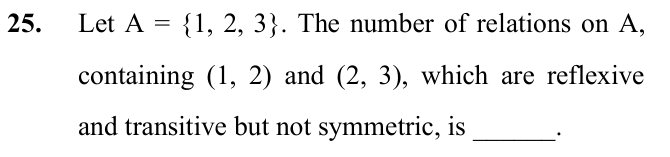
Numerical Value:
[ ]
QUESTION 2
MATHEMATICS · Trigonometric Functions
SECTION A · MCQ (+4, -1)
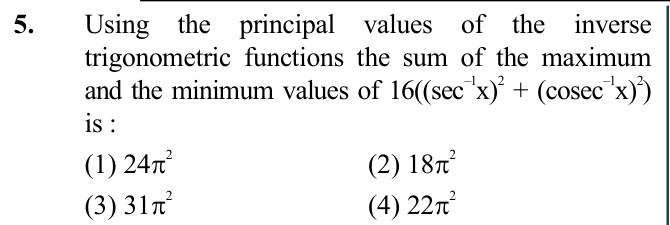
Candidate Response:
(1) (2) (3) (4)
QUESTION 3
MATHEMATICS · Sets
SECTION A · MCQ (+4, -1)
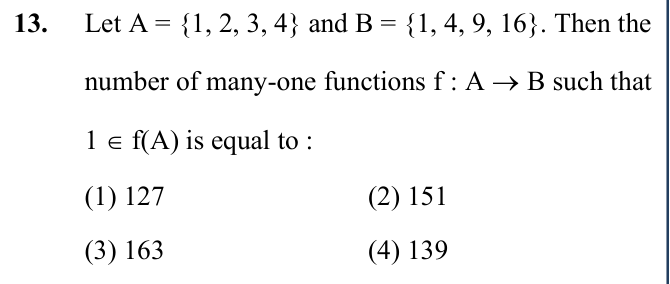
Candidate Response:
(1) (2) (3) (4)
QUESTION 4
MATHEMATICS · Permutations and Combinations
SECTION B · NUMERICAL (+4, 0)
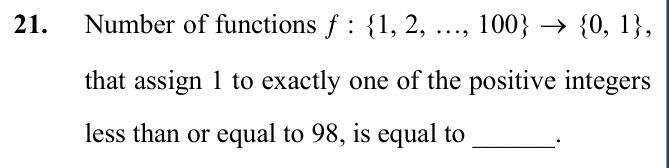
Numerical Value:
[ ]
QUESTION 5
MATHEMATICS · Relations and Functions
SECTION A · MCQ (+4, -1)
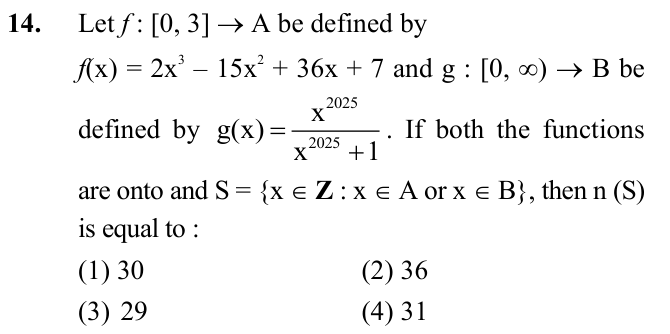
Candidate Response:
(1) (2) (3) (4)
QUESTION 6
MATHEMATICS · Relations and Functions
SECTION A · MCQ (+4, -1)
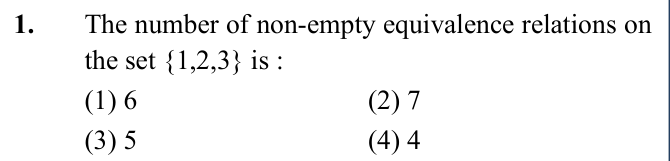
Candidate Response:
(1) (2) (3) (4)
QUESTION 7
MATHEMATICS · Relations and Functions
SECTION A · MCQ (+4, -1)
Find the inverse of f(x) = 2x + 3.
(1) 2x - 3
(2) 3x + 2
(3) (x - 3)/2
(4) (x + 3)/2
Candidate Response:
(1) (2) (3) (4)
QUESTION 8
MATHEMATICS · Relations and Functions
SECTION A · MCQ (+4, -1)
If [a] and [b] are equivalence classes and [a] cap [b] is non-empty, what can you conclude?
(1) (-∞, [a] = [b] (the two classes are completely identical).)
(2) (-5, 7]
(3) [a] = [b] (the two classes are completely identical).
(4) (a) = (b) (the two classes are completely identical).
Candidate Response:
(1) (2) (3) (4)
QUESTION 9
MATHEMATICS · Relations and Functions
SECTION A · MCQ (+4, -1)
Is (f o g o h)(x) equal to ((f o g) o h)(x)?
(1) Requires uniform continuity across the entire open interval $(a, b)$.
(2) Yes, because function composition is strictly associative.
(3) Contradicted by boundary limit constraints under standard Cartesian mapping.
(4) Valid only when elements belong strictly to the non-negative real domain $\mathbb{R}^+$.
Candidate Response:
(1) (2) (3) (4)
QUESTION 10
MATHEMATICS · Relations and Functions
SECTION A · MCQ (+4, -1)
If the composite function g o f is injective, which of the following must be true?
(1) D) Neither f nor g is injective
(2) B) g is injective
(3) C) Both f and g are injective
(4) A) f is injective
Candidate Response:
(1) (2) (3) (4)
QUESTION 11
MATHEMATICS · Relations and Functions
SECTION A · MCQ (+4, -1)
Which of the following functions is surjective (onto) from R to R?
(1) f(x) = 1/x
(2) f(x) = e^x
(3) f(x) = x²
(4) f(x) = x³
Candidate Response:
(1) (2) (3) (4)
QUESTION 12
MATHEMATICS · Relations and Functions
SECTION A · MCQ (+4, -1)
Let R be the equivalence relation on Z defined by a R b if and only if 2 divides (a - b). What is the equivalence class [0] under this relation?
(1) {...,-5,-3,-1,1,3,5,...}
(2) {...,-6,-4,-2,0,2,4,6,...}
(3) {...,-4,-2,0,2,4,...}
(4) ∅
Candidate Response:
(1) (2) (3) (4)
QUESTION 13
MATHEMATICS · Relations and Functions
SECTION A · MCQ (+4, -1)
Let f(x) = x + 1 and g(x) = 2x. Which of the following is true about the compositions (g o f)(x) and (f o g)(x)?
(1) (g o f)(x) = 2x + 2 and (f o g)(x) = 2x + 1
(2) (g o f)(x) = 2x + 2 and (f o g)(x) = x + 2
(3) (g o f)(x) = x + 2 and (f o g)(x) = 2x + 1
(4) (g o f)(x) = 2x + 1 and (f o g)(x) = 2x + 2
Candidate Response:
(1) (2) (3) (4)
QUESTION 14
MATHEMATICS · Relations and Functions
SECTION A · MCQ (+4, -1)
Which of the following is a binary operation on the set of positive rational numbers Q+?
(1) Subtraction (−)
(2) Division (÷)
(3) Modulo (%)
(4) Exponentiation (^)
Candidate Response:
(1) (2) (3) (4)
QUESTION 15
MATHEMATICS · Relations and Functions
SECTION A · MCQ (+4, -1)
Which of the following is a necessary and sufficient condition for a function f: X → Y to be invertible?
(1) It must be neither one-one nor onto
(2) It must be both one-one and onto
(3) It must be onto
(4) It must be one-one
Candidate Response:
(1) (2) (3) (4)