
⚡ OFFICIAL NTA ASSESSMENT GENERATOR & WORD (.DOCX) EXPORTER
System of Particles and Rotational Motion · Practice Worksheet
JEE Main Physics · Curated Assessment Set Print directly or export as a beautifully formatted Microsoft Word document with embedded 180-DPI mathematical prompt clips and step-by-step derivations.
EDUPROD JEE MAIN TEST SERIES · NTA PATTERN
System of Particles and Rotational Motion · Practice Worksheet
JEE Main Physics · Curated Assessment Set · Assessment Code: JEE-101
Total Marks: 60
Marking: +4 / -1 (Sec A) · +4 / 0 (Sec B)
QUESTION 1
PHYSICS · System of Particles & Rotational Motion
SECTION A · MCQ (+4, -1)
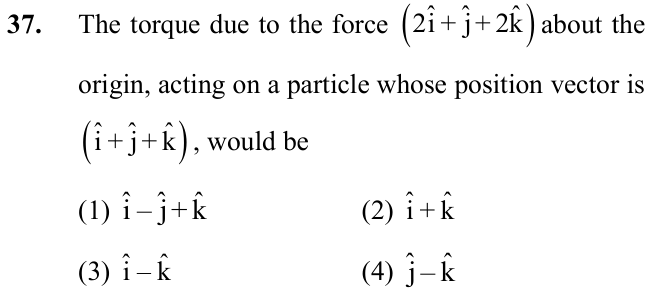
Candidate Response:
(1) (2) (3) (4)
QUESTION 2
PHYSICS · System of Particles & Rotational Motion
SECTION A · MCQ (+4, -1)
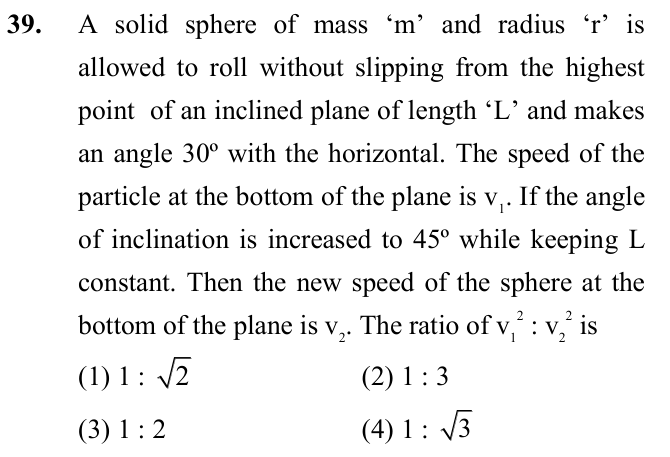
Candidate Response:
(1) (2) (3) (4)
QUESTION 3
PHYSICS · System of Particles & Rotational Motion
SECTION A · MCQ (+4, -1)
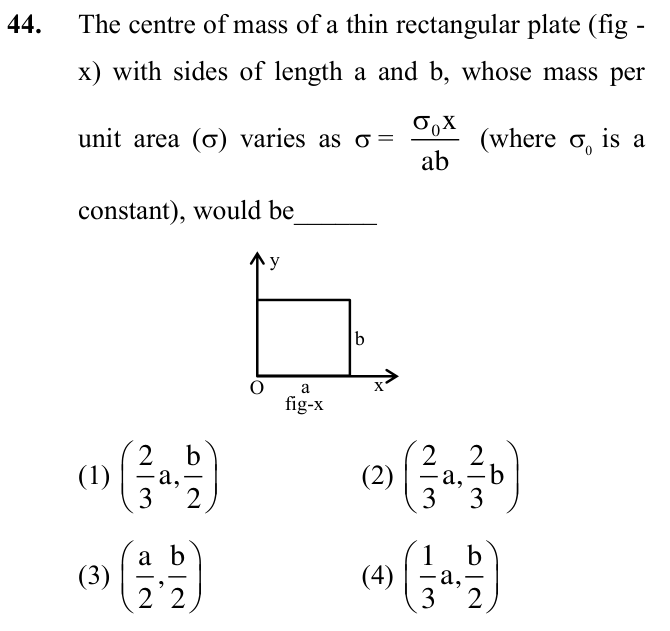
Candidate Response:
(1) (2) (3) (4)
QUESTION 4
PHYSICS · System of Particles & Rotational Motion
SECTION A · MCQ (+4, -1)
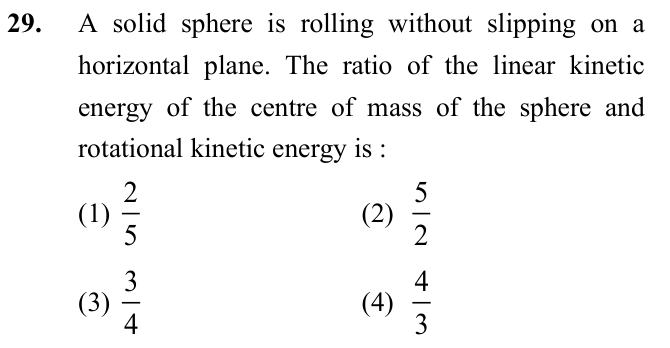
Candidate Response:
(1) (2) (3) (4)
QUESTION 5
PHYSICS · System of Particles & Rotational Motion
SECTION B · NUMERICAL (+4, 0)
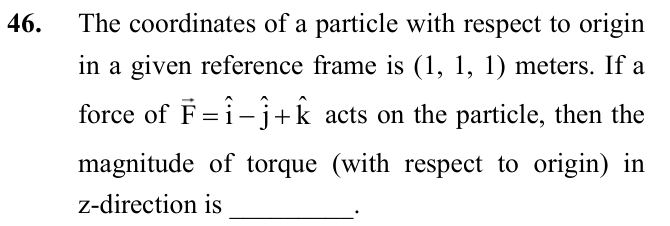
Numerical Value:
[ ]
QUESTION 6
PHYSICS · System of Particles & Rotational Motion
SECTION B · NUMERICAL (+4, 0)
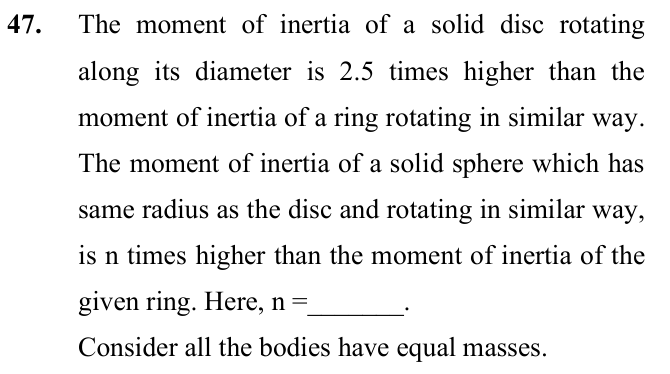
Numerical Value:
[ ]
QUESTION 7
PHYSICS · System of Particles & Rotational Motion
SECTION A · MCQ (+4, -1)
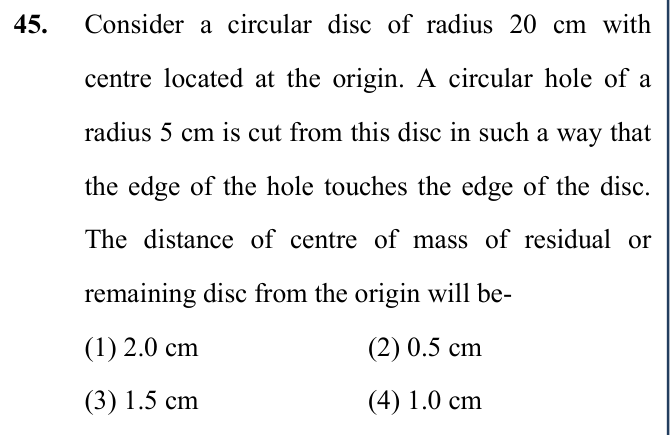
Candidate Response:
(1) (2) (3) (4)
QUESTION 8
PHYSICS · System of Particles & Rotational Motion
SECTION A · MCQ (+4, -1)
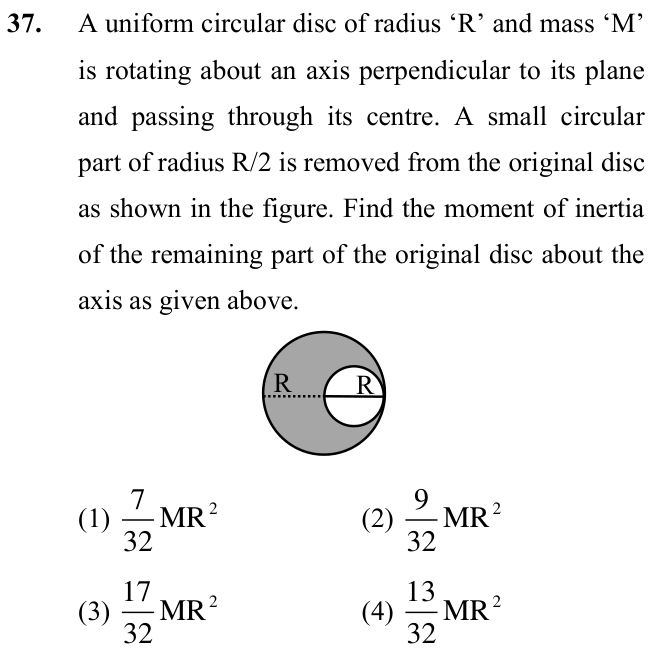
Candidate Response:
(1) (2) (3) (4)
QUESTION 9
PHYSICS · System of Particles and Rotational Motion
SECTION A · MCQ (+4, -1)
A wheel of radius 0.5 m rolls without slipping with angular speed 4 rad/s. What is the speed of the topmost point of the wheel?
(1) 4 m/s
(2) 2 m/s
(3) 1 m/s
(4) 8 m/s
Candidate Response:
(1) (2) (3) (4)
QUESTION 10
PHYSICS · System of Particles and Rotational Motion
SECTION A · MCQ (+4, -1)
A spinning ice skater pulls her arms inward. Which statement correctly describes what happens?
(1) Her moment of inertia decreases, so her angular speed increases to conserve angular momentum.
(2) Her angular momentum increases because of the inward force.
(3) Her angular speed stays the same because no external force acts.
(4) Her moment of inertia increases and she slows down.
Candidate Response:
(1) (2) (3) (4)
QUESTION 11
PHYSICS · System of Particles and Rotational Motion
SECTION A · MCQ (+4, -1)
The parallel axis theorem I = I_cm + M d² is used to find the moment of inertia about a new axis. Which condition is mandatory?
(1) The body must be a two-dimensional planar lamina.
(2) One of the two axes (the reference axis) must pass through the centre of mass.
(3) The new axis may be arbitrary; d is any convenient distance.
(4) The theorem is valid only for a body of uniform density.
Candidate Response:
(1) (2) (3) (4)
QUESTION 12
PHYSICS · System of Particles and Rotational Motion
SECTION A · MCQ (+4, -1)
The moment of inertia of a body about an axis is expressed as I = Σ m_i r_i², where r_i is the distance of each particle from the
(1) surface of the body
(2) centre of mass
(3) origin
(4) axis of rotation
Candidate Response:
(1) (2) (3) (4)
QUESTION 13
PHYSICS · System of Particles and Rotational Motion
SECTION A · MCQ (+4, -1)
A particle moves in a circle of radius 2 m with angular velocity 3 rad/s; its linear speed is
(1) 0.67 m/s
(2) 6 m/s
(3) 1.5 m/s
(4) 5 m/s
Candidate Response:
(1) (2) (3) (4)
QUESTION 14
PHYSICS · System of Particles and Rotational Motion
SECTION A · MCQ (+4, -1)
A rigid body moves such that every line drawn on it remains parallel to its original orientation at all times. What can be concluded about the motion?
(1) The body is in pure translation, and every particle has the same instantaneous velocity and acceleration (v_i = v_cm, a_i = a_cm).
(2) The body is necessarily at rest because no line segment changes orientation.
(3) The body is in pure rotation about a fixed axis, with all particles orbiting that axis.
(4) The body is in combined rolling motion with the point of contact at rest.
Candidate Response:
(1) (2) (3) (4)
QUESTION 15
PHYSICS · System of Particles and Rotational Motion
SECTION A · MCQ (+4, -1)
A rigid body is in mechanical equilibrium when both the net external force and the net external torque acting on it are
(1) equal to its weight
(2) maximum
(3) constant but non-zero
(4) zero
Candidate Response:
(1) (2) (3) (4)