
⚡ OFFICIAL NTA ASSESSMENT GENERATOR & WORD (.DOCX) EXPORTER
Mechanical Properties of Fluids · Practice Worksheet
JEE Main Physics · Curated Assessment Set Print directly or export as a beautifully formatted Microsoft Word document with embedded 180-DPI mathematical prompt clips and step-by-step derivations.
EDUPROD JEE MAIN TEST SERIES · NTA PATTERN
Mechanical Properties of Fluids · Practice Worksheet
JEE Main Physics · Curated Assessment Set · Assessment Code: JEE-101
Total Marks: 60
Marking: +4 / -1 (Sec A) · +4 / 0 (Sec B)
QUESTION 1
PHYSICS · Mechanical Properties of Fluids
SECTION A · MCQ (+4, -1)
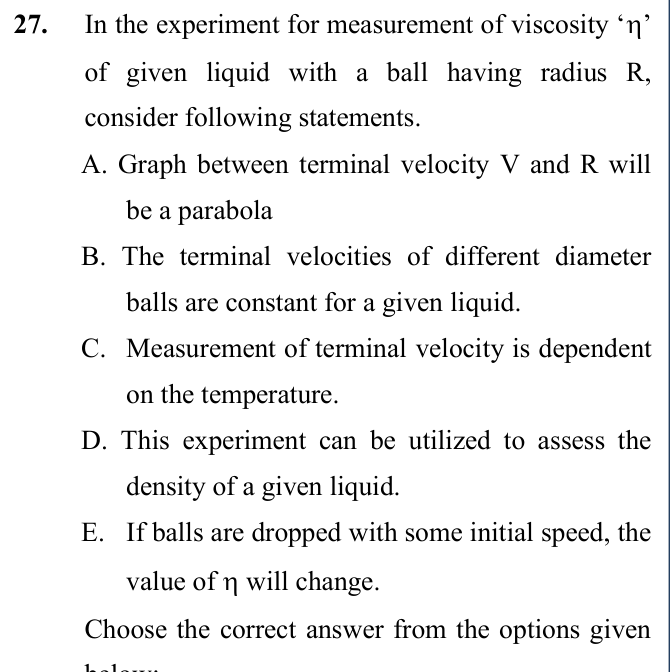
Candidate Response:
(1) (2) (3) (4)
QUESTION 2
PHYSICS · Mechanical Properties of Fluids
SECTION A · MCQ (+4, -1)
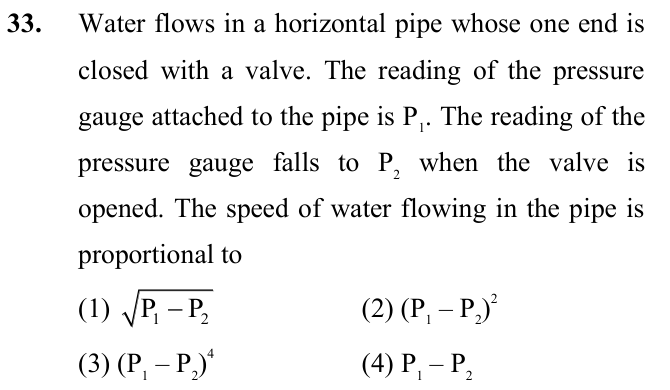
Candidate Response:
(1) (2) (3) (4)
QUESTION 3
PHYSICS · Mechanical Properties of Fluids
SECTION A · MCQ (+4, -1)
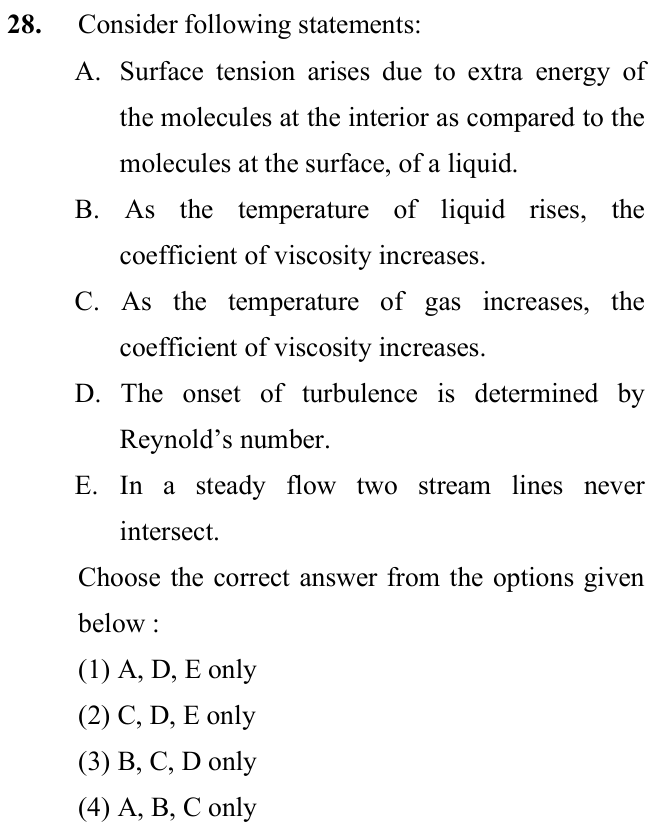
Candidate Response:
(1) (2) (3) (4)
QUESTION 4
PHYSICS · Mechanical Properties of Fluids
SECTION A · MCQ (+4, -1)
The SI unit of surface tension is
(1) J m⁻²
(2) N m⁻²
(3) N m
(4) N m⁻¹
Candidate Response:
(1) (2) (3) (4)
QUESTION 5
PHYSICS · Mechanical Properties of Fluids
SECTION A · MCQ (+4, -1)
According to Bernoulli's principle, when an incompressible fluid flows through a horizontal constriction where its speed increases, the pressure at the constriction:
(1) decreases
(2) becomes equal to atmospheric pressure
(3) increases
(4) remains unchanged
Candidate Response:
(1) (2) (3) (4)
QUESTION 6
PHYSICS · Mechanical Properties of Fluids
SECTION A · MCQ (+4, -1)
The flow of a fluid in which each particle follows the same smooth path as its predecessor is called
(1) Oscillatory flow
(2) Turbulent flow
(3) Streamline flow
(4) Uniform flow
Candidate Response:
(1) (2) (3) (4)
QUESTION 7
PHYSICS · Mechanical Properties of Fluids
SECTION A · MCQ (+4, -1)
The force acting per unit length on an imaginary line drawn on the free surface of a liquid, tangential to the surface, is called
(1) Surface tension
(2) Viscosity
(3) Buoyant force
(4) Pressure
Candidate Response:
(1) (2) (3) (4)
QUESTION 8
PHYSICS · Mechanical Properties of Fluids
SECTION A · MCQ (+4, -1)
For the steady streamline flow of an incompressible fluid, the equation of continuity is:
(1) A₁/v₁ = A₂/v₂
(2) A₁v₁² = A₂v₂²
(3) A₁v₁ = A₂v₂
(4) A₁ + v₁ = A₂ + v₂
Candidate Response:
(1) (2) (3) (4)
QUESTION 9
PHYSICS · Mechanical Properties of Fluids
SECTION A · MCQ (+4, -1)
The SI unit of the coefficient of viscosity is
(1) Pa s
(2) Pa s⁻¹
(3) N s m
(4) kg m s⁻¹
Candidate Response:
(1) (2) (3) (4)
QUESTION 10
PHYSICS · Mechanical Properties of Fluids
SECTION A · MCQ (+4, -1)
Three vessels of different shapes have the same base area and are filled with the same liquid to the same height. The pressure at the base is the same in all three. This is known as the:
(1) hydrostatic paradox
(2) Bernoulli's principle
(3) Pascal's paradox
(4) Archimedes' principle
Candidate Response:
(1) (2) (3) (4)
QUESTION 11
PHYSICS · Mechanical Properties of Fluids
SECTION A · MCQ (+4, -1)
A liquid of density ρ is at rest in an open container. If P₀ is atmospheric pressure, the pressure at a depth h below the free surface is given by:
(1) P₀ − ρgh
(2) P₀ (independent of depth)
(3) ρgh − P₀
(4) P₀ + ρgh
Candidate Response:
(1) (2) (3) (4)
QUESTION 12
PHYSICS · Mechanical Properties of Fluids
SECTION A · MCQ (+4, -1)
Liquids and gases together are collectively known as
(1) Plasmas
(2) Fluids
(3) Crystals
(4) Solids
Candidate Response:
(1) (2) (3) (4)
QUESTION 13
PHYSICS · Mechanical Properties of Fluids
SECTION A · MCQ (+4, -1)
Pascal's law states that the pressure applied to an enclosed fluid is transmitted:
(1) equally and undiminished in all directions
(2) only along the direction of applied force
(3) proportional to the volume of the fluid
(4) only vertically upward
Candidate Response:
(1) (2) (3) (4)
QUESTION 14
PHYSICS · Mechanical Properties of Fluids
SECTION A · MCQ (+4, -1)
According to Jurin's law, the height h to which a liquid rises in a capillary tube is inversely proportional to:
(1) the square of the radius
(2) the atmospheric pressure
(3) the surface tension S
(4) the radius r of the tube
Candidate Response:
(1) (2) (3) (4)
QUESTION 15
PHYSICS · Mechanical Properties of Fluids
SECTION A · MCQ (+4, -1)
For a pipe of cross-sectional area A through which a fluid moves with speed v, the volume of fluid flowing per second (volume flow rate) equals
(1) A × v
(2) A/v
(3) ρ × v
(4) A × v²
Candidate Response:
(1) (2) (3) (4)