
✎ ANSWER ONLINE · EVERY MISTAKE LINKS BACK TO THE CONCEPT
Thermodynamics · Practice Worksheet
Answer each question here and it marks straight away, with the derivation and a link to the exact micro-concept to revisit.
// CONCEPT AUDIT RESULT
Everything you missed has been added to your Error Arena — retest them blind there, and a concept clears once you get it right.
QUESTION 1
Thermodynamics
SECTION A · MCQ (+4, -1)
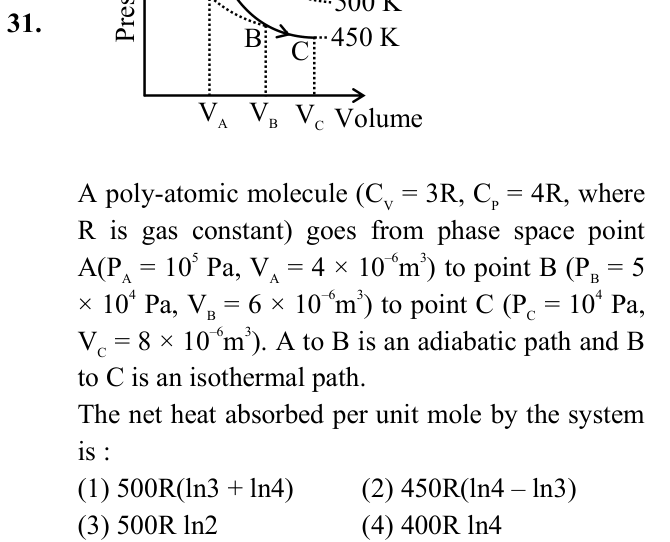
(1) 500R(ln3 + ln4)
(2) 450R(ln4 – ln3)
(3) 500R ln2
(4) 400R ln4
ΔQAB = 0 adiabatic
ΔQBC = ΔWBC
C
B
V
nRT n V
) = (
[
)
6
6
8 10
450R n 6 10 - -
) × =
( × [
)
4
450R n 3
) = (
[
)
= 450R (λn4 – λn3)
∴ΔQ = ΔQAB + ΔQBC
ΔQ = 450 R (λn4 – λn3)
Note : Solution is based on direct data. B and C
are not satisfying the condition of isothermal
process.
QUESTION 2
Thermodynamics
SECTION A · MCQ (+4, -1)
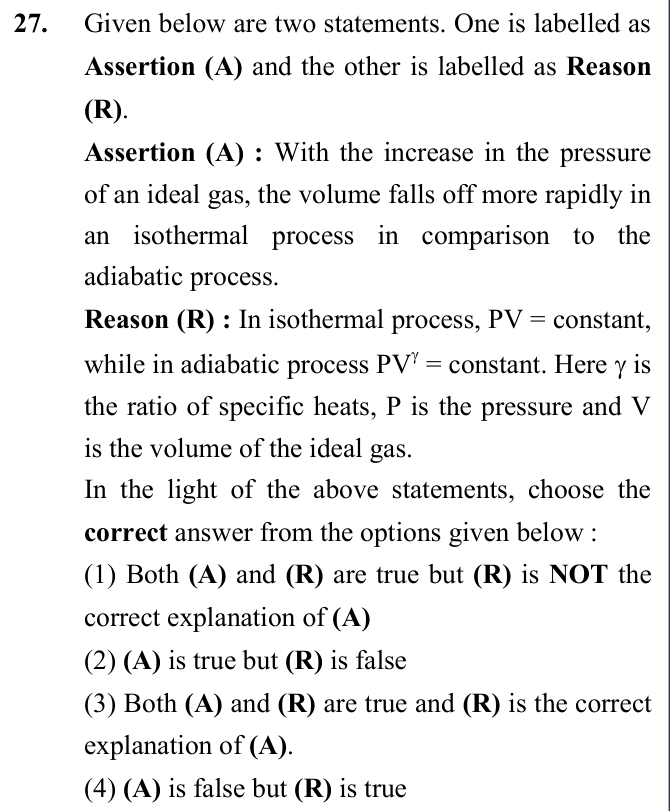
(1) Both statements are true and correct explanation
(2) Both statements are true but NOT the correct explanation
(3) Statement I is true but Statement II is false
(4) Statement I is false but Statement II is true
P
Adiabatic
V
compression
Pressure increases
Isothermal
Adiabatic
Isothermal
dP
dP
dV
dV
)
)
>
(
(
[
)
[
)
QUESTION 3
Thermodynamics
SECTION A · MCQ (+4, -1)
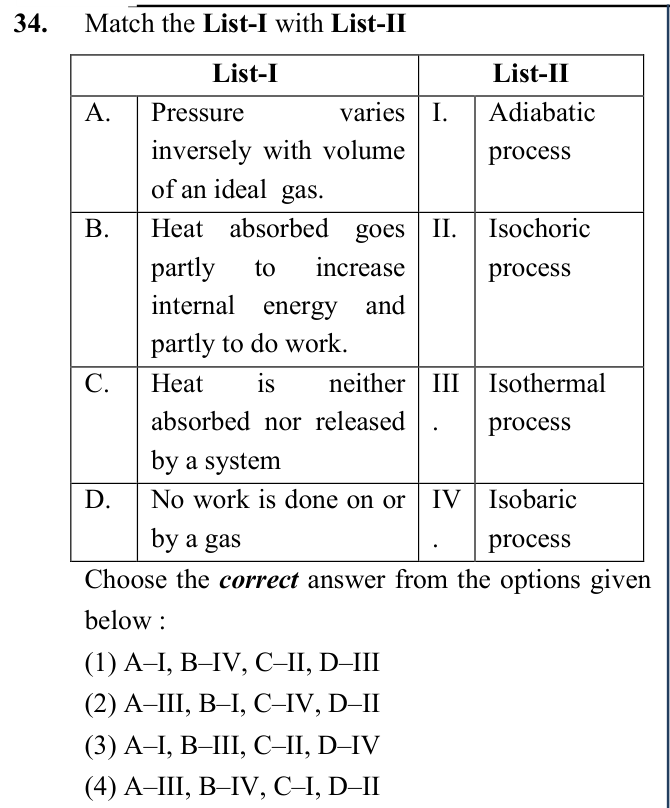
(1) A–I, B–IV, C–II, D–III
(2) A–III, B–I, C–IV, D–II
(3) A–I, B–III, C–II, D–IV
(4) A–III, B–IV, C–I, D–II
A →
1
P
V
∝
⇒PV = constant
⇒nRT = const. ⇒ T = const.
Hence Isothermal III
B → IV
W ≠ 0, ΔU ≠ 0, ΔQ ≠ 0 [only isobaric]
C → I ΔQ = 0 Adiabatic
D → II w = 0 Isochoric
III IV I II
QUESTION 4
Thermodynamics
SECTION A · MCQ (+4, -1)
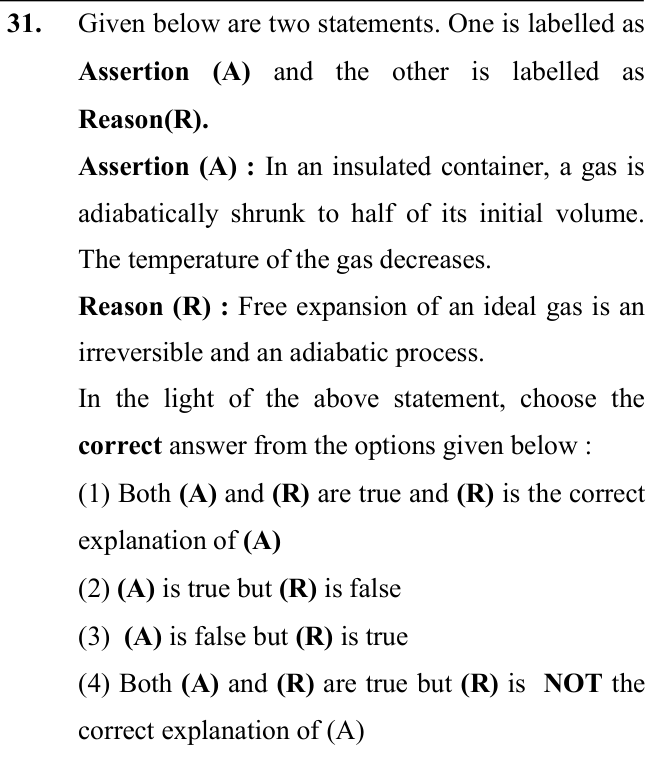
(1) Both (A) and (R) are true and (R) is the correct
explanation of (A)
(2) (A) is true but (R) is false
(3) (A) is false but (R) is true
(4) Both (A) and (R) are true but (R) is NOT the
correct explanation of (A)
(A)
γ-
γ- = 1
1
1
1
2
2
T V
T V
Temp increases
R) Free expansion is assumed fast, so Adiabatic
QUESTION 5
Thermodynamics
SECTION B · NUMERICAL (+4, 0)
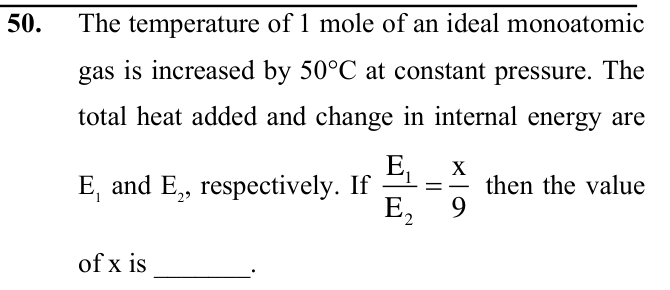
Given that process is isobaric ΔT = 50°C
Q in isobaric process = nCPΔT = E1
ΔU in isobaric process = nCVΔT = E2
1
P
2
V
E
C
E
C
∴ = =γ
Given, gas is monoatomic
∴ γ = 1 + 2
f = 2
1
3 + = 5
3
Now, as per question.
5
x
3
9 = x = 15
1
JEE–MAIN EXAMINATION – JANUARY 2025
QUESTION 6
Thermodynamics
SECTION A · MCQ (+4, -1)
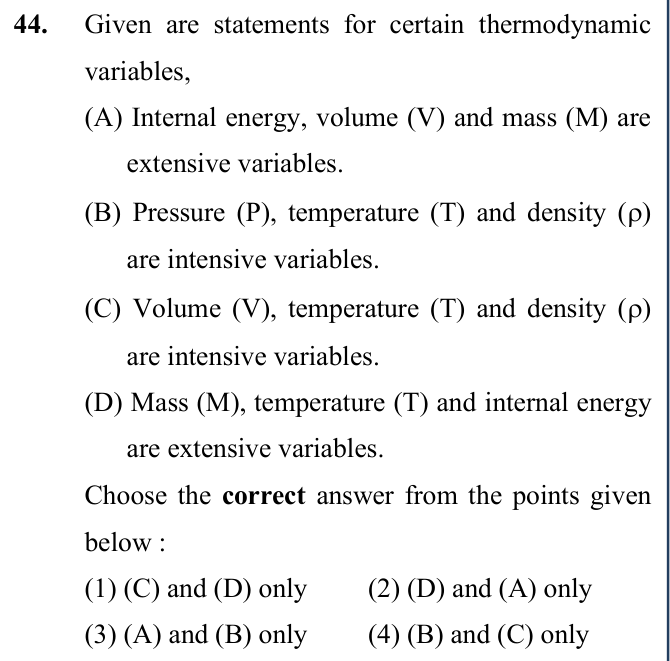
(1) (C) and (D) only
(2) (D) and (A) only
(3) (A) and (B) only
(4) (B) and (C) only
Extensive variables depends on size or mass of
system ex : internal energy, volume, mass
QUESTION 7
Thermodynamics
SECTION A · MCQ (+4, -1)
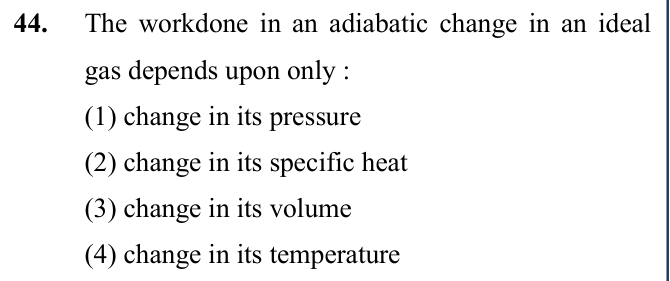
(1) change in its pressure
(2) change in its specific heat
(3) change in its volume
(4) change in its temperature
ΔW = –ΔU = – nCVΔT
QUESTION 8
Thermodynamics
SECTION A · MCQ (+4, -1)
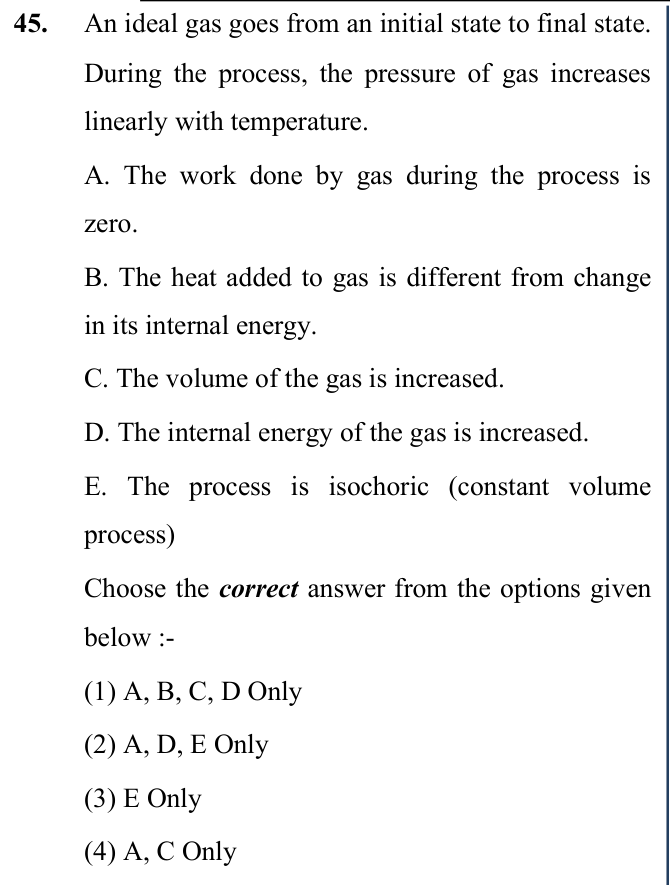
(1) A, B, C, D Only
(2) A, D, E Only
(3) E Only
(4) A, C Only
Given that
P = kT
P
T = constant
∴ Volume is constant or isochoric process.
∴ WD = 0
∴ Q = ΔU
Also temperature increases hence internal energy
increases.
SECTION-B
QUESTION 9
Thermodynamics
SECTION A · MCQ (+4, -1)
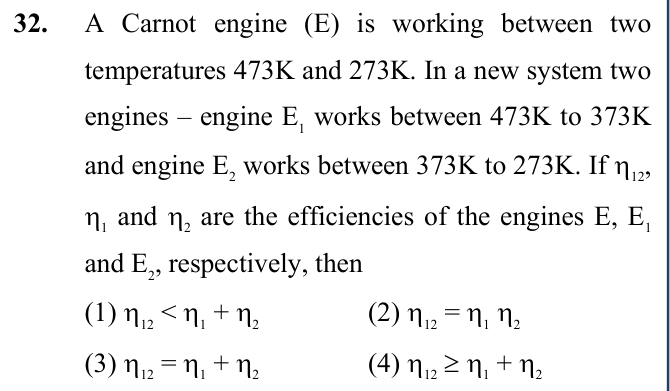
(1) η12 < η1 + η2
(2) η12 = η1 η2
(3) η12 = η1 + η2
(4) η12 ≥ η1 + η2
η12 =
273
200
1
0.423
473
473 - = = 1
373
100
1
0.211
473
473
η=- = =
2
273
100
1
0.268
373
373
η=- = =
QUESTION 10
Thermodynamics
SECTION A · MCQ (+4, -1)
A temperature of 27 °C is equal to how many kelvin?
(1) 27 K
(2) 327 K
(3) 246 K
(4) 300 K
Kelvin = Celsius + 273, so 27 °C = 300 K.