
✎ ANSWER ONLINE · EVERY MISTAKE LINKS BACK TO THE CONCEPT
Thermodynamics · Practice Worksheet
Answer each question here and it marks straight away, with the derivation and a link to the exact micro-concept to revisit.
1 question from this set could not be marked online — a
bonus or dual-key question, which has no single defensible answer. The print and
.docx versions still include it.
// CONCEPT AUDIT RESULT
Everything you missed has been added to your Error Arena — retest them blind there, and a concept clears once you get it right.
QUESTION 1
Thermodynamics
SECTION A · MCQ (+4, -1)
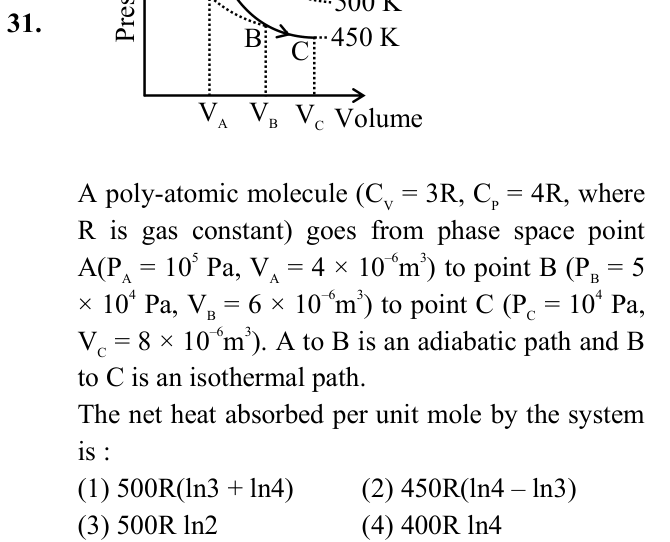
(1) 500R(ln3 + ln4)
(2) 450R(ln4 – ln3)
(3) 500R ln2
(4) 400R ln4
ΔQAB = 0 adiabatic
ΔQBC = ΔWBC
C
B
V
nRT n V
) = (
[
)
6
6
8 10
450R n 6 10 - -
) × =
( × [
)
4
450R n 3
) = (
[
)
= 450R (λn4 – λn3)
∴ΔQ = ΔQAB + ΔQBC
ΔQ = 450 R (λn4 – λn3)
Note : Solution is based on direct data. B and C
are not satisfying the condition of isothermal
process.
QUESTION 2
Thermodynamics
SECTION A · MCQ (+4, -1)
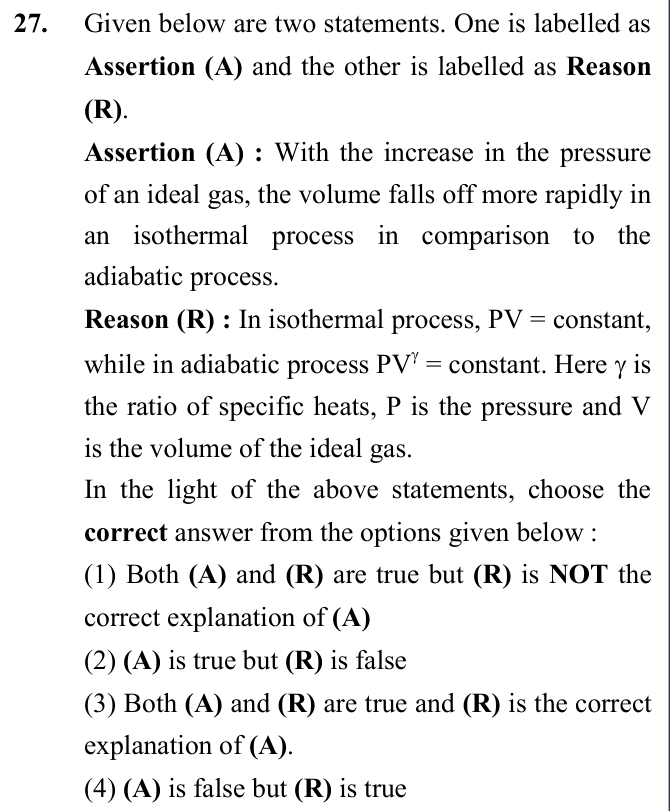
(1) Both statements are true and correct explanation
(2) Both statements are true but NOT the correct explanation
(3) Statement I is true but Statement II is false
(4) Statement I is false but Statement II is true
P
Adiabatic
V
compression
Pressure increases
Isothermal
Adiabatic
Isothermal
dP
dP
dV
dV
)
)
>
(
(
[
)
[
)
QUESTION 3
Thermodynamics
SECTION A · MCQ (+4, -1)
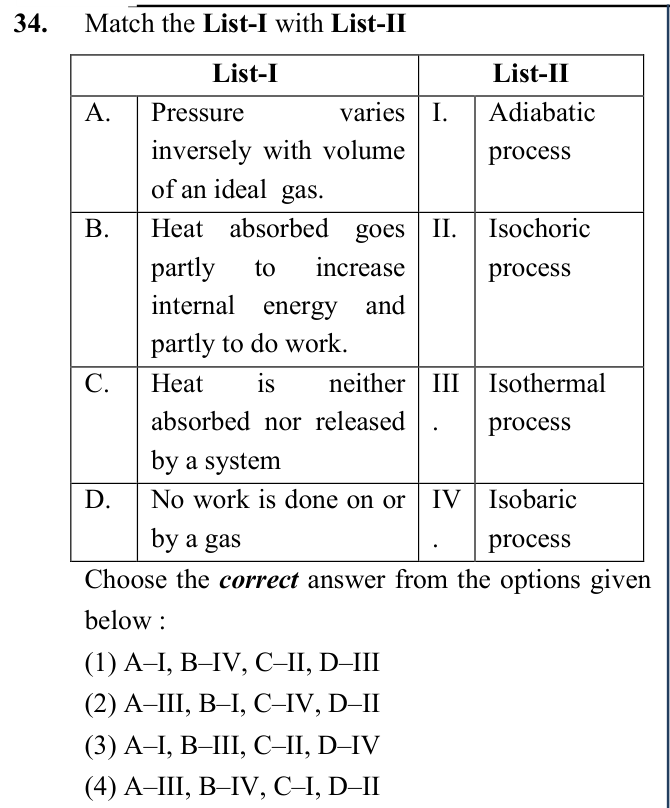
(1) A–I, B–IV, C–II, D–III
(2) A–III, B–I, C–IV, D–II
(3) A–I, B–III, C–II, D–IV
(4) A–III, B–IV, C–I, D–II
A →
1
P
V
∝
⇒PV = constant
⇒nRT = const. ⇒ T = const.
Hence Isothermal III
B → IV
W ≠ 0, ΔU ≠ 0, ΔQ ≠ 0 [only isobaric]
C → I ΔQ = 0 Adiabatic
D → II w = 0 Isochoric
III IV I II
QUESTION 4
Thermodynamics
SECTION A · MCQ (+4, -1)
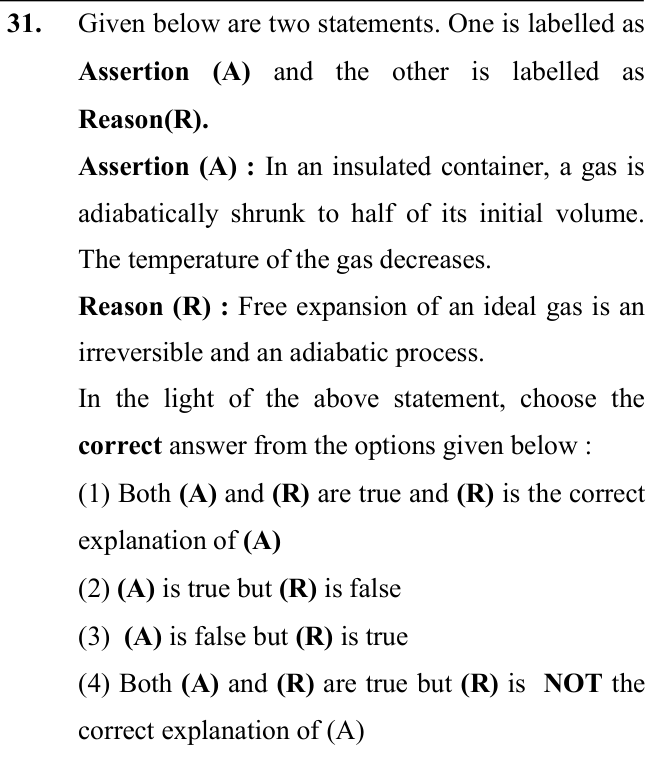
(1) Both (A) and (R) are true and (R) is the correct
explanation of (A)
(2) (A) is true but (R) is false
(3) (A) is false but (R) is true
(4) Both (A) and (R) are true but (R) is NOT the
correct explanation of (A)
(A)
γ-
γ- = 1
1
1
1
2
2
T V
T V
Temp increases
R) Free expansion is assumed fast, so Adiabatic
QUESTION 5
Thermodynamics
SECTION B · NUMERICAL (+4, 0)
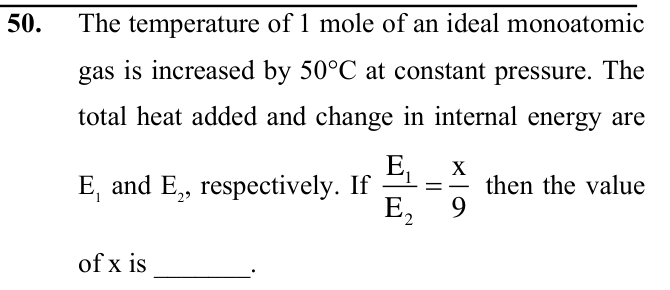
Given that process is isobaric ΔT = 50°C
Q in isobaric process = nCPΔT = E1
ΔU in isobaric process = nCVΔT = E2
1
P
2
V
E
C
E
C
∴ = =γ
Given, gas is monoatomic
∴ γ = 1 + 2
f = 2
1
3 + = 5
3
Now, as per question.
5
x
3
9 = x = 15
1
JEE–MAIN EXAMINATION – JANUARY 2025
QUESTION 6
Thermodynamics
SECTION A · MCQ (+4, -1)
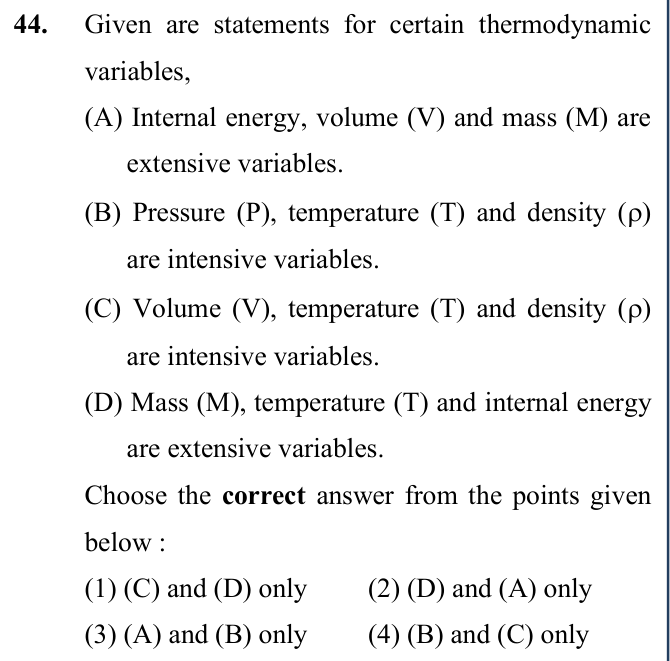
(1) (C) and (D) only
(2) (D) and (A) only
(3) (A) and (B) only
(4) (B) and (C) only
Extensive variables depends on size or mass of
system ex : internal energy, volume, mass
QUESTION 7
Thermodynamics
SECTION A · MCQ (+4, -1)
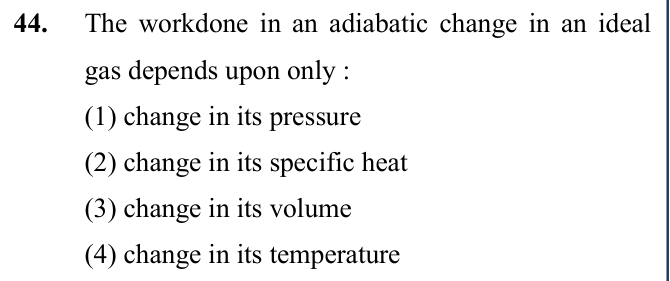
(1) change in its pressure
(2) change in its specific heat
(3) change in its volume
(4) change in its temperature
ΔW = –ΔU = – nCVΔT
QUESTION 8
Thermodynamics
SECTION A · MCQ (+4, -1)
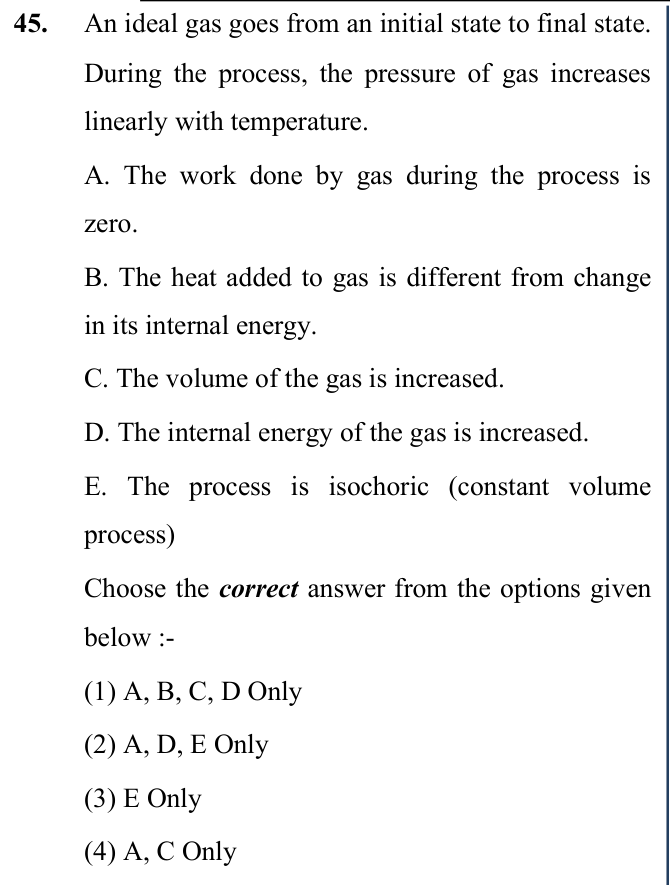
(1) A, B, C, D Only
(2) A, D, E Only
(3) E Only
(4) A, C Only
Given that
P = kT
P
T = constant
∴ Volume is constant or isochoric process.
∴ WD = 0
∴ Q = ΔU
Also temperature increases hence internal energy
increases.
SECTION-B
QUESTION 9
Thermodynamics
SECTION A · MCQ (+4, -1)
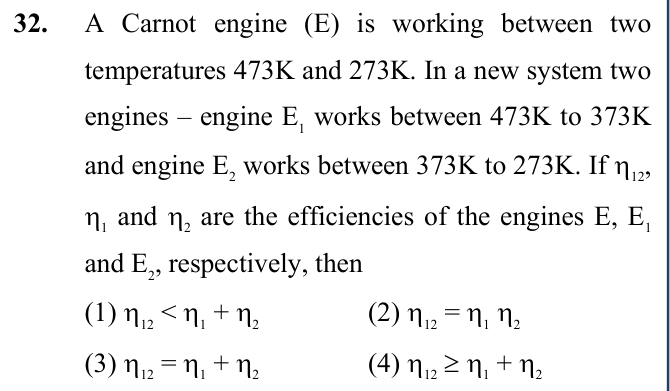
(1) η12 < η1 + η2
(2) η12 = η1 η2
(3) η12 = η1 + η2
(4) η12 ≥ η1 + η2
η12 =
273
200
1
0.423
473
473 - = = 1
373
100
1
0.211
473
473
η=- = =
2
273
100
1
0.268
373
373
η=- = =
QUESTION 10
Thermodynamics
SECTION A · MCQ (+4, -1)
A temperature of 27 °C is equal to how many kelvin?
(1) 27 K
(2) 327 K
(3) 246 K
(4) 300 K
Kelvin = Celsius + 273, so 27 °C = 300 K.
QUESTION 11
Thermodynamics
SECTION A · MCQ (+4, -1)
The maximum possible efficiency of a heat engine operating between two reservoirs is always less than
(1) 50%
(2) 100%
(3) 200%
(4) 0%
The second law forbids any engine from being 100% efficient.
QUESTION 12
Thermodynamics
SECTION A · MCQ (+4, -1)
For a reversible process, the infinitesimal entropy change is defined as:
(1) dS = dQ_rev x T
(2) dS = dQ_rev - T
(3) dS = T / dQ_rev
(4) dS = dQ_rev / T
Entropy change for a reversible transition is dS = dQ_rev / T, where dQ_rev is the heat exchanged reversibly at absolute temperature T.
QUESTION 13
Thermodynamics
SECTION A · MCQ (+4, -1)
Mayer's relation for an ideal gas states that:
(1) C_p - C_v = 0
(2) C_p + C_v = R
(3) C_p - C_v = R
(4) C_p / C_v = R
Mayer's relation gives C_p - C_v = R for an ideal gas, since heating at constant pressure must additionally do expansion work.
QUESTION 14
Thermodynamics
SECTION A · MCQ (+4, -1)
When 80 J of heat is removed from a system and 20 J of work is done on it, the change in internal energy is
(1) 60 J
(2) -100 J
(3) 100 J
(4) -60 J
ΔU = ΔQ − W = −80 − (−20) = −60 J, taking work done on the system as negative.
QUESTION 15
Thermodynamics
SECTION A · MCQ (+4, -1)
The mechanical equivalent of heat (Joule's constant) is approximately
(1) 9.8 J/cal
(2) 4.186 J/cal
(3) 1 J/cal
(4) 4.186 cal/J
One calorie equals 4.186 joules, so J ≈ 4.186 J/cal.
QUESTION 16
Thermodynamics
SECTION A · MCQ (+4, -1)
A Carnot engine operates between a hot reservoir at 500 K and a cold reservoir at 300 K. Its efficiency is:
(1) 40%
(2) 30%
(3) 60%
(4) 100%
efficiency = 1 - T_C/T_H = 1 - 300/500 = 1 - 0.6 = 0.4 = 40%.
QUESTION 17
Thermodynamics
SECTION A · MCQ (+4, -1)
A gas absorbs 300 J of heat and does 100 J of work on its surroundings. The change in internal energy is:
(1) 100 J
(2) 400 J
(3) 300 J
(4) 200 J
Change in U = Q - W = 300 J - 100 J = 200 J.
QUESTION 18
Thermodynamics
SECTION A · MCQ (+4, -1)
For a monatomic ideal gas, C_v = 12.5 J mol⁻¹ K⁻¹. Taking R = 8.3 J mol⁻¹ K⁻¹, the value of C_p is:
(1) 4.2 J mol⁻¹ K⁻¹
(2) 20.8 J mol⁻¹ K⁻¹
(3) 12.5 J mol⁻¹ K⁻¹
(4) 8.3 J mol⁻¹ K⁻¹
Using Mayer's relation, C_p = C_v + R = 12.5 + 8.3 = 20.8 J mol⁻¹ K⁻¹.
QUESTION 19
Thermodynamics
SECTION A · MCQ (+4, -1)
Which of the following is a state function (depends only on the state, not the path)?
(1) Both heat and work
(2) Heat Q
(3) Internal energy U
(4) Work W
Internal energy U is a state function determined solely by the thermodynamic state. Heat Q and work W are path functions whose values depend on the process connecting two states.
QUESTION 20
Thermodynamics
SECTION A · MCQ (+4, -1)
In any irreversible process, the entropy of the universe
(1) remains constant
(2) increases
(3) becomes zero
(4) decreases
The second law states the entropy of the universe always increases for irreversible processes.
QUESTION 21
Thermodynamics
SECTION A · MCQ (+4, -1)
The maximum efficiency of a Carnot engine operating between reservoirs at temperatures T_H and T_C is:
(1) efficiency = 1 - T_H / T_C
(2) efficiency = 1 - T_C / T_H
(3) efficiency = (T_H - T_C) / T_C
(4) efficiency = T_C / T_H
Carnot efficiency is 1 - T_C/T_H, where both temperatures MUST be in absolute kelvins.
QUESTION 22
Thermodynamics
SECTION A · MCQ (+4, -1)
The ice point (melting point of pure ice) on the Celsius scale is fixed at
(1) 273.16 K
(2) 32 °F
(3) 0 °C
(4) 100 °C
The Celsius scale fixes the ice point at 0 °C.
QUESTION 23
Thermodynamics
SECTION A · MCQ (+4, -1)
The specific heat capacity of water is approximately
(1) 2100 J kg⁻¹ K⁻¹
(2) 420 J kg⁻¹ K⁻¹
(3) 4200 J kg⁻¹ K⁻¹
(4) 4.2 J kg⁻¹ K⁻¹
Water has a specific heat capacity of about 4200 J kg⁻¹ K⁻¹.
QUESTION 24
Thermodynamics
SECTION A · MCQ (+4, -1)
The temperature of the triple point of water is defined as exactly
(1) 0 K
(2) 373.16 K
(3) 273.16 K
(4) 273 K
The triple point of water is 273.16 K, the fixed point of the kelvin scale.
QUESTION 25
Thermodynamics
SECTION A · MCQ (+4, -1)
A heat engine absorbs 1000 J from a hot reservoir and rejects 600 J to a cold reservoir. Its efficiency is:
(1) 40%
(2) 100%
(3) 60%
(4) 37.5%
efficiency = 1 - Q_C/Q_H = 1 - 600/1000 = 0.4 = 40%.
QUESTION 26
Thermodynamics
SECTION A · MCQ (+4, -1)
A constant-volume gas thermometer shows pressure X at an unknown temperature and X_tr = 2.0 x 10⁴ Pa at the triple point of water (273.16 K). If X = 3.0 x 10⁴ Pa, the unknown temperature is:
(1) 819.5 K
(2) 182.1 K
(3) 136.6 K
(4) 409.7 K
T = 273.16 x (X / X_tr) = 273.16 x (3.0 x 10⁴ / 2.0 x 10⁴) = 273.16 x 1.5 = 409.7 K.
QUESTION 27
Thermodynamics
SECTION A · MCQ (+4, -1)
For a complete reversible (cyclic) process, the change in entropy of the system plus surroundings is
(1) negative
(2) positive
(3) infinite
(4) zero
A reversible cycle has no net entropy change.
QUESTION 28
Thermodynamics
SECTION A · MCQ (+4, -1)
A process carried out infinitely slowly through a continuous sequence of equilibrium states is called
(1) irreversible
(2) spontaneous
(3) quasi-static
(4) isothermal
A quasi-static process stays infinitesimally close to equilibrium throughout.
QUESTION 29
Thermodynamics
SECTION A · MCQ (+4, -1)
A Carnot engine operates between a source at 500 K and a sink at 300 K; its efficiency is
(1) 100%
(2) 20%
(3) 60%
(4) 40%
η = 1 − T2/T1 = 1 − 300/500 = 0.4 = 40%.