
✎ ANSWER ONLINE · EVERY MISTAKE LINKS BACK TO THE CONCEPT
Current Electricity · Practice Worksheet
Answer each question here and it marks straight away, with the derivation and a link to the exact micro-concept to revisit.
1 question from this set could not be marked online — a
bonus or dual-key question, which has no single defensible answer. The print and
.docx versions still include it.
// CONCEPT AUDIT RESULT
Everything you missed has been added to your Error Arena — retest them blind there, and a concept clears once you get it right.
QUESTION 1
Current Electricity
SECTION B · NUMERICAL (+4, 0)

A
3Ω
3Ω
3Ω
B
C
⇒
3Ω
B
C
6Ω
9Ω is the resistance of whole wire
∴ resistance of each wire = 3Ω.
∴ Equivalent resistance = 2Ω
QUESTION 2
Current Electricity
SECTION A · MCQ (+4, -1)
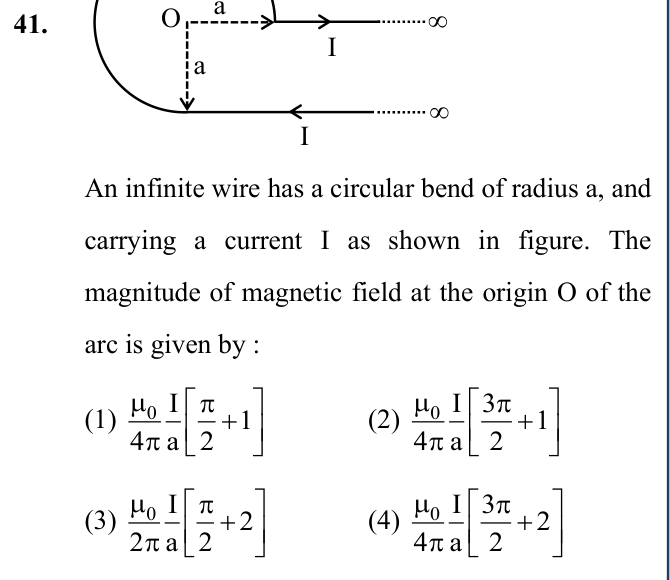
(1) 0 I
1
4 a 2
μ
π
] + [
]
π
{
}
(2) 0 I 3
1
4 a
2
μ
π
] + [
]
π
{
}
(3) 0 I
2
2 a 2
μ
π
] + [
]
π
{
}
(4) 0 I 3
2
4 a
2
μ
π
] + [
]
π
{
}
a
a
(1)
∞
∞
O
(3)
(2)
0
1
i
B
4 a
μ = ⊗
π
0
2
i 3
B
4 a
2
μ
π
) = ⊗
(
π
[
)
B3 = 0
0 i
3
B
1
4 a
2
μ
π
) = ⊗
(
π
[
)
QUESTION 3
Current Electricity
SECTION B · NUMERICAL (+4, 0)
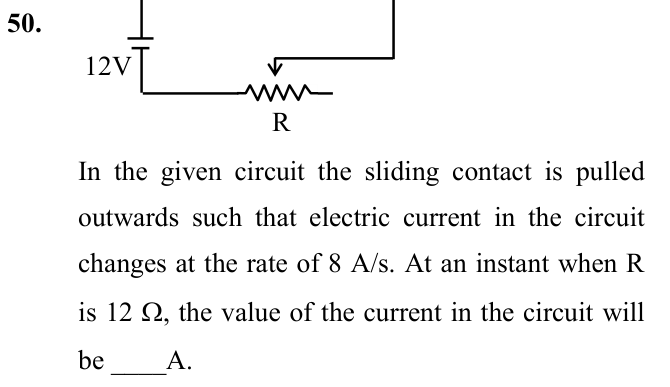
ε = LdI
–
– IR
0
dt
12 – 3 × (–8) – I × 12 = 0
I = 3
1
JEE–MAIN EXAMINATION – JANUARY 2025
QUESTION 4
Current Electricity
SECTION A · MCQ (+4, -1)
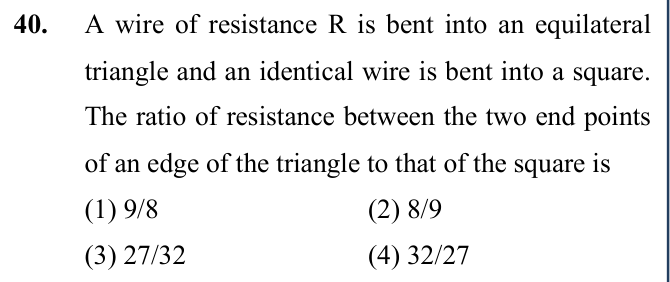
(1) 9/8
(2) 8/9
(3) 27/32
(4) 32/27
R = A
ρ
So, R α λ
Side length of triangle is 1/3 of total length.
B
R/3
R/3
A
R/3
R/4
R/4
R/4
R/4
A
B
2r/3
r/3
A
B
3r/4
r/4
A
B
(Req)1 = 2r / 3 r / 3
2r / 3
r / 3 × +
(Req)2 = 3r / 4
r / 4
3r / 4
r / 4 × +
(Req)1 = 2r/9
(Req)2 = 3r/16
eq 1
eq
2
(R )
2r / 9
32
(R )
3r /16
27 = =
QUESTION 5
Current Electricity
SECTION A · MCQ (+4, -1)
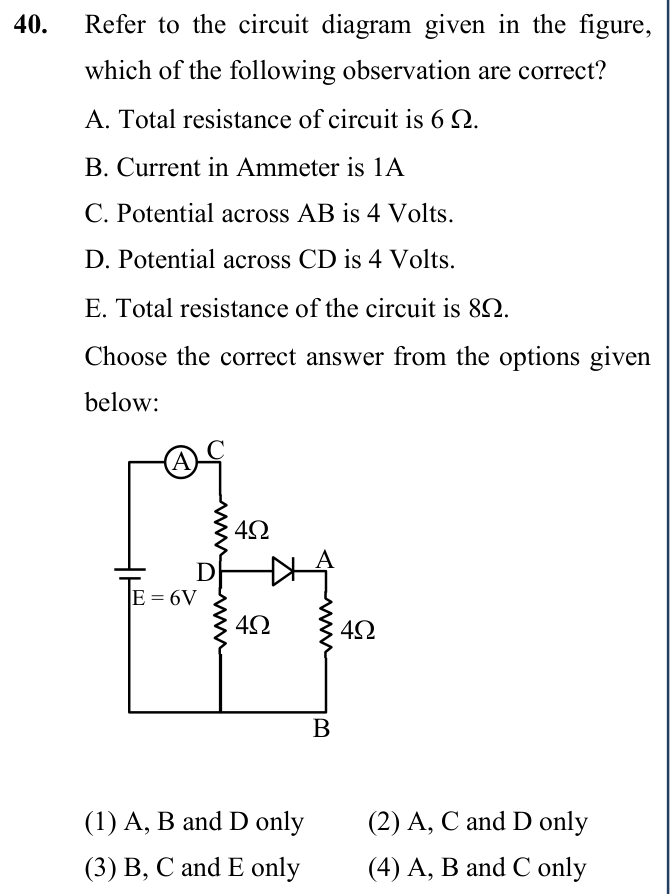
(1) A, B and D only
(2) A, C and D only
(3) B, C and E only
(4) A, B and C only
4Ω
6V
D
A
4Ω
B
A
C
4Ω
4
6
4
4Ω
⇓
⇓
6
2Ω
4Ω
⇓
6
6
Current through ammeter = 1 A
Rnet = 6Ω
6V
D
A
0.5A
B
A
C
0.5A
1A
VAB = 0.5 × 4 = 2 volt
VCD = 1 × 4 = 4 volt
A, B & D are correct
QUESTION 6
Current Electricity
SECTION A · MCQ (+4, -1)
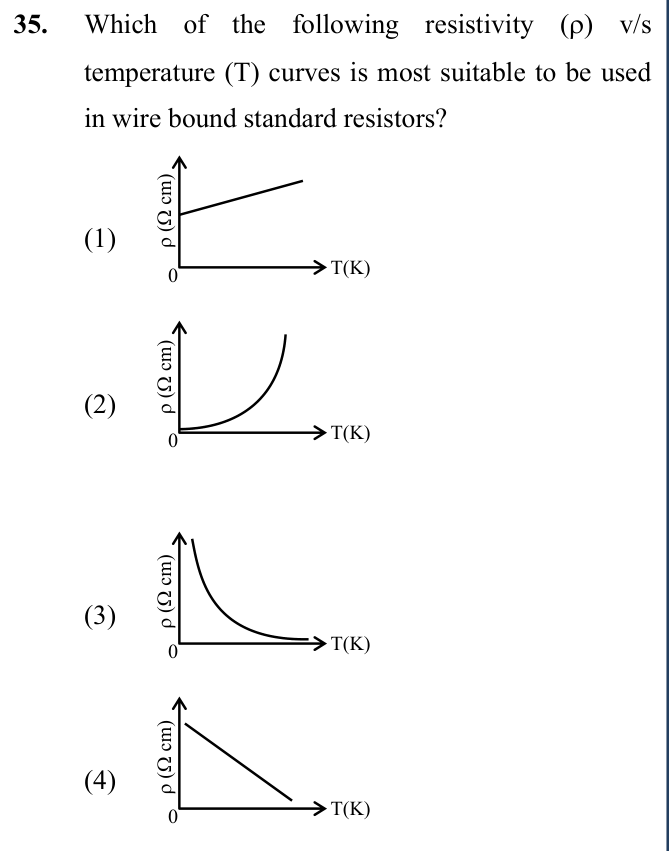
(1) 0
T(K)
ρ (Ω cm)
(2) 0
T(K)
ρ (Ω cm)
(3) 0
T(K)
ρ (Ω cm)
(4) 0
T(K)
ρ (Ω cm)
Resistivity is independent of temperature for wire
bound resistors
QUESTION 7
Current Electricity
SECTION A · MCQ (+4, -1)
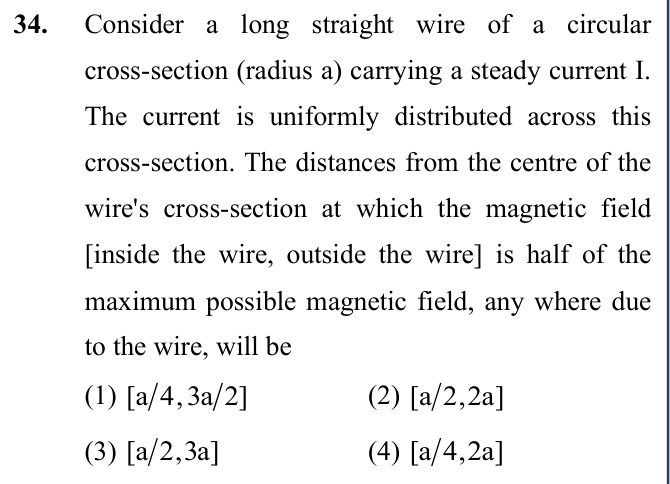
(1) [a 4, 3a 2]
(2) [a 2,2a]
(3) [a 2,3a]
(4) [a 4,2a]
Maximum possible magnetic field is at the surface
μ = π
0
max
I
B
2 a
μ = π
max
0
B
I
2
4 a
It can be obtained inside as well as outside the wire
For inside,
μ
μ = π
π
0
0
2
I
Ir
4 a
2 a
⇒=a
r
2
For outside
μ
μ = π
π
0
0
I
I
4 a
2 r
⇒ r = 2a
Correct answer
]
[
]
{
}
a ,2a
2
QUESTION 8
Current Electricity
SECTION A · MCQ (+4, -1)
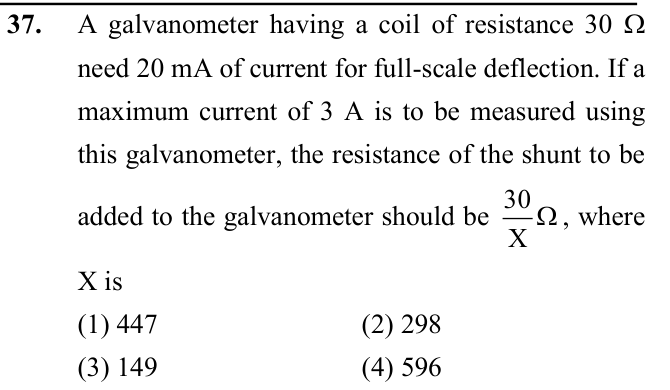
(1) 447
(2) 298
(3) 149
(4) 596
rs
(I–Ig)
I
Ig
G.M.
Ig Rg = (I – Ig) rs
20 × 10
–3 × 30 = (3 – 0.02) × rs
) = =
(
[
)
s
0.6
30
r
2.98
x × )
=(
[
)
2.98 30
x
0.6
= 149
QUESTION 9
Current Electricity
SECTION A · MCQ (+4, -1)
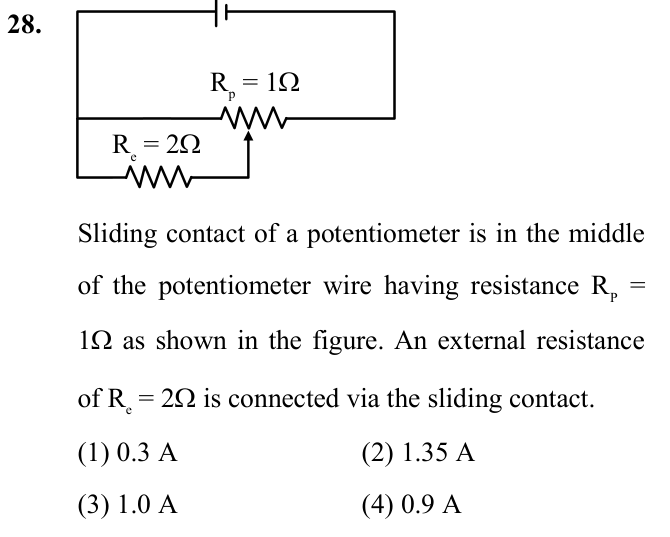
(1) 0.3 A
(2) 1.35 A
(3) 1.0 A
(4) 0.9 A
The circuit can be considered as
2Ω
0.9V
0.5Ω
0.5Ω
eq
0.5
2
5
10
R
0.5
2
0.5
10
25 × )
∴ = + = +
Ω
( + [
)
45
9
0.9
50
10 = = = 0.9
i
1A
0.9
∴ = =
(1) Both Statement I and Statement II are false.
(2) Statement I is true but Statement II is false.
(3) Both Statement I and Statement II are true.
(4) Statement I is false but Statement II is true.
NTA Ans. (2)
Sol. In general one vernier scale division is smaller than
2
QUESTION 10
Current Electricity
SECTION A · MCQ (+4, -1)
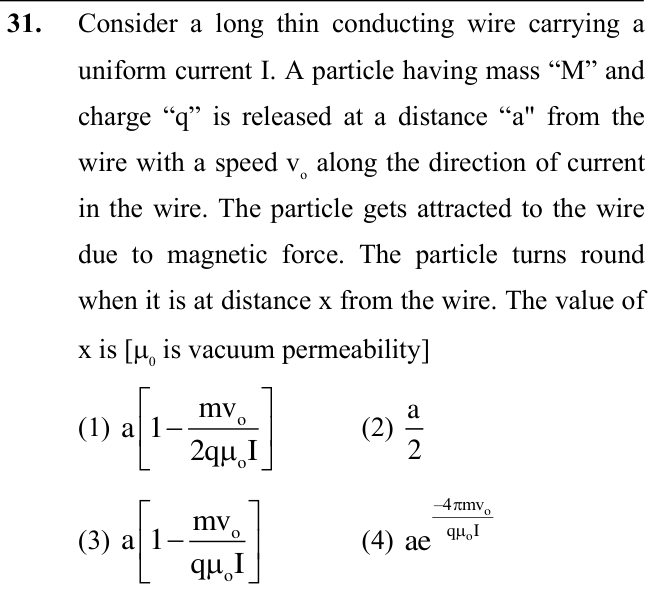
(1) o
o
mv
a 1
2q
I
] - [
]
μ
{
}
(2) a
2
(3) o
o
mv
a 1
q
I
] - [
]
μ
{
}
(4) o
o
–4 mv
q
I
ae
π
μ
x1
r
vx
vy
C
x
A
v0
vy
vx
v0 B
x
y
I
A → B
x
y
ˆ
ˆ
V
–v i
v j = +
0I
ˆ
B
(–k)
2 r
μ = π
0
x
y
Iq
ˆ
ˆ
F
q(v
B)
[–v j – v i]
2 r
μ = × = π
ax = –
y
0
v
Iq .
2 m
r
μ
π
ay = –
0
x
Iq v
.
2 m
r
μ
π
y
x
x
0
v
v dv
Iq
–
dr
2 m r
μ = π
x
x
0
y
v dv
Iq dr
–
v
2 m r
μ = π
0
1
v
x
x
x
0
2
2
0
a
0
x
v dv
Iq
dr
– 2 m
r
v – v
μ = π
∫
∫
Let, z
2 = v0
2 – vx
2
2zdz = –2vxdvx
3
zdz = – vxdvx
x
x
2
2
0
x
v dv
zdz
–dz
z
v – v - = = then integral becomes
0
0
0
1
v
Iq
x
– dz
–
ln
2 m
a
μ = π
∫
v0 =
0
1
Iq
x
–
ln
2 m
a
μ
π
x1 = a
0
0
2 mv
–
Iq
e
π
μ
……(1)
For B → C
x
y
ˆ
ˆ
v
–v i – v j = 0I
ˆ
B
(–k)
2 r
μ = π
0
x
y
Iq
ˆ
ˆ
F
q(v
B)
(–v j
v i)
2 r
μ = × = +
π
ax = +
y
0
v
Iq
2 m r
μ
π
ay = –
0
x
Iq v
.
2 m
r
μ
π
y
x
x
0
v
v dv
Iq
dr
2 m r
μ
=π
0
1
0
x
x
x
0
2
2
v
x
0
x
v dv
Iq
dr
2 m
r
v – v
μ
=π
∫
∫
0
v
0
0
1
0
Iq
x
ln
– dz
–v
2 m
x
μ = =
π
∫
x = x1
0
0
2 mv
–
Iq
e
π
μ
….. (2)
From equation 1 and 2
X = a
0
0
4 mv
–
Iq
e
π
μ
QUESTION 11
Current Electricity
SECTION A · MCQ (+4, -1)
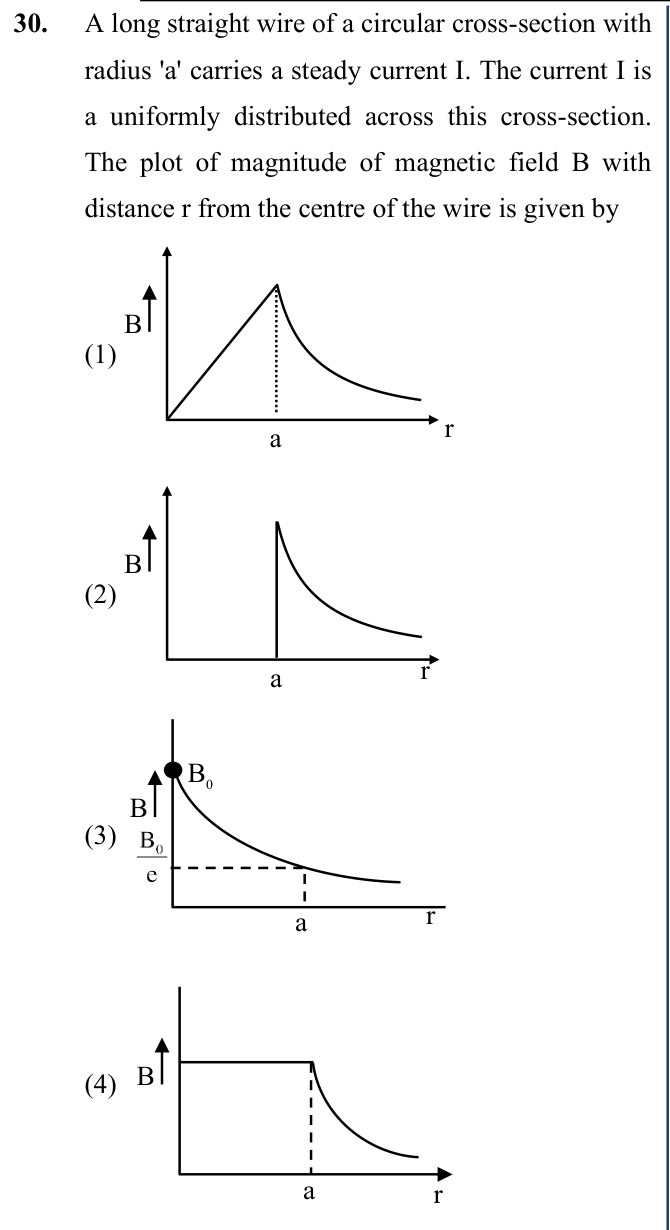
(1) r
B
a
(2) r
B
a
(3) r
B
a
B0
(4) r
B
a
a
I
(
)
μ × =
0
in
J
r
B
2
∝
in
B
r
Bout = μ
π
0I
2 r
∝
net
1
B
r
QUESTION 12
Current Electricity
SECTION A · MCQ (+4, -1)
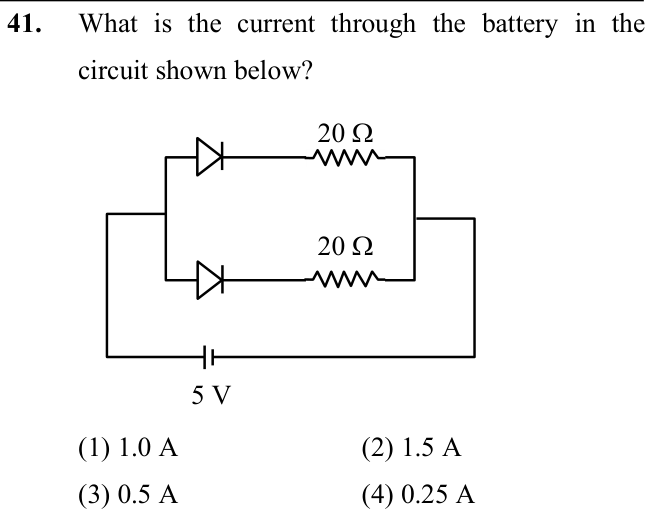
(1) 1.0 A
(2) 1.5 A
(3) 0.5 A
(4) 0.25 A
Both are forward biased
hence Req = 10 Ω = = = V
5
1
i
A
R
10
2
QUESTION 13
Current Electricity
SECTION A · MCQ (+4, -1)
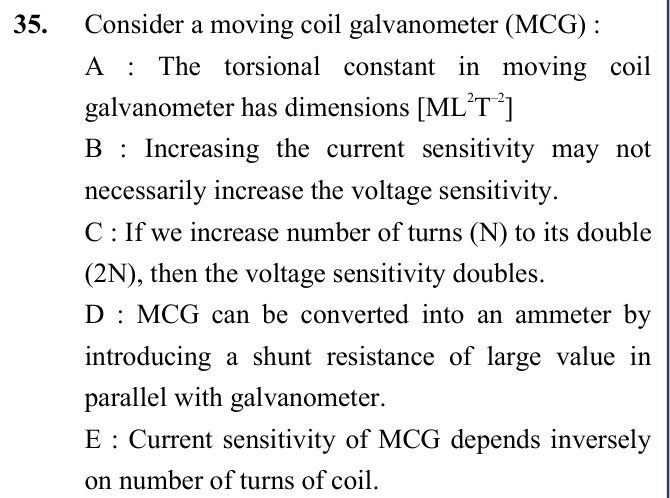
(1) A, B only
(2) A, D, only
(3) B, D, E only
(4) A, B, E only
(A) τ = Cθ ⇒ [ML
2T
–2] = [C][1]
(B) C.S = θ=BNA
I
C
;
V.S. = BNA
RC [R also depends on ‘N’]
(C)
NAB
V.S.
CR
∝
R → NR
(D) False [Theory]
(E) E [False]
C.S ∝ N
NAB
C.S.
C
⇒
=
QUESTION 14
Current Electricity
SECTION A · MCQ (+4, -1)
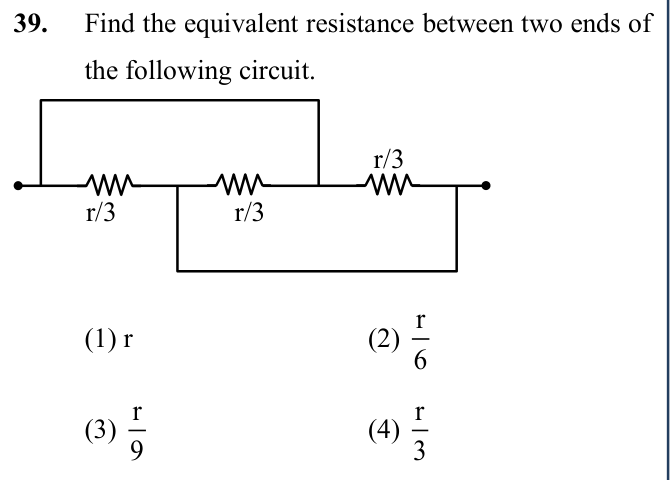
(1) r
(2) r
6
(3) r
9
(4) r
3
r/3
r/3
r/3
A
B
B
A
r/3
r/3
r/3
A
B
All are in parallel
Req = r / 3
r / 9
3 =
QUESTION 15
Current Electricity
SECTION B · NUMERICAL (+4, 0)
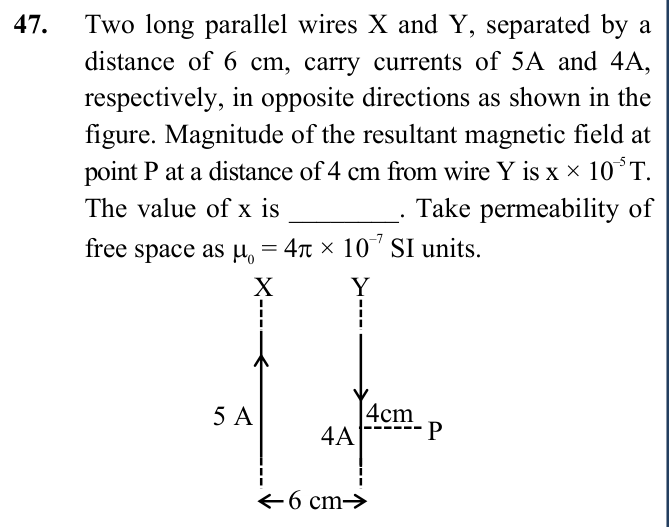
5 A
6 cm
X
Y
4cm P
4A
B = μ
μ
π×
π×
0
0
(5)
4
–
2
.01
2
0.04
= –
μ
π
0
100
4
= – 100 × 10
–7
= –1 × 10
–5 T
QUESTION 16
Current Electricity
SECTION A · MCQ (+4, -1)
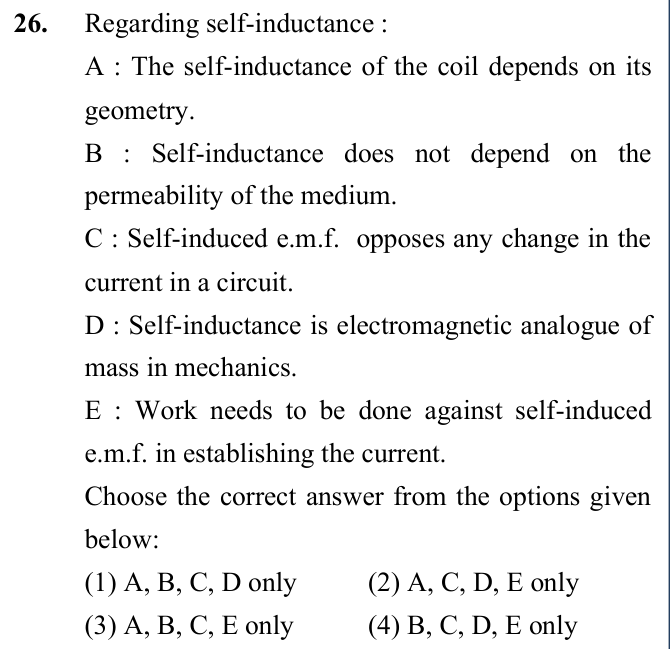
(1) A, B, C, D only
(2) A, C, D, E only
(3) A, B, C, E only
(4) B, C, D, E only
Self inductance of coil
L = μ
π
2
0N A
2 R
QUESTION 17
Current Electricity
SECTION B · NUMERICAL (+4, 0)
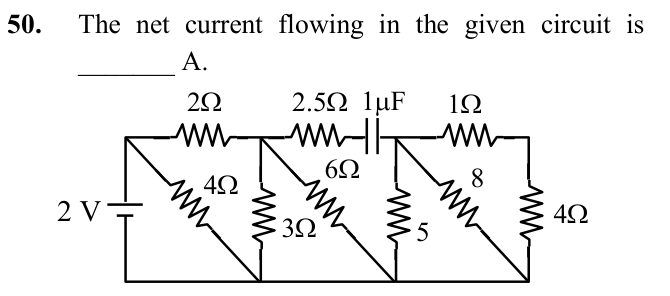
2 V
6Ω
3Ω
4Ω
2Ω
Req = 2Ω
I = 2
2 = 1A
1
JEE–MAIN EXAMINATION – JANUARY 2025
QUESTION 18
Current Electricity
SECTION A · MCQ (+4, -1)
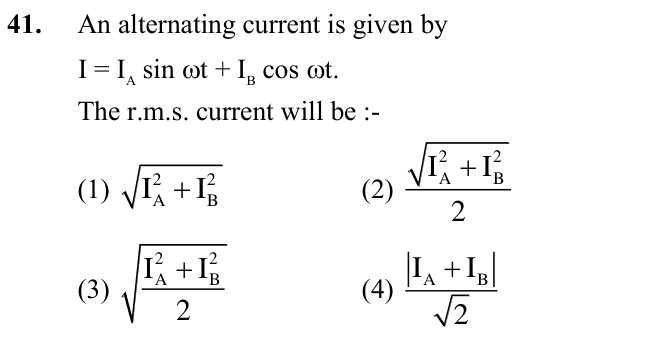
(1) 2
2
A
B
I
I
+
(2) 2
2
A
B
I
I
2
+
(3) 2
2
A
B
I
I
2
+
(4) A
B
I
I
2
+
2
rms
I dt
i
dt
=∫
∫
2
2
A
B
rms
I
I
i
2 + =
5
QUESTION 19
Current Electricity
SECTION A · MCQ (+4, -1)
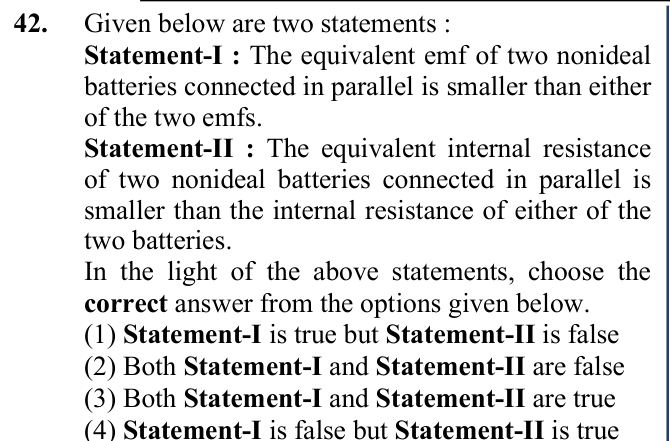
(1) Statement-I is true but Statement-II is false
(2) Both Statement-I and Statement-II are false
(3) Both Statement-I and Statement-II are true
(4) Statement-I is false but Statement-II is true
1
2
1
2
1
2
r
r
1
1
r
r
ε
ε + =
=ε
+
QUESTION 20
Current Electricity
SECTION B · NUMERICAL (+4, 0)
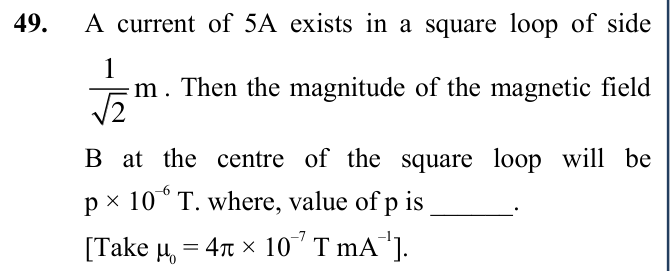
45°
45°
i=5A
Square loop
Let B be the magnetic field due to single side
then
(
)
0
1
2
i
B
sin
sin
4 d
μ = θ+
θ
π
7
6
10
5 2
1
2 10
1
2
2 2 - -
×× = × = ×
∴ Bnet at centre O = 4B
= 8 × 10
–6
∴ P = 8 Ans.
QUESTION 21
Current Electricity
SECTION A · MCQ (+4, -1)
Two cells of emf 1.5 V each are connected in series with the same polarity (aiding). The equivalent emf is:
(1) 3.0 V
(2) 1.5 V
(3) 0 V
(4) 0.75 V
Aiding series cells add their emfs: ε_eq = ε₁ + ε₂ = 1.5 + 1.5 = 3.0 V. Their internal resistances also add.
QUESTION 22
Current Electricity
SECTION A · MCQ (+4, -1)
How does the drift velocity v_d of electrons in a conductor compare with their random thermal speed?
(1) Both are of the same order of magnitude.
(2) Drift velocity (~10⁻⁴ m/s) is much smaller than thermal speed (~10⁵ m/s).
(3) Drift velocity is much larger than thermal speed.
(4) Thermal speed is zero while drift velocity is large.
Electrons move chaotically at thermal speeds near 10⁵ m/s with zero average, while the applied field superimposes a tiny net drift velocity of order 10⁻⁴ m/s.
QUESTION 23
Current Electricity
SECTION A · MCQ (+4, -1)
In a balanced Wheatstone bridge, the galvanometer shows zero deflection when:
(1) P + Q = R + S
(2) P/Q = R/S
(3) P/Q = S/R
(4) P·Q = R·S
The bridge is balanced (null galvanometer deflection) when the ratio of the two arms in one branch equals that in the other: P/Q = R/S.
QUESTION 24
Current Electricity
SECTION A · MCQ (+4, -1)
Electric power is the rate at which ____.
(1) voltage changes
(2) charge flows through a wire
(3) electrical energy is dissipated or consumed
(4) resistance increases
Power P = W/t is the rate of energy dissipation.
QUESTION 25
Current Electricity
SECTION A · MCQ (+4, -1)
With an increase in temperature, the resistivity of a metal ____.
(1) first decreases then increases
(2) remains constant
(3) increases
(4) decreases
Metals have a positive temperature coefficient, so resistivity rises with temperature.
QUESTION 26
Current Electricity
SECTION A · MCQ (+4, -1)
An electron has charge e = 1.6 × 10⁻¹⁹ C and mass m = 9.1 × 10⁻³¹ kg. If its relaxation time is τ = 2.5 × 10⁻¹⁴ s, its mobility is:
(1) 4.4 × 10⁻³ m²/(V·s)
(2) 4.4 m²/(V·s)
(3) 2.3 × 10⁻³ m²/(V·s)
(4) 4.4 × 10⁻⁶ m²/(V·s)
Mobility μ = eτ/m = (1.6 × 10⁻¹⁹ × 2.5 × 10⁻¹⁴)/(9.1 × 10⁻³¹) = 4.4 × 10⁻³ m²/(V·s).
QUESTION 27
Current Electricity
SECTION A · MCQ (+4, -1)
One kilowatt-hour (1 kWh) of electrical energy equals ____.
(1) 1.0 × 10³ J
(2) 3.6 × 10⁸ J
(3) 3.6 × 10³ J
(4) 3.6 × 10⁶ J
1 kWh = 1000 W × 3600 s = 3.6 × 10⁶ J.
QUESTION 28
Current Electricity
SECTION A · MCQ (+4, -1)
Electric current is defined as the ____.
(1) rate of change of voltage
(2) amount of charge stored
(3) rate of flow of energy
(4) rate of flow of electric charge
Current I = Q/t is the rate at which charge flows.
QUESTION 29
Current Electricity
SECTION A · MCQ (+4, -1)
Which option gives the correct ordering of resistivity magnitude for metals, semiconductors, and insulators?
(1) Metals < Semiconductors < Insulators
(2) Semiconductors < Metals < Insulators
(3) Metals < Insulators < Semiconductors
(4) Insulators < Semiconductors < Metals
Metals have the lowest resistivity (~10⁻⁸ Ω·m), semiconductors are intermediate (10⁻⁵ to 10² Ω·m), and insulators the highest (10¹⁰ to 10¹⁶ Ω·m).
QUESTION 30
Current Electricity
SECTION A · MCQ (+4, -1)
The drift velocity of electrons in a typical copper wire carrying current is of the order of ____.
(1) 3 × 10⁸ m/s
(2) 10⁴ m/s
(3) 10⁻¹⁹ m/s
(4) 10⁻⁴ m/s
Drift speeds are very small, of the order of 10⁻⁴ m/s.
QUESTION 31
Current Electricity
SECTION A · MCQ (+4, -1)
In a metre bridge experiment, a known resistance of 20 Ω gives a balance point at 80 cm from one end. The unknown resistance in the other gap is:
(1) 80 Ω
(2) 20 Ω
(3) 5 Ω
(4) 100 Ω
S = R(100 − l₁)/l₁ = 20 × (100 − 80)/80 = 20 × 20/80 = 5 Ω.
QUESTION 32
Current Electricity
SECTION A · MCQ (+4, -1)
A cell of emf 1.5 V and internal resistance 0.5 Ω is connected to a 2.5 Ω resistor. The terminal voltage of the cell is:
(1) 1.5 V
(2) 0.25 V
(3) 1.0 V
(4) 1.25 V
Current I = ε/(R + r) = 1.5/3 = 0.5 A. Terminal voltage V = ε − Ir = 1.5 − 0.5 × 0.5 = 1.25 V.
QUESTION 33
Current Electricity
SECTION A · MCQ (+4, -1)
Six identical cells, each of emf 1.5 V and internal resistance 1 Ω, are arranged as 3 rows in parallel with 2 cells in series in each row. The total current through a load of 2 Ω is:
(1) 1.125 A
(2) 1.5 A
(3) 0.75 A
(4) 4.5 A
For mixed grouping with m = 3 rows and n = 2 cells per row, I = mnε/(mR + nr) = (3 × 2 × 1.5)/(3 × 2 + 2 × 1) = 9/8 = 1.125 A.
QUESTION 34
Current Electricity
SECTION A · MCQ (+4, -1)
A uniform wire of resistance 10 Ω is stretched to three times its original length, with its volume remaining constant. Its new resistance is:
(1) 60 Ω
(2) 30 Ω
(3) 10 Ω
(4) 90 Ω
At constant volume, stretching to 3 times the length reduces the area to A/3. R' = ρ(3L)/(A/3) = 9R = 9 × 10 Ω = 90 Ω.
QUESTION 35
Current Electricity
SECTION A · MCQ (+4, -1)
The SI unit of the temperature coefficient of resistivity α is ____.
(1) K⁻¹
(2) Ω m
(3) K
(4) Ω m K⁻¹
α is the fractional change in resistivity per unit temperature, so its unit is per kelvin.
QUESTION 36
Current Electricity
SECTION A · MCQ (+4, -1)
A charge of 5 C flows through a wire in 10 s; the current is ____.
(1) 2 A
(2) 5 A
(3) 50 A
(4) 0.5 A
I = Q/t = 5/10 = 0.5 A.
QUESTION 37
Current Electricity
SECTION A · MCQ (+4, -1)
The resistivity of copper at room temperature is of the order of ____.
(1) 10⁻⁶ Ω m
(2) 10⁸ Ω m
(3) 10⁻⁸ Ω m
(4) 10² Ω m
Copper has a resistivity around 1.7 × 10⁻⁸ Ω m.
QUESTION 38
Current Electricity
SECTION A · MCQ (+4, -1)
A steady current of 2 A flows through a conductor for 1 minute. How much charge crosses any cross-section of the conductor in this time?
(1) 120 C
(2) 30 C
(3) 60 C
(4) 2 C
Charge Q = I × t. Converting 1 minute to 60 s gives Q = 2 A × 60 s = 120 C.
QUESTION 39
Current Electricity
SECTION A · MCQ (+4, -1)
A Wheatstone bridge is balanced when the current through its galvanometer is ____.
(1) alternating
(2) infinite
(3) zero
(4) maximum
At balance the galvanometer shows no deflection (zero current).
QUESTION 40
Current Electricity
SECTION A · MCQ (+4, -1)
In a metallic conductor, electric current is carried primarily by ____.
(1) bound electrons
(2) protons
(3) free electrons
(4) positive ions
Metals have free conduction electrons that drift to carry current.
QUESTION 41
Current Electricity
SECTION A · MCQ (+4, -1)
For a cell of emf E and internal resistance r delivering current I, its terminal voltage is ____.
(1) E/I
(2) E - Ir
(3) E + Ir
(4) Ir
Terminal voltage V = E - Ir due to the internal voltage drop.
QUESTION 42
Current Electricity
SECTION A · MCQ (+4, -1)
What constitutes an electric current?
(1) A static accumulation of charge
(2) The vibration of nuclei
(3) The flow of electric charge
(4) The flow of atoms
Current electricity deals with charges in motion, i.e., a net flow of charge.
QUESTION 43
Current Electricity
SECTION A · MCQ (+4, -1)
The resistivity of a material is independent of its ____.
(1) composition
(2) nature
(3) temperature
(4) length and cross-sectional area
Resistivity is a material property; resistance, not resistivity, depends on length and area.
QUESTION 44
Current Electricity
SECTION A · MCQ (+4, -1)
When several cells are connected in series, the total emf of the combination is obtained by ____ their individual emfs.
(1) multiplying
(2) subtracting
(3) adding
(4) averaging
In series, the individual emfs add to give the total emf.
QUESTION 45
Current Electricity
SECTION A · MCQ (+4, -1)
n identical cells, each of internal resistance r, are connected in series; the total internal resistance is ____.
(1) nr
(2) n²r
(3) r/n
(4) r
Internal resistances add in series, giving nr.
QUESTION 46
Current Electricity
SECTION A · MCQ (+4, -1)
A current of 2 A flows through a 10 Ω resistor for 5 minutes. The heat produced is:
(1) 600 J
(2) 12 kJ
(3) 1.2 kJ
(4) 1200 J
H = I²Rt = (2)² × 10 × 300 = 12000 J = 12 kJ.
QUESTION 47
Current Electricity
SECTION A · MCQ (+4, -1)
The small average velocity acquired by free electrons in a conductor under an applied electric field is called the ____.
(1) terminal velocity
(2) thermal velocity
(3) drift velocity
(4) escape velocity
Drift velocity is the net average velocity of electrons due to the applied field.
QUESTION 48
Current Electricity
SECTION A · MCQ (+4, -1)
Which statement about the temperature coefficient of resistivity α is correct?
(1) Metals have α > 0 because increased lattice vibrations reduce the relaxation time τ.
(2) Metals have α < 0 because carriers multiply with temperature.
(3) Both metals and semiconductors have α = 0.
(4) Semiconductors have α > 0 because carriers multiply with temperature.
In metals the carrier density n is fixed, so heating increases lattice vibrations, shortens τ, and raises resistivity (α > 0). Semiconductors instead gain carriers with temperature, giving α < 0.
QUESTION 49
Current Electricity
SECTION A · MCQ (+4, -1)
For a resistor R carrying current I under potential difference V, the power dissipated is:
(1) P = VI = I²R = V²/R
(2) P = VR²
(3) P = V²I
(4) P = I²/V
Electrical power is P = VI; substituting V = IR gives P = I²R, and substituting I = V/R gives P = V²/R.