
⚡ OFFICIAL NTA ASSESSMENT GENERATOR & WORD (.DOCX) EXPORTER
Moving Charges and Magnetism · Practice Worksheet
JEE Main Physics · Curated Assessment Set Print directly or export as a beautifully formatted Microsoft Word document with embedded 180-DPI mathematical prompt clips and step-by-step derivations.
EDUPROD JEE MAIN TEST SERIES · NTA PATTERN
Moving Charges and Magnetism · Practice Worksheet
JEE Main Physics · Curated Assessment Set · Assessment Code: JEE-101
Total Marks: 60
Marking: +4 / -1 (Sec A) · +4 / 0 (Sec B)
QUESTION 1
PHYSICS · Moving Charges and Magnetism
SECTION A · MCQ (+4, -1)
Candidate Response:
(1) (2) (3) (4)
QUESTION 2
PHYSICS · Moving Charges and Magnetism
SECTION A · MCQ (+4, -1)
Candidate Response:
(1) (2) (3) (4)
QUESTION 3
PHYSICS · Moving Charges and Magnetism
SECTION A · MCQ (+4, -1)
Candidate Response:
(1) (2) (3) (4)
QUESTION 4
PHYSICS · Moving Charges and Magnetism
SECTION B · NUMERICAL (+4, 0)
Numerical Value:
[ ]
QUESTION 5
PHYSICS · Moving Charges and Magnetism
SECTION B · NUMERICAL (+4, 0)
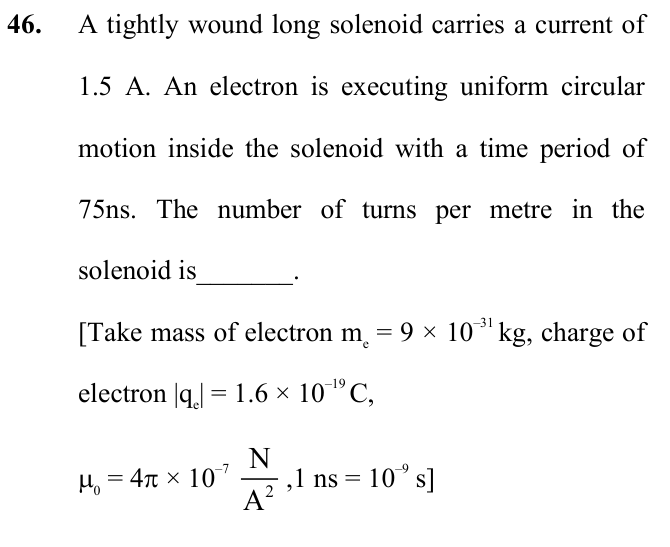
Numerical Value:
[ ]
QUESTION 6
PHYSICS · Moving Charges and Magnetism
SECTION A · MCQ (+4, -1)
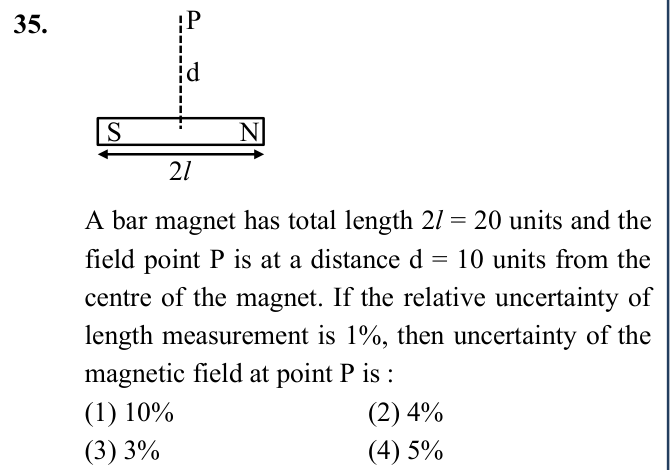
Candidate Response:
(1) (2) (3) (4)
QUESTION 7
PHYSICS · Moving Charges and Magnetism
SECTION A · MCQ (+4, -1)
Why are concave pole pieces and a soft-iron core used in a moving-coil galvanometer?
(1) To produce a uniform field directed along the coil's axis.
(2) To make the coil rotate continuously in one direction.
(3) To increase the resistance of the galvanometer.
(4) To produce a radial magnetic field so the coil plane is always parallel to B⃗, giving a linear (uniform) scale.
Candidate Response:
(1) (2) (3) (4)
QUESTION 8
PHYSICS · Moving Charges and Magnetism
SECTION A · MCQ (+4, -1)
Two long parallel wires 10 cm apart carry currents of 3 A and 4 A in the same direction. What is the force per unit length between them? (μ₀ = 4π × 10⁻⁷ T·m/A)
(1) 4.8 × 10⁻⁵ N/m (attractive)
(2) 2.4 × 10⁻⁵ N/m (repulsive)
(3) 2.4 × 10⁻⁵ N/m (attractive)
(4) 1.2 × 10⁻⁵ N/m (attractive)
Candidate Response:
(1) (2) (3) (4)
QUESTION 9
PHYSICS · Moving Charges and Magnetism
SECTION A · MCQ (+4, -1)
Two long parallel wires carrying currents in the same direction ____ each other.
(1) attract
(2) repel
(3) neutralise
(4) exert no force on
Candidate Response:
(1) (2) (3) (4)
QUESTION 10
PHYSICS · Moving Charges and Magnetism
SECTION A · MCQ (+4, -1)
A charged particle moving perpendicular to a uniform magnetic field moves in a ____ path.
(1) helical
(2) parabolic
(3) circular
(4) straight-line
Candidate Response:
(1) (2) (3) (4)
QUESTION 11
PHYSICS · Moving Charges and Magnetism
SECTION A · MCQ (+4, -1)
A galvanometer of resistance 20 Ω gives full-scale deflection for 1 mA. What shunt resistance is required to convert it into an ammeter that reads up to 1 A?
(1) 2 Ω
(2) 0.002 Ω
(3) 0.02 Ω
(4) 0.2 Ω
Candidate Response:
(1) (2) (3) (4)
QUESTION 12
PHYSICS · Moving Charges and Magnetism
SECTION A · MCQ (+4, -1)
According to the Biot-Savart law, what is the magnetic field dB⃗ produced by a current element I dl⃗ at a point located on the same line as the element (the collinear axial point)?
(1) dB⃗ is directed along the current element.
(2) dB⃗ is inversely proportional to r rather than r².
(3) dB⃗ is zero because dl⃗ and r̂ are parallel, making dl⃗ × r̂ = 0.
(4) dB⃗ is maximum and perpendicular to dl⃗.
Candidate Response:
(1) (2) (3) (4)
QUESTION 13
PHYSICS · Moving Charges and Magnetism
SECTION A · MCQ (+4, -1)
According to the Biot-Savart law, the magnetic field due to a small current element varies inversely with the ____ of the distance.
(1) square root
(2) cube
(3) square
(4) first power
Candidate Response:
(1) (2) (3) (4)
QUESTION 14
PHYSICS · Moving Charges and Magnetism
SECTION A · MCQ (+4, -1)
One ampere is that current which, in each of two parallel conductors 1 m apart, produces a force per unit length of ____.
(1) 2 × 10⁻⁷ N/m
(2) 2 × 10⁻⁷ N
(3) 1 N/m
(4) 4π × 10⁻⁷ N/m
Candidate Response:
(1) (2) (3) (4)
QUESTION 15
PHYSICS · Moving Charges and Magnetism
SECTION A · MCQ (+4, -1)
What is the magnetic field inside a long (ideal) solenoid with n turns per unit length carrying a current I?
(1) B = μ₀ n I
(2) B = μ₀ n I / 2
(3) B = μ₀ n I / R
(4) B = μ₀ I / (2π n)
Candidate Response:
(1) (2) (3) (4)