
⚡ OFFICIAL NTA ASSESSMENT GENERATOR & WORD (.DOCX) EXPORTER
Electromagnetic Induction · Practice Worksheet
JEE Main Physics · Curated Assessment Set Print directly or export as a beautifully formatted Microsoft Word document with embedded 180-DPI mathematical prompt clips and step-by-step derivations.
EDUPROD JEE MAIN TEST SERIES · NTA PATTERN
Electromagnetic Induction · Practice Worksheet
JEE Main Physics · Curated Assessment Set · Assessment Code: JEE-101
Total Marks: 120
Marking: +4 / -1 (Sec A) · +4 / 0 (Sec B)
QUESTION 1
PHYSICS · Electric Charges and Fields
SECTION A · MCQ (+4, -1)
Candidate Response:
(1) (2) (3) (4)
⚡ OFFICIAL KEY: 2
Step-by-Step Derivation
QUESTION 2
PHYSICS · Electromagnetic Induction
SECTION A · MCQ (+4, -1)
Candidate Response:
(1) (2) (3) (4)
⚡ OFFICIAL KEY: 2
Step-by-Step Derivation
QUESTION 3
PHYSICS · Laws of Motion
SECTION A · MCQ (+4, -1)
Candidate Response:
(1) (2) (3) (4)
⚡ OFFICIAL KEY: 2
Step-by-Step Derivation

QUESTION 4
PHYSICS · Oscillations
SECTION A · MCQ (+4, -1)
Candidate Response:
(1) (2) (3) (4)
⚡ OFFICIAL KEY: 4
Step-by-Step Derivation

QUESTION 5
PHYSICS · Electromagnetic Induction
SECTION A · MCQ (+4, -1)
Candidate Response:
(1) (2) (3) (4)
⚡ OFFICIAL KEY: 3
Step-by-Step Derivation
QUESTION 6
PHYSICS · Electromagnetic Induction
SECTION A · MCQ (+4, -1)
Candidate Response:
(1) (2) (3) (4)
⚡ OFFICIAL KEY: 2
Step-by-Step Derivation
QUESTION 7
PHYSICS · Electric Charges and Fields
SECTION A · MCQ (+4, -1)
Candidate Response:
(1) (2) (3) (4)
⚡ OFFICIAL KEY: 3
Step-by-Step Derivation
QUESTION 8
PHYSICS · Current Electricity
SECTION A · MCQ (+4, -1)
Candidate Response:
(1) (2) (3) (4)
⚡ OFFICIAL KEY: 2
Step-by-Step Derivation
QUESTION 9
PHYSICS · Electromagnetic Induction
SECTION A · MCQ (+4, -1)
A strong bar magnet is dropped with its north pole downward toward a fixed, closed metal ring. During the interval the magnet is approaching the ring from above but has not yet passed through, what is observed about its acceleration?
(1) The magnet moves with constant velocity, because the induced current exactly cancels gravity.
(2) The magnet accelerates with a = g, since gravity is the only force acting.
(3) The magnet accelerates with a > g, because the induced current adds to the gravitational pull.
(4) The magnet accelerates with a < g, because the ring induces a current whose magnetic field repels the approaching magnet.
Candidate Response:
(1) (2) (3) (4)
⚡ OFFICIAL KEY: The magnet accelerates with a < g, because the ring induces a current whose magnetic field repels the approaching magnet.
Step-by-Step Derivation
By Lenz's law the ring opposes the increase in flux caused by the approaching magnet, so it induces a current whose face toward the magnet is a like (north) pole. The resulting upward repulsion reduces the net downward acceleration below g.
QUESTION 10
PHYSICS · Electromagnetic Induction
SECTION A · MCQ (+4, -1)
An AC generator works on the principle of
(1) electromagnetic induction
(2) electrostatic repulsion
(3) photoelectric effect
(4) magnetic resonance
Candidate Response:
(1) (2) (3) (4)
⚡ OFFICIAL KEY: electromagnetic induction
Step-by-Step Derivation
An AC generator induces an emf by rotating a coil in a magnetic field.
QUESTION 11
PHYSICS · Electromagnetic Induction
SECTION A · MCQ (+4, -1)
The SI unit of magnetic flux is the
(1) weber
(2) henry
(3) tesla
(4) gauss
Candidate Response:
(1) (2) (3) (4)
⚡ OFFICIAL KEY: weber
Step-by-Step Derivation
Magnetic flux is measured in weber (Wb).
QUESTION 12
PHYSICS · Electromagnetic Induction
SECTION A · MCQ (+4, -1)
The magnetic flux through each turn of an N-turn coil of resistance R is changed by ΔΦ over some time interval. The total charge that flows through the coil during this interval is given by which relation?
(1) Δq = N ΔΦ / R, and it increases as the change is made slower.
(2) Δq = N ΔΦ / R, and it is independent of the duration of the flux change.
(3) Δq = N ΔΦ / R², and it is independent of the number of turns.
(4) Δq = N ΔΦ × R, and it increases as the change is made slower.
Candidate Response:
(1) (2) (3) (4)
⚡ OFFICIAL KEY: Δq = N ΔΦ / R, and it is independent of the duration of the flux change.
Step-by-Step Derivation
The total charge flown is Δq = ∫ i dt = ∫ (ε/R) dt = (N/R)∫ (dΦ/dt) dt = N ΔΦ / R. The time interval cancels out, so the charge depends only on the total flux change, not on how fast it occurs.
QUESTION 13
PHYSICS · Electromagnetic Induction
SECTION A · MCQ (+4, -1)
The SI unit of inductance is the
(1) weber
(2) ohm
(3) henry
(4) farad
Candidate Response:
(1) (2) (3) (4)
⚡ OFFICIAL KEY: henry
Step-by-Step Derivation
Inductance is measured in henry (H).
QUESTION 14
PHYSICS · Electromagnetic Induction
SECTION A · MCQ (+4, -1)
Magnetic flux through a surface is a measure of the number of magnetic field lines
(1) parallel to it
(2) passing through it
(3) circulating around it
(4) leaving it
Candidate Response:
(1) (2) (3) (4)
⚡ OFFICIAL KEY: passing through it
Step-by-Step Derivation
Magnetic flux counts the field lines crossing a surface.
QUESTION 15
PHYSICS · Electromagnetic Induction
SECTION A · MCQ (+4, -1)
A coil in which a changing current induces an EMF that opposes the change is said to possess self-inductance. Which pair correctly gives the defining relation and the SI unit of self-inductance?
(1) ε = L (dI/dt), with unit farad (F), where 1 F = 1 C/V.
(2) ε = −L (dI/dt), with unit henry (H), where 1 H = 1 V·s/A = 1 Wb/A.
(3) ε = −L (dI/dt), with unit tesla (T), where 1 T = 1 N/(A·m).
(4) ε = −L (d²I/dt²), with unit henry (H).
Candidate Response:
(1) (2) (3) (4)
⚡ OFFICIAL KEY: ε = −L (dI/dt), with unit henry (H), where 1 H = 1 V·s/A = 1 Wb/A.
Step-by-Step Derivation
Self-inductance L is defined by ε = −L (dI/dt): a coil has L = 1 henry when a current changing at 1 A/s induces an EMF of 1 V. Hence 1 H = 1 V·s/A = 1 Wb/A.
QUESTION 16
PHYSICS · Electromagnetic Induction
SECTION A · MCQ (+4, -1)
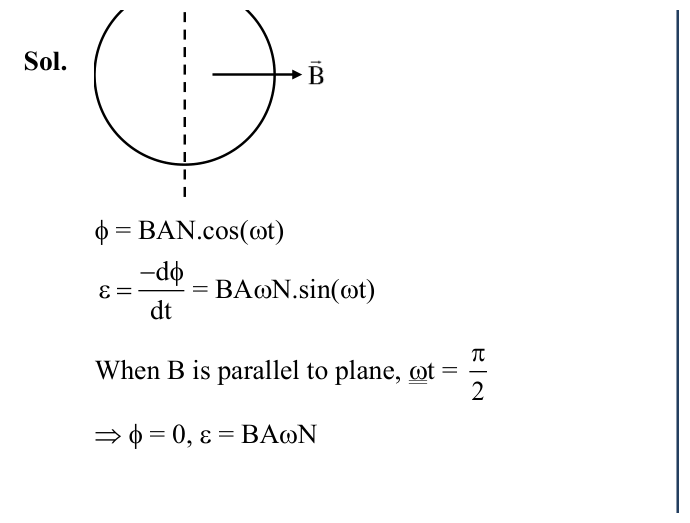
A coil of N turns and area A rotates with angular velocity ω in a uniform magnetic field B. If the flux through the coil is Φ = N B A cos ωt, what is the induced EMF ε(t)?
(1) ε(t) = N B A ω cos ωt = ε₀ cos ωt.
(2) ε(t) = N B A ω sin ωt = ε₀ sin ωt.
(3) ε(t) = N B A sin ωt.
(4) ε(t) = N B A ω tan ωt.
Candidate Response:
(1) (2) (3) (4)
⚡ OFFICIAL KEY: ε(t) = N B A ω sin ωt = ε₀ sin ωt.
Step-by-Step Derivation
Since ε = −dΦ/dt and Φ = N B A cos ωt, differentiating gives ε = N B A ω sin ωt = ε₀ sin ωt, with peak EMF ε₀ = N B A ω.
QUESTION 17
PHYSICS · Electromagnetic Induction
SECTION A · MCQ (+4, -1)
A magnet is pushed into a coil against the repulsive force exerted by the induced current. From the viewpoint of energy conservation, what happens to the mechanical work done by the external agent?
(1) It is entirely converted into electrical energy in the circuit, which is dissipated as Joule heat in the resistance.
(2) It is lost completely, violating the law of conservation of energy.
(3) It reappears as kinetic energy of the magnet after it passes through the coil.
(4) It is stored permanently as magnetic potential energy inside the coil with no other effect.
Candidate Response:
(1) (2) (3) (4)
⚡ OFFICIAL KEY: It is entirely converted into electrical energy in the circuit, which is dissipated as Joule heat in the resistance.
Step-by-Step Derivation
Lenz's law is a statement of energy conservation: the mechanical work done against the induced magnetic force is converted 100% into electrical energy, which is then dissipated as Joule heat (I²R) in the circuit resistance.
QUESTION 18
PHYSICS · Electromagnetic Induction
SECTION A · MCQ (+4, -1)
A conducting rod of length L rotates in a plane perpendicular to a uniform magnetic field B about one of its ends with angular velocity ω. What is the EMF induced between the two ends of the rod?
(1) ε = 2 B ω L²
(2) ε = (1/2) B ω L²
(3) ε = B ω L²
(4) ε = (1/2) B ω² L
Candidate Response:
(1) (2) (3) (4)
⚡ OFFICIAL KEY: ε = (1/2) B ω L²
Step-by-Step Derivation
For a rod rotating about one end, the linear velocity of an element at distance r is v = ω r, varying from 0 at the pivot to ω L at the tip. Integrating, ε = ∫₀^L B (ω r) dr = (1/2) B ω L².
QUESTION 19
PHYSICS · Electromagnetic Induction
SECTION A · MCQ (+4, -1)
Two long coaxial solenoids of the same length l are wound so that an inner solenoid (radius r₁, n₁ turns per unit length) is surrounded by an outer solenoid (n₂ turns per unit length). What is the mutual inductance M between them?
(1) M = μ₀ n₁ n₂ l / (π r₁²).
(2) M = μ₀ n₁ n₂ π r₂² l, using the cross-sectional area of the outer solenoid.
(3) M = μ₀ n₁ n₂ π (r₂² − r₁²) l, using the annular area between the two solenoids.
(4) M = μ₀ n₁ n₂ π r₁² l, using the cross-sectional area of the inner solenoid.
Candidate Response:
(1) (2) (3) (4)
⚡ OFFICIAL KEY: M = μ₀ n₁ n₂ π r₁² l, using the cross-sectional area of the inner solenoid.
Step-by-Step Derivation
The mutual inductance of coaxial solenoids is M = μ₀ n₁ n₂ π r₁² l, where the area is always that of the inner solenoid (radius r₁) because that is the region through which the flux of one links the other.
QUESTION 20
PHYSICS · Electromagnetic Induction
SECTION A · MCQ (+4, -1)
Electromagnetic induction was first discovered by Faraday in the year
(1) 1831
(2) 1820
(3) 1900
(4) 1800
Candidate Response:
(1) (2) (3) (4)
⚡ OFFICIAL KEY: 1831
Step-by-Step Derivation
Faraday discovered electromagnetic induction in 1831.
QUESTION 21
PHYSICS · Electromagnetic Induction
SECTION A · MCQ (+4, -1)
Faraday and Henry performed three kinds of experiments that produce induced currents. Which of the following correctly states the common feature of all three?
(1) In all three experiments the galvanometer deflects only while the magnetic flux linked with the coil is changing, and shows zero when the flux is steady.
(2) In all three experiments the induced current persists indefinitely after the motion stops.
(3) In all three experiments a battery drives a steady current through a coil to produce the deflection.
(4) In all three experiments a magnet is always moved relative to a stationary coil.
Candidate Response:
(1) (2) (3) (4)
⚡ OFFICIAL KEY: In all three experiments the galvanometer deflects only while the magnetic flux linked with the coil is changing, and shows zero when the flux is steady.
Step-by-Step Derivation
Faraday's three experiments — moving a magnet, moving a current-carrying primary coil, and switching a current on/off in a stationary primary — all produce a deflection only while the magnetic flux linked with the secondary changes; a steady flux gives zero deflection.
QUESTION 22
PHYSICS · Electromagnetic Induction
SECTION A · MCQ (+4, -1)
The phenomenon in which an emf is induced in a coil by a change in the current flowing through the same coil is called
(1) mutual induction
(2) resonance
(3) conduction
(4) self-induction
Candidate Response:
(1) (2) (3) (4)
⚡ OFFICIAL KEY: self-induction
Step-by-Step Derivation
Self-induction arises from a coil's own changing current and flux.
QUESTION 23
PHYSICS · Electromagnetic Induction
SECTION A · MCQ (+4, -1)
A magnet and a nearby conducting coil are both moved together with the same velocity in the same direction so that there is no relative motion between them. What does a galvanometer connected across the coil show?
(1) A deflection that grows linearly with time as the magnet keeps moving.
(2) Zero deflection, because with no relative motion the magnetic flux linked with the coil does not change.
(3) A steady deflection, because the coil is still moving through space.
(4) A momentary deflection only at the instant the motion starts.
Candidate Response:
(1) (2) (3) (4)
⚡ OFFICIAL KEY: Zero deflection, because with no relative motion the magnetic flux linked with the coil does not change.
Step-by-Step Derivation
Induction depends on relative motion because that is what changes the magnetic flux linked with the coil. When magnet and coil move together at the same velocity, their separation — and hence the linked flux — stays constant, so the induced EMF is zero.
QUESTION 24
PHYSICS · Electromagnetic Induction
SECTION A · MCQ (+4, -1)
What is the functional difference between the slip rings used in an AC generator and the split-ring commutator used in a DC generator?
(1) Both produce identical alternating (AC) output.
(2) Slip rings maintain a continuous alternating (AC) output, while a split-ring commutator rectifies the output into pulsating DC.
(3) Slip rings rectify the output into DC, while a split-ring commutator maintains AC.
(4) Both produce identical unidirectional (DC) output.
Candidate Response:
(1) (2) (3) (4)
⚡ OFFICIAL KEY: Slip rings maintain a continuous alternating (AC) output, while a split-ring commutator rectifies the output into pulsating DC.
Step-by-Step Derivation
Slip rings maintain continuous electrical contact without reversing, so the output remains sinusoidal AC. A split-ring commutator reverses the connection to the external circuit every half rotation, making both half-cycles unidirectional to give pulsating DC.
QUESTION 25
PHYSICS · Electromagnetic Induction
SECTION A · MCQ (+4, -1)
The peak emf of an AC generator having N turns and coil area A, rotating with angular speed ω in a field B, is
(1) N B A ω
(2) N B A / ω
(3) N B ω / A
(4) B A / (N ω)
Candidate Response:
(1) (2) (3) (4)
⚡ OFFICIAL KEY: N B A ω
Step-by-Step Derivation
The maximum induced emf of an AC generator is ε₀ = NBAω.
QUESTION 26
PHYSICS · Electromagnetic Induction
SECTION A · MCQ (+4, -1)
The phenomenon of producing an induced emf in a coil by changing the magnetic flux linked with it is called
(1) electromagnetic induction
(2) electrostatic induction
(3) magnetic resonance
(4) self-capacitance
Candidate Response:
(1) (2) (3) (4)
⚡ OFFICIAL KEY: electromagnetic induction
Step-by-Step Derivation
A changing magnetic flux induces an emf; this is electromagnetic induction.
QUESTION 27
PHYSICS · Electromagnetic Induction
SECTION A · MCQ (+4, -1)
The emf induced across a conductor moving through a magnetic field is called
(1) contact emf
(2) back emf
(3) motional emf
(4) thermal emf
Candidate Response:
(1) (2) (3) (4)
⚡ OFFICIAL KEY: motional emf
Step-by-Step Derivation
Motion of a conductor in a magnetic field produces a motional emf.
QUESTION 28
PHYSICS · Electromagnetic Induction
SECTION A · MCQ (+4, -1)
A straight conducting rod of length L moves with constant velocity v perpendicular to a uniform magnetic field B, with the rod also perpendicular to both v and B. What is the motional EMF induced across the ends of the rod, and what is its physical origin?
(1) ε = B L / v, arising from the heating of the rod.
(2) ε = B v / L, arising from the changing resistance of the rod.
(3) ε = B v L, arising from the magnetic force q(v × B) on the free charges in the moving rod.
(4) ε = B v L², arising from the electric field generated by the rod's acceleration.
Candidate Response:
(1) (2) (3) (4)
⚡ OFFICIAL KEY: ε = B v L, arising from the magnetic force q(v × B) on the free charges in the moving rod.
Step-by-Step Derivation
In a rod moving perpendicular to B, each free charge feels F = q(v × B), driving electrons to one end. The resulting charge separation builds an electric field until qE = qvB, giving the motional EMF ε = E L = B v L.
QUESTION 29
PHYSICS · Electromagnetic Induction
SECTION A · MCQ (+4, -1)
The motional emf induced in a rod of length l moving with speed v perpendicular to a uniform magnetic field B is
(1) B l / v
(2) B l v
(3) B / (l v)
(4) B v / l
Candidate Response:
(1) (2) (3) (4)
⚡ OFFICIAL KEY: B l v
Step-by-Step Derivation
Motional emf is ε = B l v when the rod, field and velocity are mutually perpendicular.
QUESTION 30
PHYSICS · Electromagnetic Induction
SECTION A · MCQ (+4, -1)
A uniform magnetic field of magnitude B makes an angle θ with the normal to a flat surface of area A. Which expression correctly gives the magnetic flux through the surface, and what is its SI unit?
(1) Φ = B A cos θ, with unit weber (Wb).
(2) Φ = B / A, with unit weber (Wb).
(3) Φ = B A sin θ, with unit tesla (T).
(4) Φ = B A tan θ, with unit weber per metre squared (Wb m⁻²).
Candidate Response:
(1) (2) (3) (4)
⚡ OFFICIAL KEY: Φ = B A cos θ, with unit weber (Wb).
Step-by-Step Derivation
Magnetic flux is Φ = B·A = B A cos θ, the product of the field strength and the effective perpendicular area. Its SI unit is the weber: 1 Wb = 1 T·m² = 1 V·s.