
✎ ANSWER ONLINE · EVERY MISTAKE LINKS BACK TO THE CONCEPT
Electromagnetic Induction · Practice Worksheet
Answer each question here and it marks straight away, with the derivation and a link to the exact micro-concept to revisit.
1 question from this set could not be marked online — a
bonus or dual-key question, which has no single defensible answer. The print and
.docx versions still include it.
// CONCEPT AUDIT RESULT
Everything you missed has been added to your Error Arena — retest them blind there, and a concept clears once you get it right.
QUESTION 1
Electric Charges and Fields
SECTION A · MCQ (+4, -1)
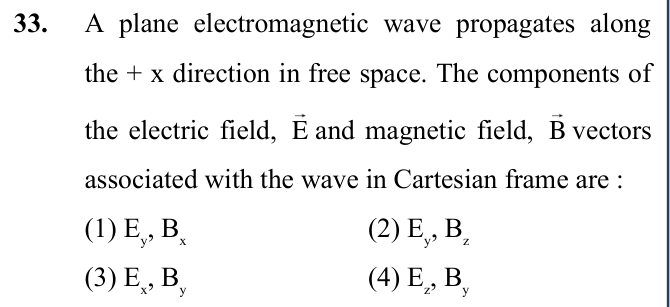
(1) Ey, Bx
(2) Ey, Bz
(3) Ex, By
(4) Ez, By
x
y
z
Direction of propogation
E
B = ×
QUESTION 2
Electromagnetic Induction
SECTION A · MCQ (+4, -1)
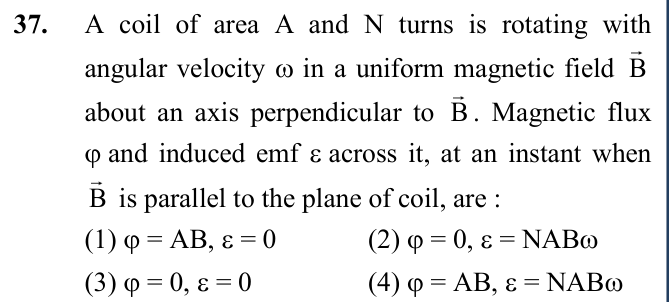
(1) ϕ = AB, ε = 0
(2) ϕ = 0, ε = NABω
(3) ϕ = 0, ε = 0
(4) ϕ = AB, ε = NABω
φ = BAN.cos(ωt)
-φ
ε=
d
dt = BAωN.sin(ωt)
When B is parallel to plane, ωt = π
2
⇒ φ = 0, ε = BAωN
QUESTION 3
Laws of Motion
SECTION A · MCQ (+4, -1)
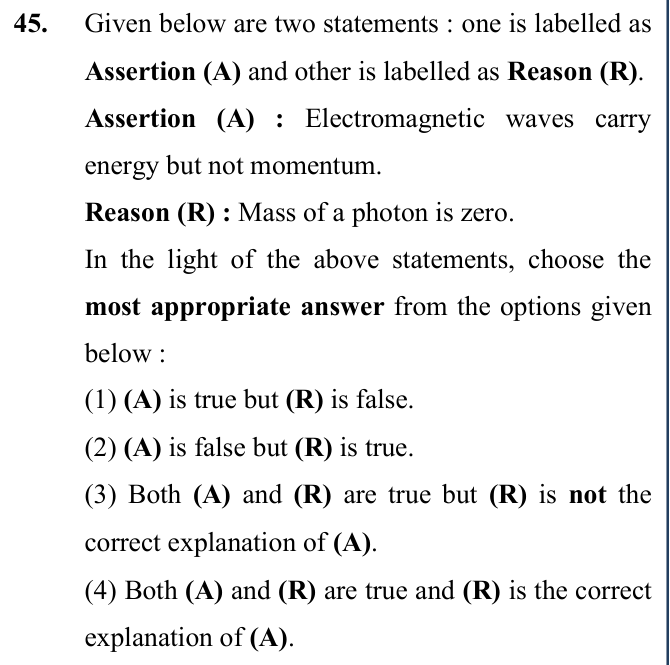
(1) (A) is true but (R) is false.
(2) (A) is false but (R) is true.
(3) Both (A) and (R) are true but (R) is not the
correct explanation of (A).
(4) Both (A) and (R) are true and (R) is the correct
explanation of (A).
Assertion is false because em waves have
momentum.
SECTION-B
QUESTION 4
Oscillations
SECTION A · MCQ (+4, -1)
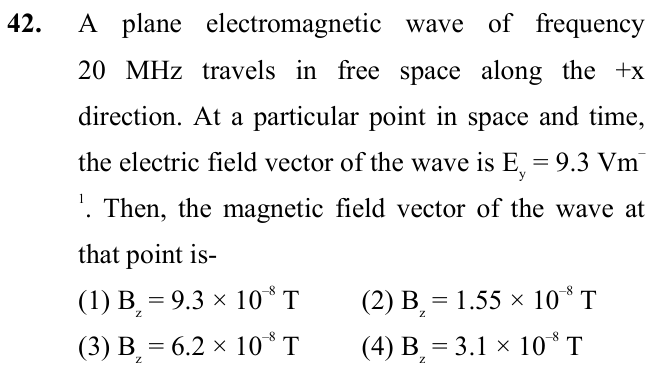
(1) Bz = 9.3 × 10
–8 T
(2) Bz = 1.55 × 10
–8 T
(3) Bz = 6.2 × 10
–8 T
(4) Bz = 3.1 × 10
–8 T
E = BC
9.3 = B × 3 × 10
8 = ×
8
9.3
B
3 10 = 3.1 × 10
–8 T
QUESTION 5
Electromagnetic Induction
SECTION A · MCQ (+4, -1)
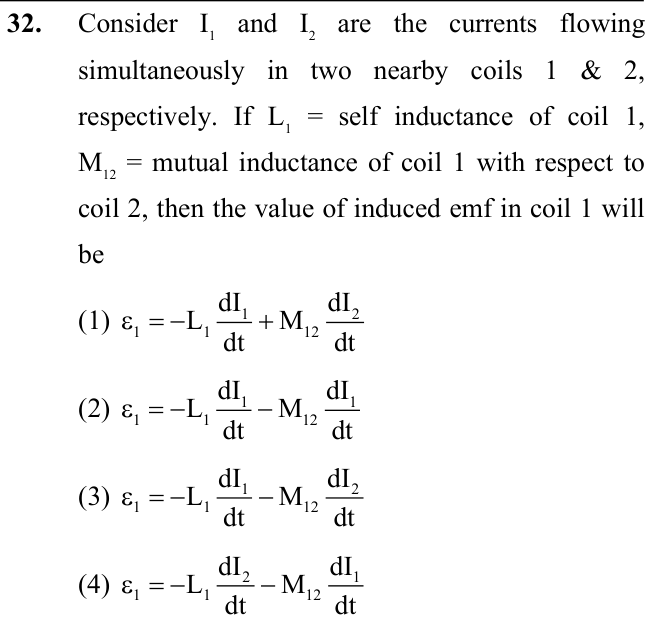
(1) 1
2
1
1
12
dI
dI
L
M
dt
dt
ε=-
+
(2) 1
1
1
1
12
dI
dI
L
M
dt
dt
ε=-
-
(3) 1
2
1
1
12
dI
dI
L
M
dt
dt
ε=-
-
(4) 2
1
1
1
12
dI
dI
L
M
dt
dt
ε=-
-
φ1 = L1 I1 + M12 I2
φ
ε=-
=- - 1
1
2
1
1
12
d
dI
dI
L
M
dt
dt
dt
QUESTION 6
Electromagnetic Induction
SECTION A · MCQ (+4, -1)
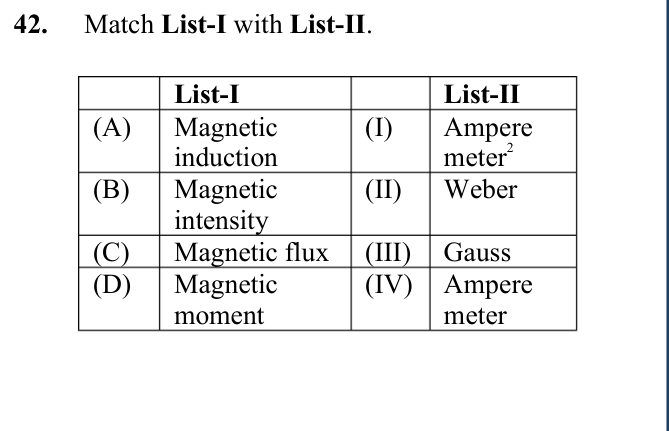
(1) (A)-(III), (B)-(IV), (C)-(I), (D)-(II)
(2) (A)-(III), (B)-(IV), (C)-(II), (D)-(I)
(3) (A)-(I), (B)-(II), (C)-(III), (D)-(IV)
(4) (A)-(III), (B)-(II), (C)-(I), (D)-(IV)
(A) Magnetic induction → Gauss (III)
(B) Magnetic intensity
B
H
Ampere / meter
) = →
(
μ
[
)
(IV)
(C) Magnetic flux → Weber (Wb) (II)
(D) Magnetic moment → Ampere-meter
2
(
)
M
iA = Note : None of the option(s) are correct but if
we need to choose most appropriate option then
the answer is (2)
QUESTION 7
Electric Charges and Fields
SECTION A · MCQ (+4, -1)
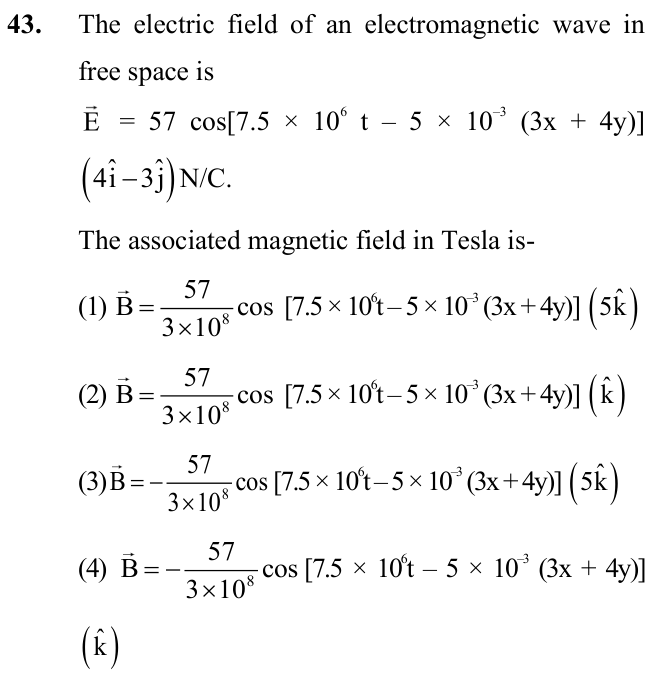
(1) = × 8
57
B
cos
3 10
[7.5 × 10
6t – 5 × 10
–3 (3x + 4y)] (
)
ˆ
5k
(2) = × 8
57
B
cos
3 10
[7.5 × 10
6t – 5 × 10
–3 (3x + 4y)] ()
ˆk
(3) =- × 8
57
B
cos
3 10
[7.5 × 10
6t – 5 × 10
–3 (3x + 4y)] (
)
ˆ
5k
(4) =-×
8
57
B
cos
3 10
[7.5 × 10
6t – 5 × 10
–3 (3x + 4y)]
()
ˆk
= + ˆ
ˆ
K
3i
4j + =
ˆ
ˆ
3i
4j
ˆK
5 = ˆ
ˆ
4i – 3j
ˆE
5 = ×
ˆ
ˆ
ˆ
B
K
E = ˆ
ˆ
B
–Z
B0 = = ×
0
8
E
57
C
3 10
7
QUESTION 8
Current Electricity
SECTION A · MCQ (+4, -1)
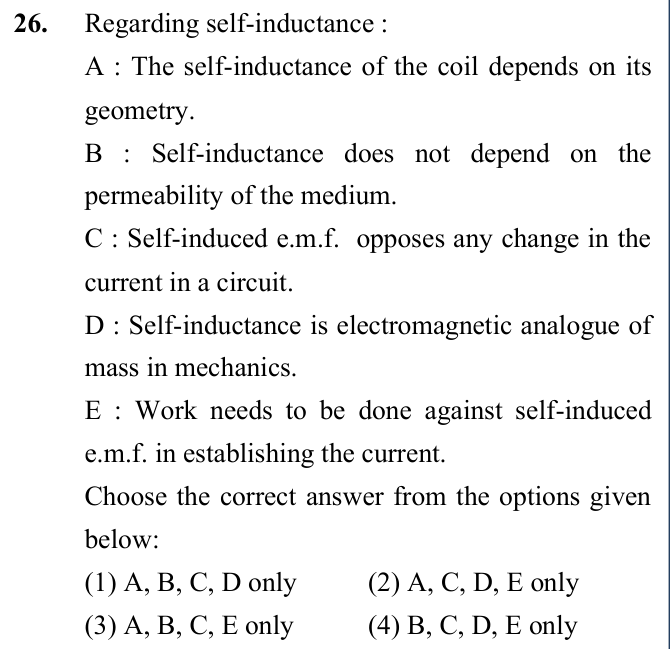
(1) A, B, C, D only
(2) A, C, D, E only
(3) A, B, C, E only
(4) B, C, D, E only
Self inductance of coil
L = μ
π
2
0N A
2 R
QUESTION 9
Electromagnetic Induction
SECTION A · MCQ (+4, -1)
An AC generator works on the principle of
(1) electromagnetic induction
(2) electrostatic repulsion
(3) photoelectric effect
(4) magnetic resonance
An AC generator induces an emf by rotating a coil in a magnetic field.