
⚡ OFFICIAL NTA ASSESSMENT GENERATOR & WORD (.DOCX) EXPORTER
Alternating Current · Practice Worksheet
JEE Main Physics · Curated Assessment Set Print directly or export as a beautifully formatted Microsoft Word document with embedded 180-DPI mathematical prompt clips and step-by-step derivations.
EDUPROD JEE MAIN TEST SERIES · NTA PATTERN
Alternating Current · Practice Worksheet
JEE Main Physics · Curated Assessment Set · Assessment Code: JEE-101
Total Marks: 200
Marking: +4 / -1 (Sec A) · +4 / 0 (Sec B)
QUESTION 1
PHYSICS · Current Electricity
SECTION A · MCQ (+4, -1)
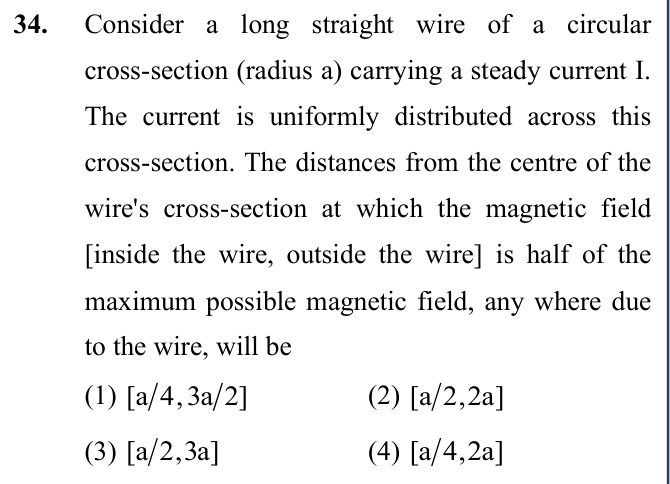
Candidate Response:
(1) (2) (3) (4)
QUESTION 2
PHYSICS · Oscillations
SECTION A · MCQ (+4, -1)
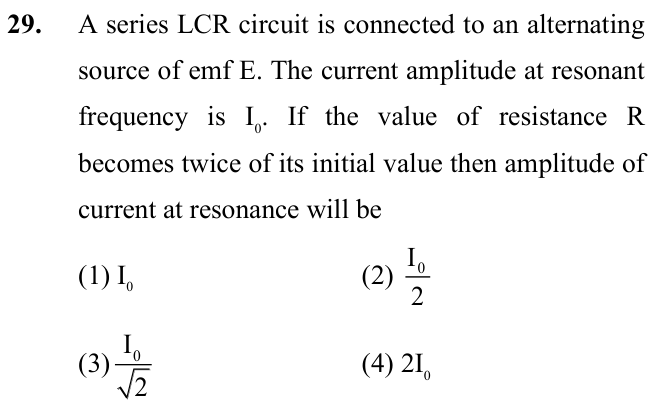
Candidate Response:
(1) (2) (3) (4)
QUESTION 3
PHYSICS · Current Electricity
SECTION A · MCQ (+4, -1)
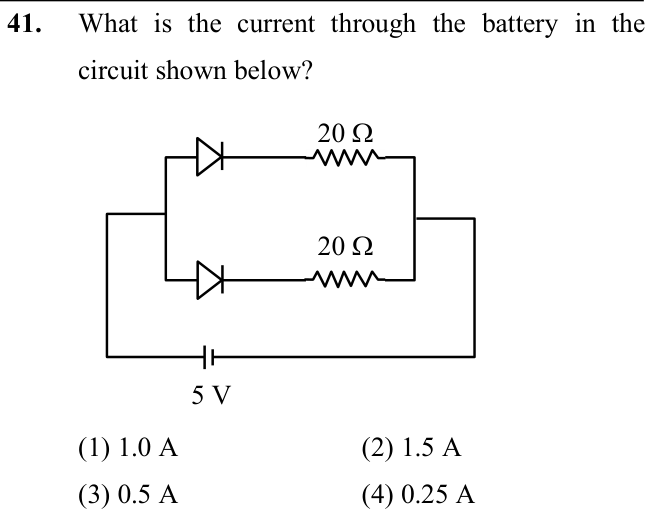
Candidate Response:
(1) (2) (3) (4)
QUESTION 4
PHYSICS · Motion in a Straight Line
SECTION B · NUMERICAL (+4, 0)
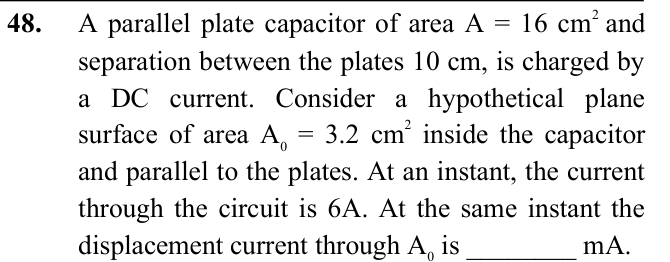
Numerical Value:
[ ]
QUESTION 5
PHYSICS · Oscillations
SECTION B · NUMERICAL (+4, 0)
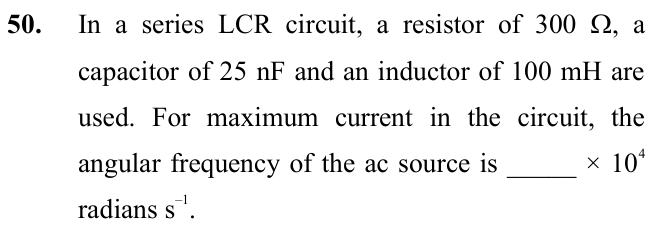
Numerical Value:
[ ]
QUESTION 6
PHYSICS · Moving Charges and Magnetism
SECTION B · NUMERICAL (+4, 0)
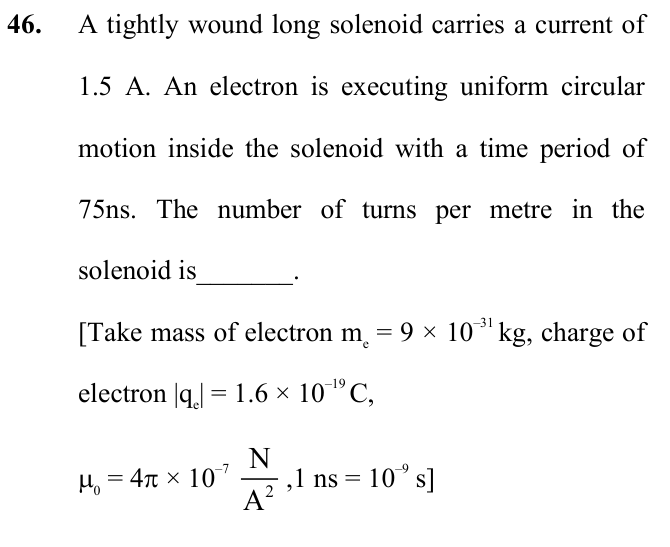
Numerical Value:
[ ]
QUESTION 7
PHYSICS · Current Electricity
SECTION A · MCQ (+4, -1)
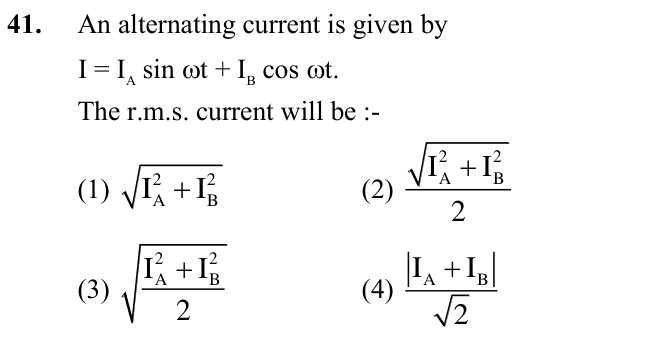
Candidate Response:
(1) (2) (3) (4)
QUESTION 8
PHYSICS · Current Electricity
SECTION B · NUMERICAL (+4, 0)
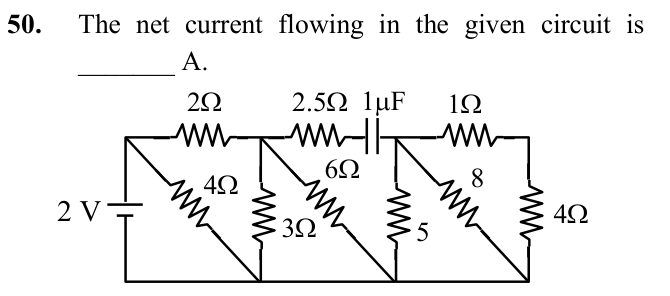
Numerical Value:
[ ]
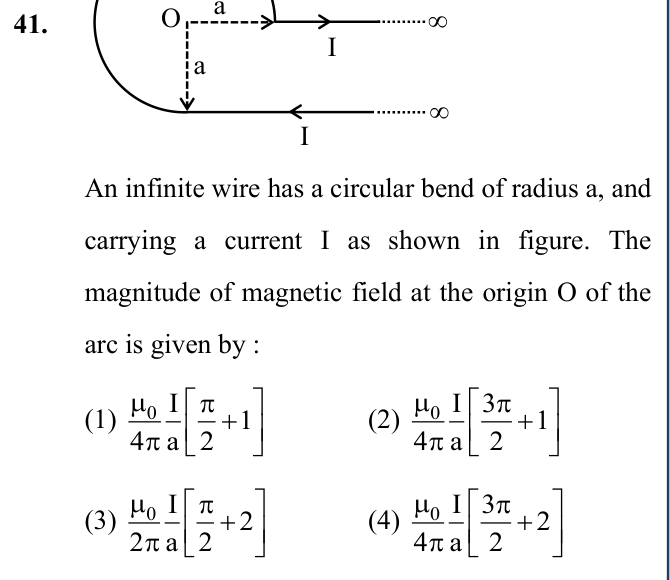
QUESTION 9
PHYSICS · Current Electricity
SECTION A · MCQ (+4, -1)
Candidate Response:
(1) (2) (3) (4)
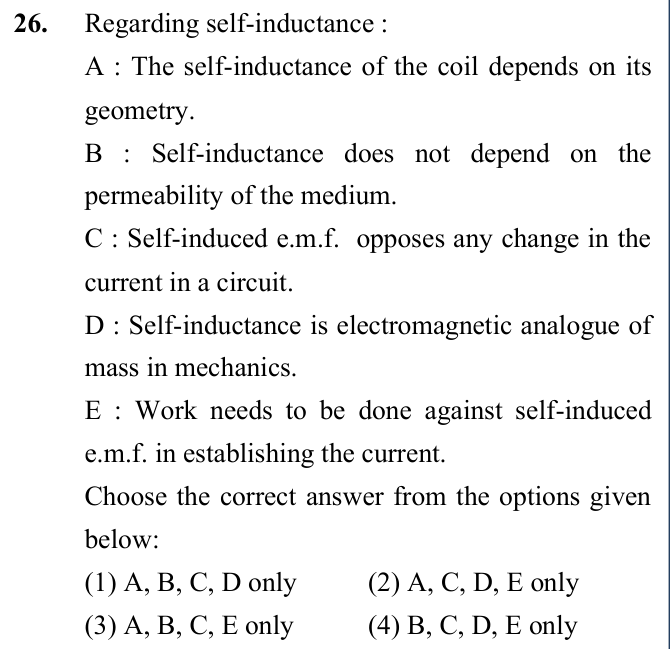
QUESTION 10
PHYSICS · Current Electricity
SECTION A · MCQ (+4, -1)
Candidate Response:
(1) (2) (3) (4)
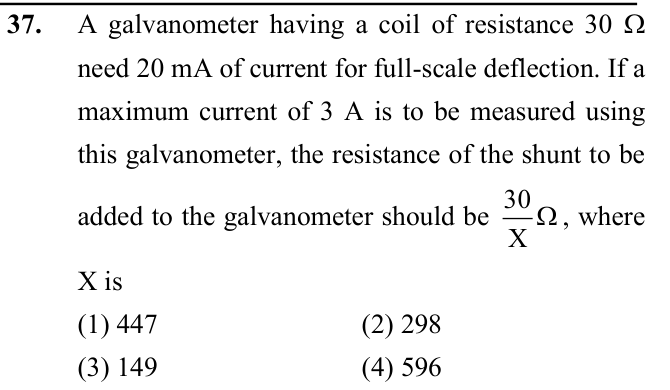
QUESTION 11
PHYSICS · Current Electricity
SECTION A · MCQ (+4, -1)
Candidate Response:
(1) (2) (3) (4)
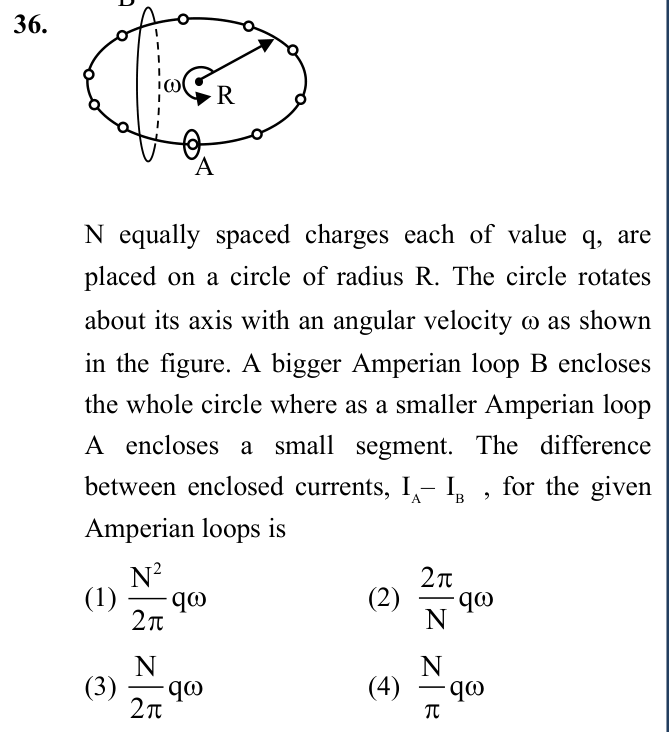
QUESTION 12
PHYSICS · Motion in a Straight Line
SECTION A · MCQ (+4, -1)
Candidate Response:
(1) (2) (3) (4)
QUESTION 13
PHYSICS · Current Electricity
SECTION B · NUMERICAL (+4, 0)
Numerical Value:
[ ]
QUESTION 14
PHYSICS · Electrostatic Potential & Capacitance
SECTION B · NUMERICAL (+4, 0)
Numerical Value:
[ ]
QUESTION 15
PHYSICS · Electrostatic Potential & Capacitance
SECTION B · NUMERICAL (+4, 0)
Numerical Value:
[ ]
QUESTION 16
PHYSICS · Current Electricity
SECTION A · MCQ (+4, -1)
Candidate Response:
(1) (2) (3) (4)
QUESTION 17
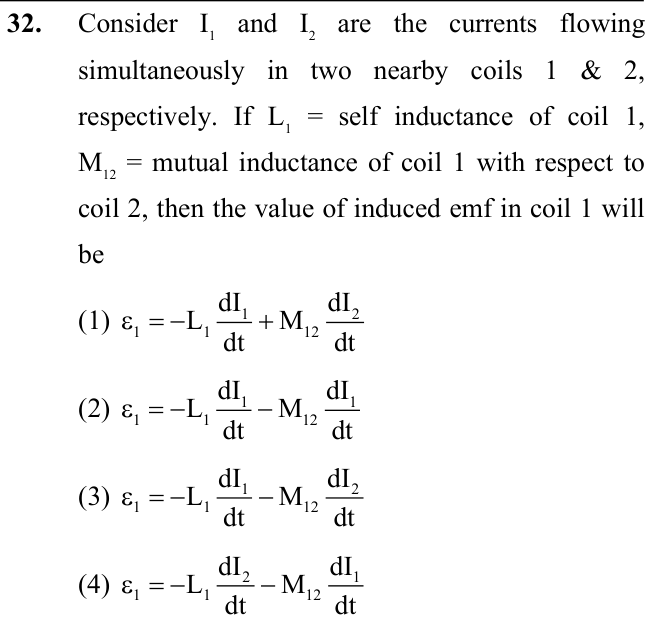
PHYSICS · Electromagnetic Induction
SECTION A · MCQ (+4, -1)
Candidate Response:
(1) (2) (3) (4)
QUESTION 18
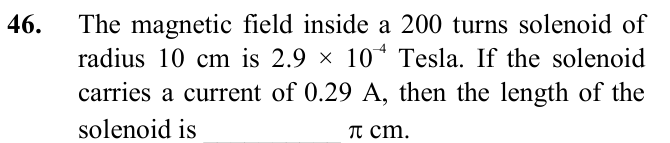
PHYSICS · Moving Charges and Magnetism
SECTION B · NUMERICAL (+4, 0)
Numerical Value:
[ ]
QUESTION 19
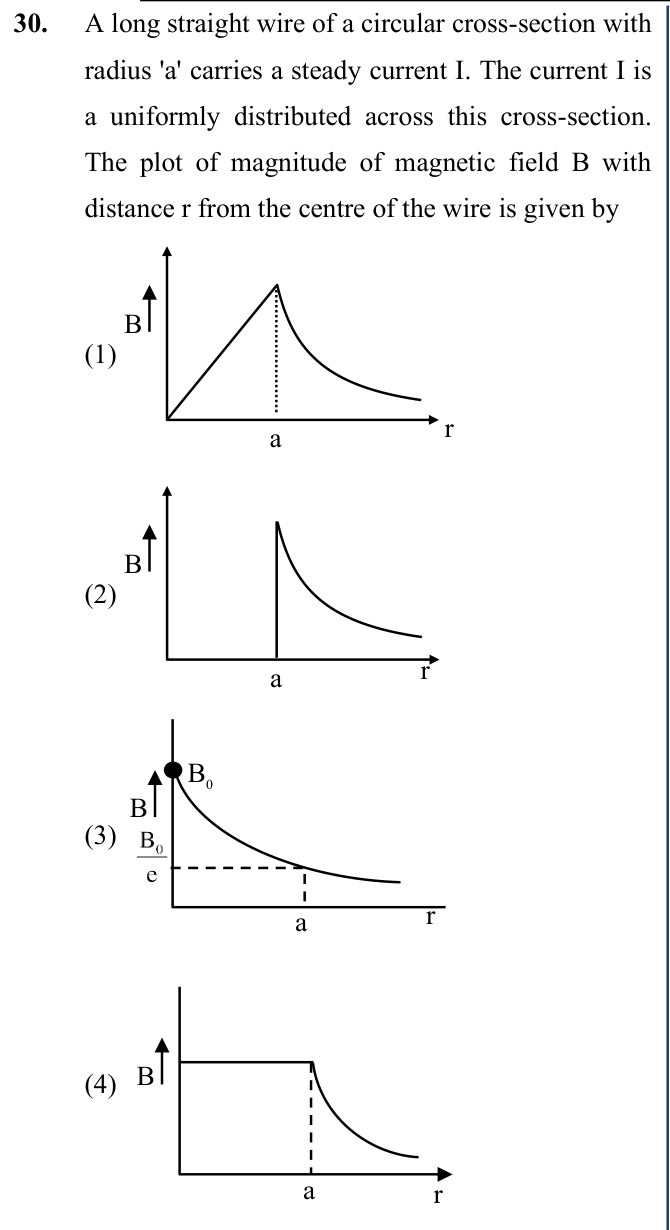
PHYSICS · Current Electricity
SECTION A · MCQ (+4, -1)
Candidate Response:
(1) (2) (3) (4)
QUESTION 20
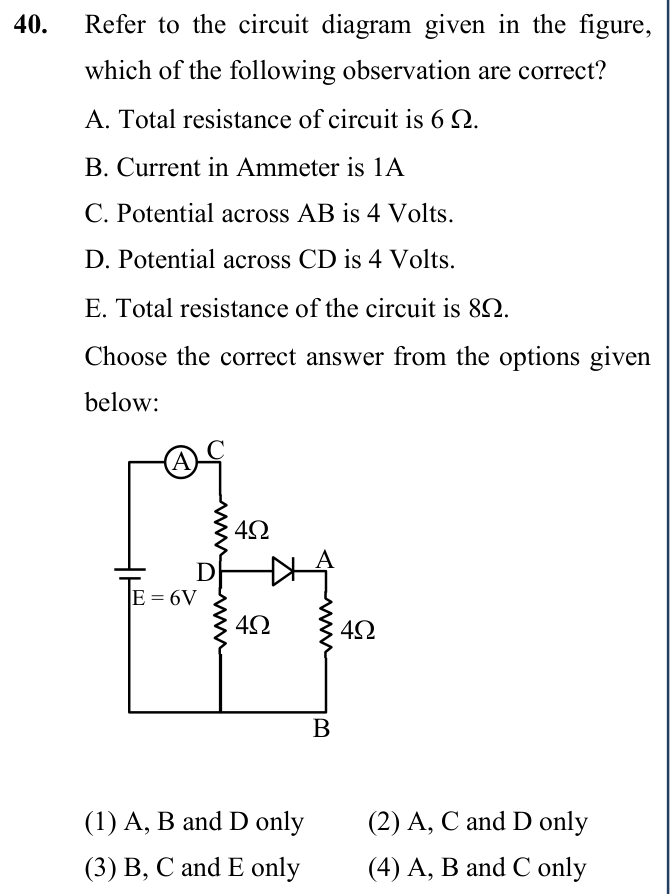
PHYSICS · Current Electricity
SECTION A · MCQ (+4, -1)
Candidate Response:
(1) (2) (3) (4)
QUESTION 21
PHYSICS · Current Electricity
SECTION B · NUMERICAL (+4, 0)
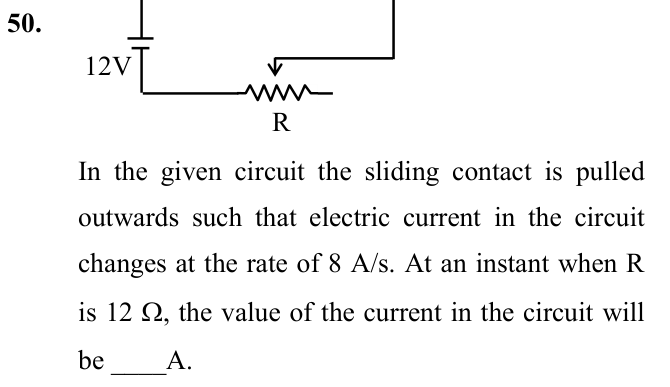
Numerical Value:
[ ]
QUESTION 22
PHYSICS · Semiconductor Electronics
SECTION A · MCQ (+4, -1)
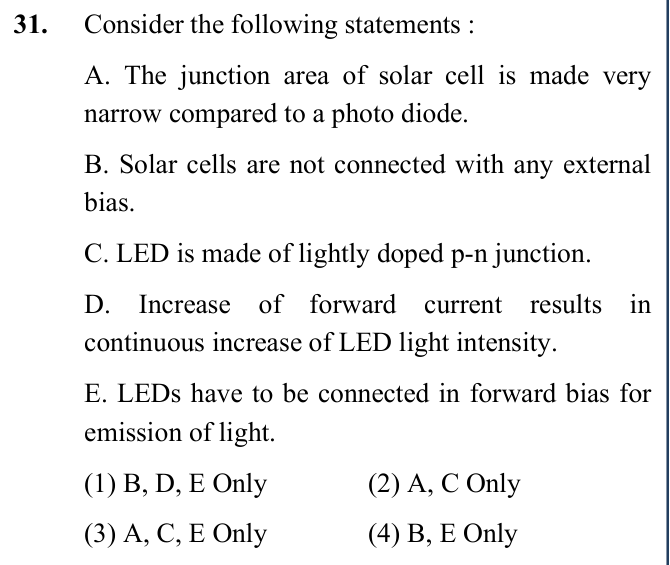
Candidate Response:
(1) (2) (3) (4)
QUESTION 23
PHYSICS · Electrostatic Potential & Capacitance
SECTION B · NUMERICAL (+4, 0)
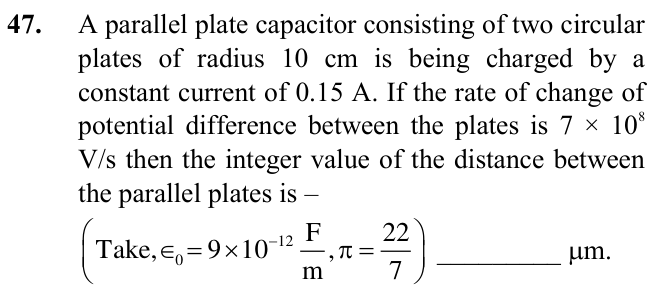
Numerical Value:
[ ]
QUESTION 24
PHYSICS · Electrostatic Potential & Capacitance
SECTION A · MCQ (+4, -1)
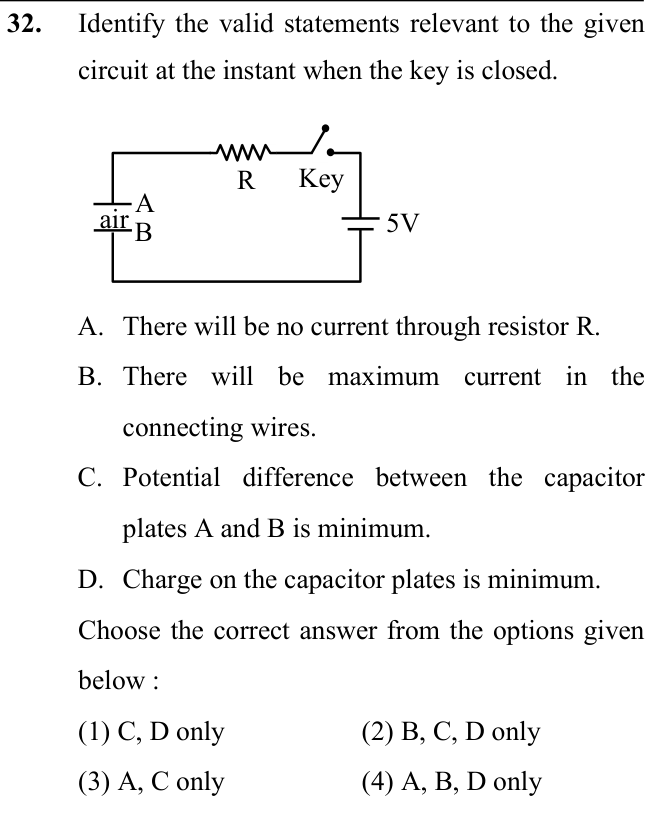
Candidate Response:
(1) (2) (3) (4)
QUESTION 25
PHYSICS · Current Electricity
SECTION A · MCQ (+4, -1)
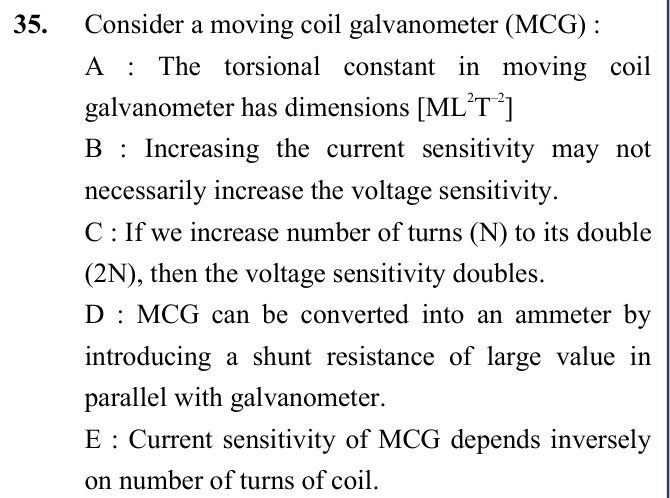
Candidate Response:
(1) (2) (3) (4)
QUESTION 26
PHYSICS · Current Electricity
SECTION B · NUMERICAL (+4, 0)
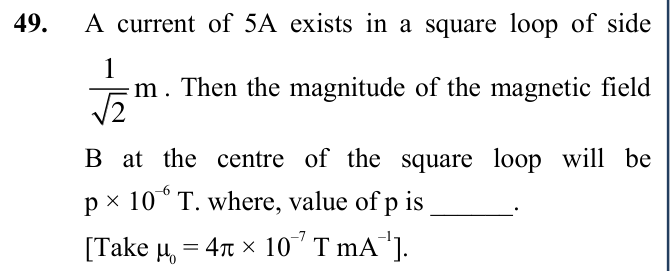
Numerical Value:
[ ]
QUESTION 27
PHYSICS · Alternating Current
SECTION A · MCQ (+4, -1)
A capacitor of C = 10 μF is connected to a 50 Hz AC supply. Its capacitive reactance is (π = 3.14):
(1) 3180 Ω
(2) 31.8 Ω
(3) 3.18 Ω
(4) 318 Ω
Candidate Response:
(1) (2) (3) (4)
QUESTION 28
PHYSICS · Alternating Current
SECTION A · MCQ (+4, -1)
An ideal inductor behaves very differently for DC and for high-frequency AC. Which statement is correct?
(1) For DC (f = 0), X_L = 0, so the inductor acts like a short circuit; for high f, X_L is large and it blocks AC.
(2) At high frequency, X_L approaches zero, so the inductor passes all AC.
(3) X_L is independent of frequency, so DC and AC behave identically.
(4) For DC, X_L is infinite, so the inductor blocks DC completely.
Candidate Response:
(1) (2) (3) (4)
QUESTION 29
PHYSICS · Alternating Current
SECTION A · MCQ (+4, -1)
The household AC mains supply is rated at 220 V (RMS). What is the peak (maximum) value of this supply voltage?
(1) 440 V
(2) 220 V
(3) 311 V
(4) 110 V
Candidate Response:
(1) (2) (3) (4)
QUESTION 30
PHYSICS · Alternating Current
SECTION A · MCQ (+4, -1)
An inductor of inductance L = 0.1 H is connected to an AC source of frequency f = 50 Hz. Its inductive reactance is (π = 3.14):
(1) 3.14 Ω
(2) 314 Ω
(3) 0.1 Ω
(4) 31.4 Ω
Candidate Response:
(1) (2) (3) (4)
QUESTION 31
PHYSICS · Alternating Current
SECTION A · MCQ (+4, -1)
The capacitive reactance of a capacitor of capacitance C at angular frequency ω is
(1) 1/ωC
(2) ωC
(3) ω/C
(4) C/ω
Candidate Response:
(1) (2) (3) (4)
QUESTION 32
PHYSICS · Alternating Current
SECTION A · MCQ (+4, -1)
An inductor of 0.2 H has an inductive reactance of 125.6 Ω. The frequency of the AC source is (π = 3.14):
(1) 100 Hz
(2) 50 Hz
(3) 200 Hz
(4) 20 Hz
Candidate Response:
(1) (2) (3) (4)
QUESTION 33
PHYSICS · Alternating Current
SECTION A · MCQ (+4, -1)
The average power dissipated in a resistor R connected to an AC source of RMS voltage V is
(1) V/R
(2) 2V²/R
(3) V²/R
(4) V²/2R
Candidate Response:
(1) (2) (3) (4)
QUESTION 34
PHYSICS · Alternating Current
SECTION A · MCQ (+4, -1)
In a purely inductive AC circuit, the current lags the applied voltage by
(1) 0°
(2) 45°
(3) 180°
(4) 90°
Candidate Response:
(1) (2) (3) (4)
QUESTION 35
PHYSICS · Alternating Current
SECTION A · MCQ (+4, -1)
In a series LCR circuit, the impedance Z is correctly given by:
(1) Z = R + X_L + X_C
(2) Z = √[R² + (X_L − X_C)²]
(3) Z = R + X_L − X_C
(4) Z = √[R² + (X_L + X_C)²]
Candidate Response:
(1) (2) (3) (4)
QUESTION 36
PHYSICS · Alternating Current
SECTION A · MCQ (+4, -1)
For an ideal transformer, the correct relationship between primary (p) and secondary (s) voltages, currents, and turns is:
(1) V_s × V_p = N_s × N_p
(2) V_s/V_p = N_p/N_s = I_s/I_p
(3) V_s/V_p = N_s/N_p = I_p/I_s
(4) V_s/V_p = N_s/N_p = I_s/I_p
Candidate Response:
(1) (2) (3) (4)
QUESTION 37
PHYSICS · Alternating Current
SECTION A · MCQ (+4, -1)
In a purely resistive AC circuit, how are the instantaneous voltage and current related?
(1) Voltage and current are in antiphase (180° apart).
(2) Current leads voltage by 90°.
(3) Current lags voltage by 90°.
(4) Voltage and current are in phase (zero phase difference).
Candidate Response:
(1) (2) (3) (4)
QUESTION 38
PHYSICS · Alternating Current
SECTION A · MCQ (+4, -1)
An electric current whose magnitude changes continuously and whose direction reverses periodically is called
(1) direct current
(2) steady current
(3) alternating current
(4) pulsating current
Candidate Response:
(1) (2) (3) (4)
QUESTION 39
PHYSICS · Alternating Current
SECTION A · MCQ (+4, -1)
At resonance in a series LCR circuit, the impedance is
(1) maximum and equal to √(R² + X_L²)
(2) zero
(3) minimum and equal to R
(4) infinite
Candidate Response:
(1) (2) (3) (4)
QUESTION 40
PHYSICS · Alternating Current
SECTION A · MCQ (+4, -1)
The frequency of the AC mains supply used in India is
(1) 50 Hz
(2) 25 Hz
(3) 100 Hz
(4) 60 Hz
Candidate Response:
(1) (2) (3) (4)
QUESTION 41
PHYSICS · Alternating Current
SECTION A · MCQ (+4, -1)
A series LCR circuit has R = 40 Ω and impedance Z = 50 Ω; its power factor is
(1) 0.5
(2) 1.25
(3) 0.8
(4) 1.0
Candidate Response:
(1) (2) (3) (4)
QUESTION 42
PHYSICS · Alternating Current
SECTION A · MCQ (+4, -1)
As the frequency of the AC source increases, the inductive reactance of an inductor
(1) becomes zero
(2) remains constant
(3) decreases
(4) increases
Candidate Response:
(1) (2) (3) (4)
QUESTION 43
PHYSICS · Alternating Current
SECTION A · MCQ (+4, -1)
A series LCR circuit has L = 2 H and C = 8 μF. Its resonant angular frequency ω0 is:
(1) 250 rad/s
(2) 1000 rad/s
(3) 125 rad/s
(4) 500 rad/s
Candidate Response:
(1) (2) (3) (4)
QUESTION 44
PHYSICS · Alternating Current
SECTION A · MCQ (+4, -1)
A resistor of 100 Ω is connected to an AC source of 220 V (RMS). The average power dissipated is:
(1) 220 W
(2) 484 W
(3) 968 W
(4) 242 W
Candidate Response:
(1) (2) (3) (4)
QUESTION 45
PHYSICS · Alternating Current
SECTION A · MCQ (+4, -1)
The length of a phasor in phasor representation is equal to the
(1) peak (amplitude) value
(2) average value
(3) RMS value
(4) instantaneous value
Candidate Response:
(1) (2) (3) (4)
QUESTION 46
PHYSICS · Alternating Current
SECTION A · MCQ (+4, -1)
The power factor of an AC circuit is defined as:
(1) cos φ = Z/R
(2) cos φ = R/Z
(3) cos φ = R/X_C
(4) cos φ = X_L/R
Candidate Response:
(1) (2) (3) (4)
QUESTION 47
PHYSICS · Alternating Current
SECTION A · MCQ (+4, -1)
In a purely capacitive AC circuit, the current leads the applied voltage by
(1) 90°
(2) 45°
(3) 180°
(4) 0°
Candidate Response:
(1) (2) (3) (4)
QUESTION 48
PHYSICS · Alternating Current
SECTION A · MCQ (+4, -1)
The power factor of an AC circuit is given by
(1) cos φ = R/X_C
(2) cos φ = X_L/R
(3) cos φ = R/Z
(4) cos φ = Z/R
Candidate Response:
(1) (2) (3) (4)
QUESTION 49
PHYSICS · Alternating Current
SECTION A · MCQ (+4, -1)
In a purely capacitive AC circuit, what is the phase relationship between the current and the applied voltage?
(1) Current leads voltage by 45°.
(2) Current and voltage are in phase.
(3) Current leads voltage by 90°.
(4) Current lags voltage by 90°.
Candidate Response:
(1) (2) (3) (4)
QUESTION 50
PHYSICS · Alternating Current
SECTION A · MCQ (+4, -1)
Two alternating voltages of the same frequency, 3 V and 4 V peak, are in phase. The peak value of their resultant is:
(1) 12 V
(2) 5 V
(3) 1 V
(4) 7 V
Candidate Response:
(1) (2) (3) (4)