
✎ ANSWER ONLINE · EVERY MISTAKE LINKS BACK TO THE CONCEPT
Alternating Current · Practice Worksheet
Answer each question here and it marks straight away, with the derivation and a link to the exact micro-concept to revisit.
1 question from this set could not be marked online — a
bonus or dual-key question, which has no single defensible answer. The print and
.docx versions still include it.
// CONCEPT AUDIT RESULT
Everything you missed has been added to your Error Arena — retest them blind there, and a concept clears once you get it right.
QUESTION 1
Current Electricity
SECTION A · MCQ (+4, -1)
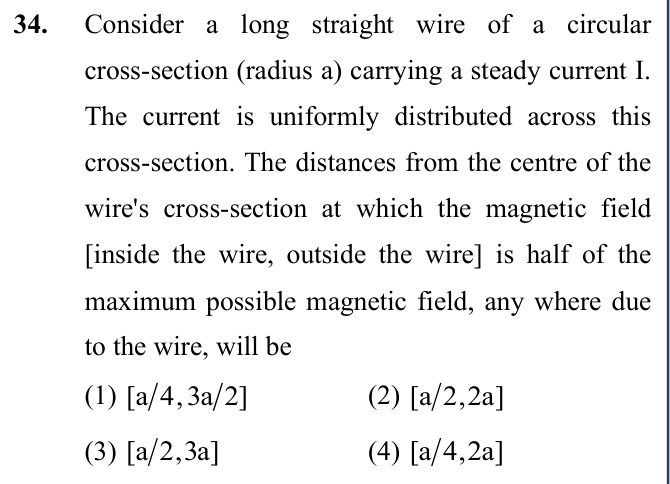
(1) [a 4, 3a 2]
(2) [a 2,2a]
(3) [a 2,3a]
(4) [a 4,2a]
Maximum possible magnetic field is at the surface
μ = π
0
max
I
B
2 a
μ = π
max
0
B
I
2
4 a
It can be obtained inside as well as outside the wire
For inside,
μ
μ = π
π
0
0
2
I
Ir
4 a
2 a
⇒=a
r
2
For outside
μ
μ = π
π
0
0
I
I
4 a
2 r
⇒ r = 2a
Correct answer
]
[
]
{
}
a ,2a
2
QUESTION 2
Oscillations
SECTION A · MCQ (+4, -1)
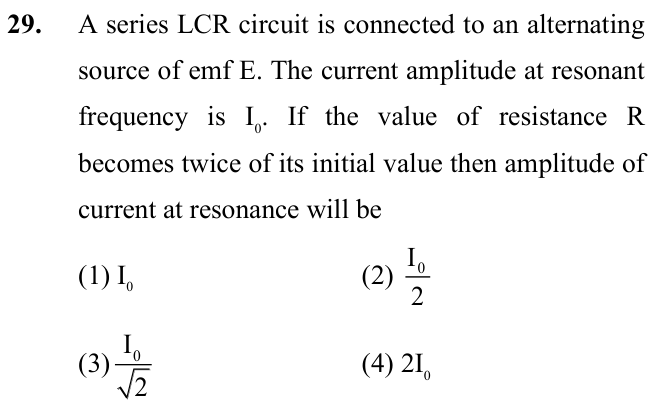
(1) I0
(2) 0I
2
(3) 0I
2
(4) 2I0
Initially,
m
0I
R
ε = Finally, 1
0
m
0
I
I
2R
2
ε = =
2
QUESTION 3
Current Electricity
SECTION A · MCQ (+4, -1)
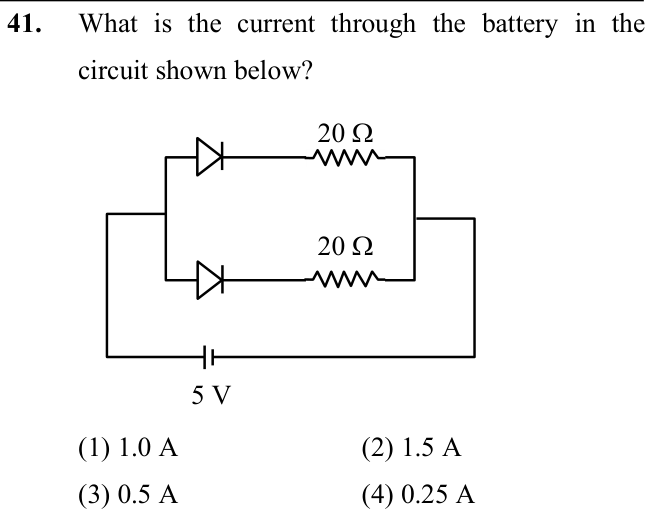
(1) 1.0 A
(2) 1.5 A
(3) 0.5 A
(4) 0.25 A
Both are forward biased
hence Req = 10 Ω = = = V
5
1
i
A
R
10
2
QUESTION 4
Motion in a Straight Line
SECTION B · NUMERICAL (+4, 0)
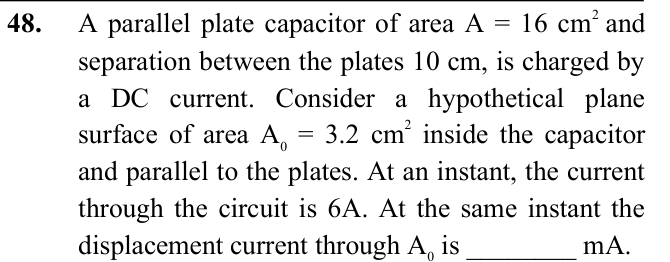
Jd = = I
6
A
16
∴I through small area = Jd × A’ =
6
16 × 3.2 =
1.2A =1200 mA
QUESTION 5
Oscillations
SECTION B · NUMERICAL (+4, 0)
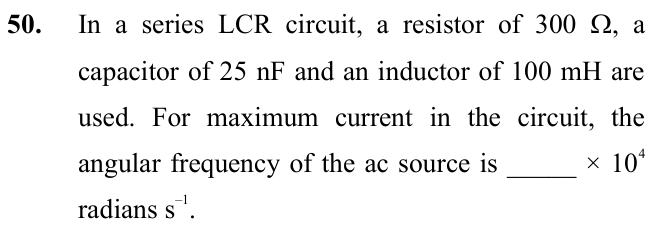
ω=
1
LC - ω= × × × –9
3
1
25 10
100 10 + ω= = ×
6
10
2
5 10
1
JEE–MAIN EXAMINATION – JANUARY 2025
QUESTION 6
Moving Charges and Magnetism
SECTION B · NUMERICAL (+4, 0)
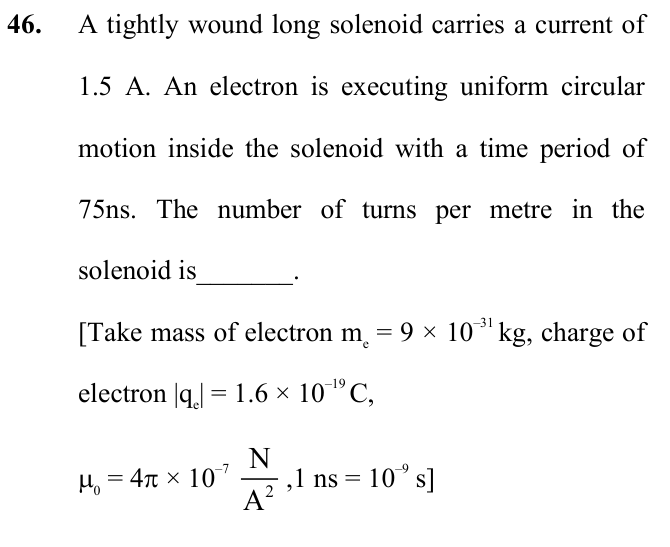
Since time period of a revolving charge is 2 m
qB
π
Where B = magnetic field
due to a solenoid = µ0nI
0
2 m
T
q(µ nI)
π
∴ = 31
9
19
7
(2 )(9 10
)
75 10
1.6 10
4
10
n 1.5 - - - -
π × × = ×
×π× × ×
N = 250
8
QUESTION 7
Current Electricity
SECTION A · MCQ (+4, -1)
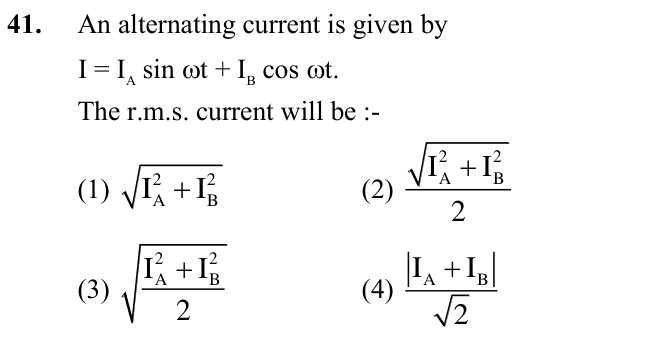
(1) 2
2
A
B
I
I
+
(2) 2
2
A
B
I
I
2
+
(3) 2
2
A
B
I
I
2
+
(4) A
B
I
I
2
+
2
rms
I dt
i
dt
=∫
∫
2
2
A
B
rms
I
I
i
2 + =
5
QUESTION 8
Current Electricity
SECTION B · NUMERICAL (+4, 0)
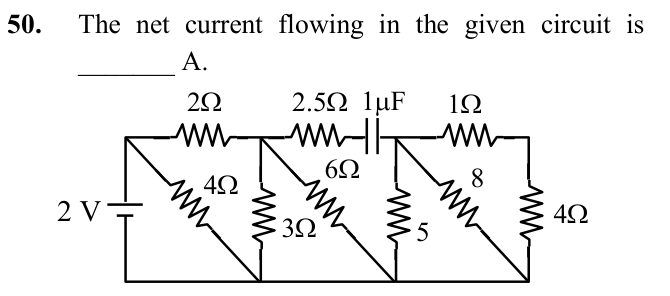
2 V
6Ω
3Ω
4Ω
2Ω
Req = 2Ω
I = 2
2 = 1A
1
JEE–MAIN EXAMINATION – JANUARY 2025
QUESTION 9
Current Electricity
SECTION A · MCQ (+4, -1)
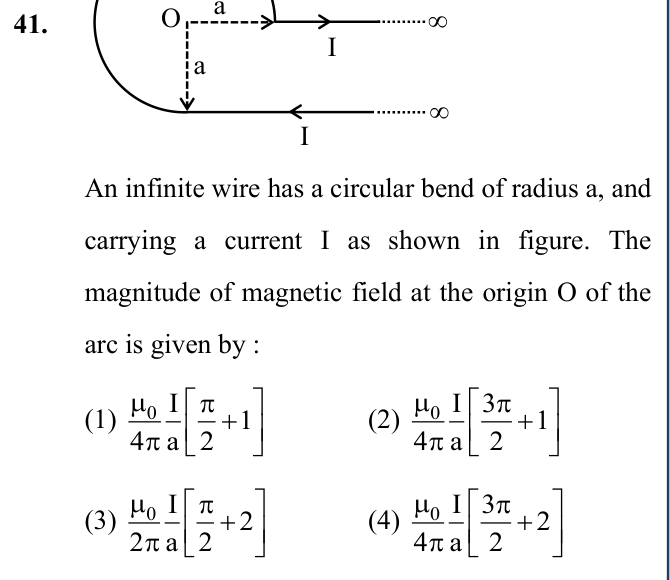
(1) 0 I
1
4 a 2
μ
π
] + [
]
π
{
}
(2) 0 I 3
1
4 a
2
μ
π
] + [
]
π
{
}
(3) 0 I
2
2 a 2
μ
π
] + [
]
π
{
}
(4) 0 I 3
2
4 a
2
μ
π
] + [
]
π
{
}
a
a
(1)
∞
∞
O
(3)
(2)
0
1
i
B
4 a
μ = ⊗
π
0
2
i 3
B
4 a
2
μ
π
) = ⊗
(
π
[
)
B3 = 0
0 i
3
B
1
4 a
2
μ
π
) = ⊗
(
π
[
)
QUESTION 10
Current Electricity
SECTION A · MCQ (+4, -1)
(1) A, B, C, D only
(2) A, C, D, E only
(3) A, B, C, E only
(4) B, C, D, E only
Self inductance of coil
L = μ
π
2
0N A
2 R
QUESTION 11
Current Electricity
SECTION A · MCQ (+4, -1)
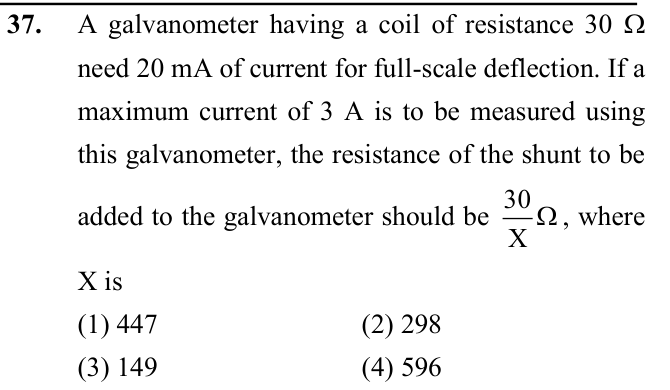
(1) 447
(2) 298
(3) 149
(4) 596
rs
(I–Ig)
I
Ig
G.M.
Ig Rg = (I – Ig) rs
20 × 10
–3 × 30 = (3 – 0.02) × rs
) = =
(
[
)
s
0.6
30
r
2.98
x × )
=(
[
)
2.98 30
x
0.6
= 149
QUESTION 12
Motion in a Straight Line
SECTION A · MCQ (+4, -1)
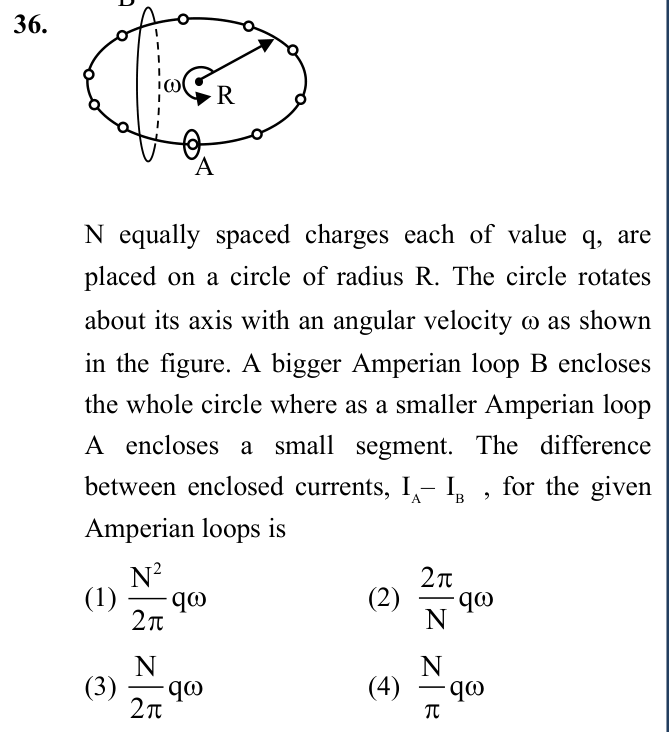
(1) ω
π
2
N q
2
(2) 2 q
N
πω
(3) N q
2
ω
π
(4) N qω
π
A
B
q
R
ω = π
ω
A
Nq
I
2
ω = π
A
Nq
I
2
, IB = 0
ω - =
π
A
B
Nq
I
I
2
QUESTION 13
Current Electricity
SECTION B · NUMERICAL (+4, 0)
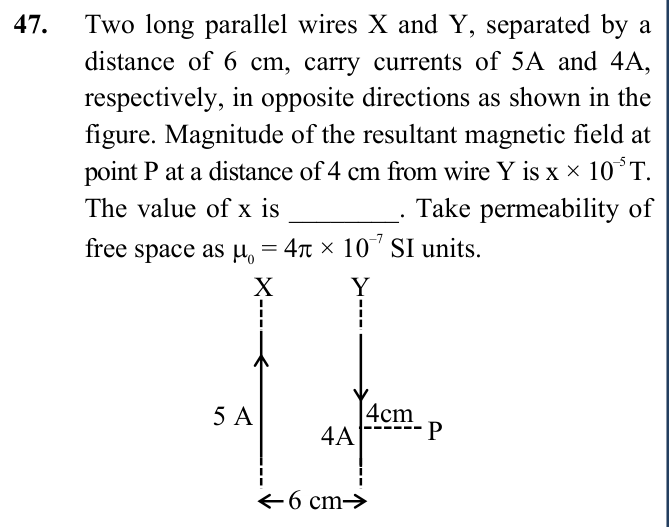
5 A
6 cm
X
Y
4cm P
4A
B = μ
μ
π×
π×
0
0
(5)
4
–
2
.01
2
0.04
= –
μ
π
0
100
4
= – 100 × 10
–7
= –1 × 10
–5 T
QUESTION 14
Electrostatic Potential & Capacitance
SECTION B · NUMERICAL (+4, 0)
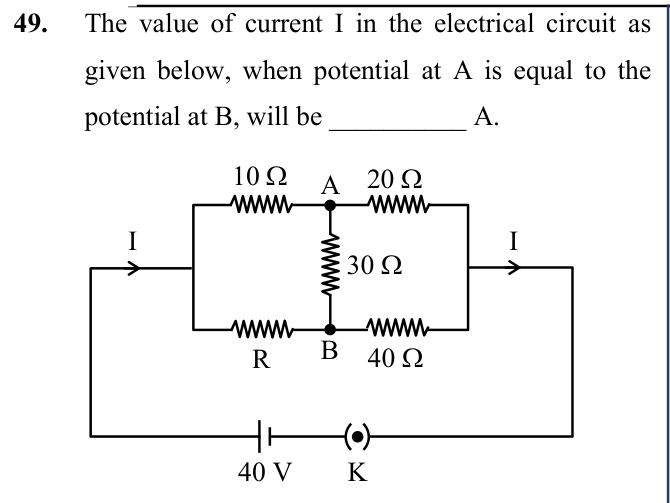
I
R
B
40 Ω
30 Ω
20 Ω
10 Ω
I
40 V
A
VA = VB ⇒ the bridge is balanced
⇒ 10
20
R
40 = R = 20Ω
40
I
2A
20 = =
QUESTION 15
Electrostatic Potential & Capacitance
SECTION B · NUMERICAL (+4, 0)
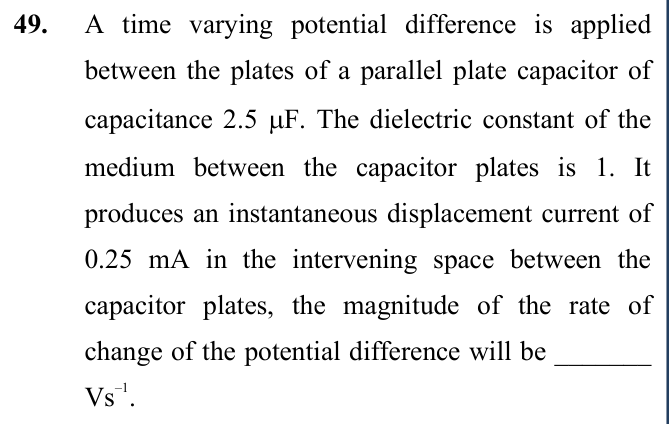
=
d
CdV
I
dt = dI
dV
dt
C - - × = × 3
6
0.25 10
2.5 10
= 100
QUESTION 16
Current Electricity
SECTION A · MCQ (+4, -1)
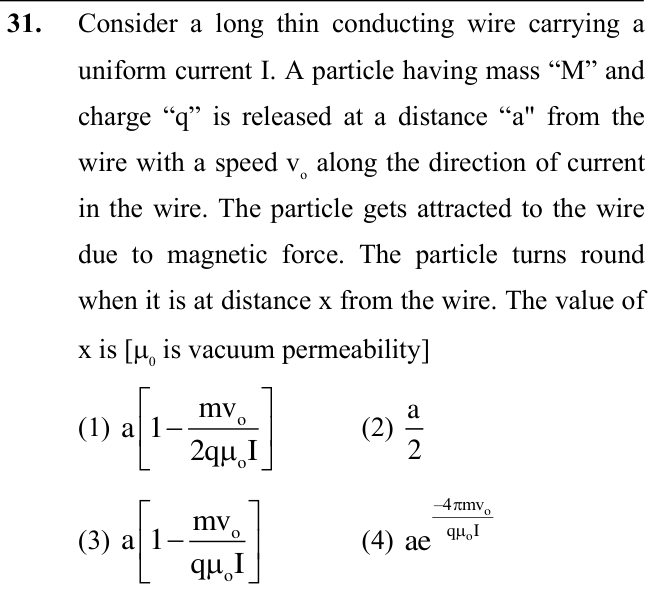
(1) o
o
mv
a 1
2q
I
] - [
]
μ
{
}
(2) a
2
(3) o
o
mv
a 1
q
I
] - [
]
μ
{
}
(4) o
o
–4 mv
q
I
ae
π
μ
x1
r
vx
vy
C
x
A
v0
vy
vx
v0 B
x
y
I
A → B
x
y
ˆ
ˆ
V
–v i
v j = +
0I
ˆ
B
(–k)
2 r
μ = π
0
x
y
Iq
ˆ
ˆ
F
q(v
B)
[–v j – v i]
2 r
μ = × = π
ax = –
y
0
v
Iq .
2 m
r
μ
π
ay = –
0
x
Iq v
.
2 m
r
μ
π
y
x
x
0
v
v dv
Iq
–
dr
2 m r
μ = π
x
x
0
y
v dv
Iq dr
–
v
2 m r
μ = π
0
1
v
x
x
x
0
2
2
0
a
0
x
v dv
Iq
dr
– 2 m
r
v – v
μ = π
∫
∫
Let, z
2 = v0
2 – vx
2
2zdz = –2vxdvx
3
zdz = – vxdvx
x
x
2
2
0
x
v dv
zdz
–dz
z
v – v - = = then integral becomes
0
0
0
1
v
Iq
x
– dz
–
ln
2 m
a
μ = π
∫
v0 =
0
1
Iq
x
–
ln
2 m
a
μ
π
x1 = a
0
0
2 mv
–
Iq
e
π
μ
……(1)
For B → C
x
y
ˆ
ˆ
v
–v i – v j = 0I
ˆ
B
(–k)
2 r
μ = π
0
x
y
Iq
ˆ
ˆ
F
q(v
B)
(–v j
v i)
2 r
μ = × = +
π
ax = +
y
0
v
Iq
2 m r
μ
π
ay = –
0
x
Iq v
.
2 m
r
μ
π
y
x
x
0
v
v dv
Iq
dr
2 m r
μ
=π
0
1
0
x
x
x
0
2
2
v
x
0
x
v dv
Iq
dr
2 m
r
v – v
μ
=π
∫
∫
0
v
0
0
1
0
Iq
x
ln
– dz
–v
2 m
x
μ = =
π
∫
x = x1
0
0
2 mv
–
Iq
e
π
μ
….. (2)
From equation 1 and 2
X = a
0
0
4 mv
–
Iq
e
π
μ
QUESTION 17
Electromagnetic Induction
SECTION A · MCQ (+4, -1)
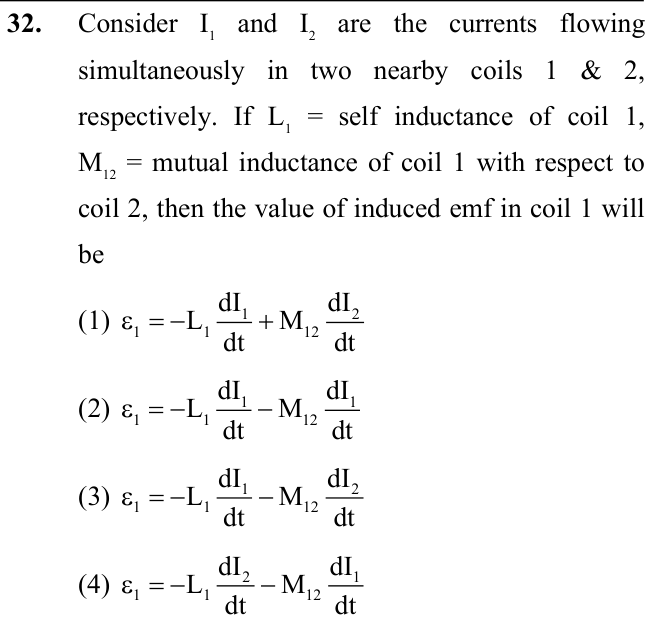
(1) 1
2
1
1
12
dI
dI
L
M
dt
dt
ε=-
+
(2) 1
1
1
1
12
dI
dI
L
M
dt
dt
ε=-
-
(3) 1
2
1
1
12
dI
dI
L
M
dt
dt
ε=-
-
(4) 2
1
1
1
12
dI
dI
L
M
dt
dt
ε=-
-
φ1 = L1 I1 + M12 I2
φ
ε=-
=- - 1
1
2
1
1
12
d
dI
dI
L
M
dt
dt
dt
QUESTION 18
Moving Charges and Magnetism
SECTION B · NUMERICAL (+4, 0)
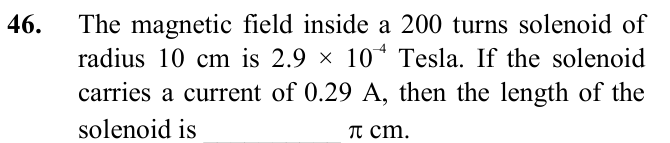
Assuming long solenoid
0
N
B
i
)
=μ(
[
)
(
)(
)(
)
7
0
4
4
10
200
0.29
Ni
m
B
2.9 10 - -
π×
μ = = × = 8π cm
QUESTION 19
Current Electricity
SECTION A · MCQ (+4, -1)
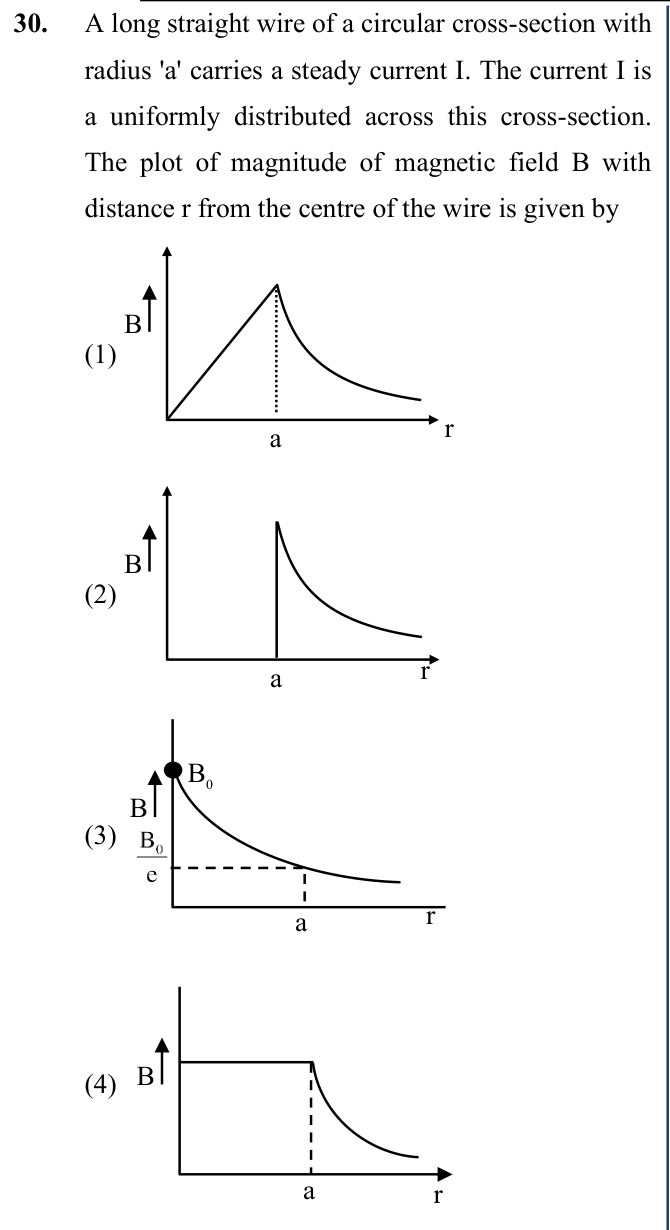
(1) r
B
a
(2) r
B
a
(3) r
B
a
B0
(4) r
B
a
a
I
(
)
μ × =
0
in
J
r
B
2
∝
in
B
r
Bout = μ
π
0I
2 r
∝
net
1
B
r
QUESTION 20
Current Electricity
SECTION A · MCQ (+4, -1)
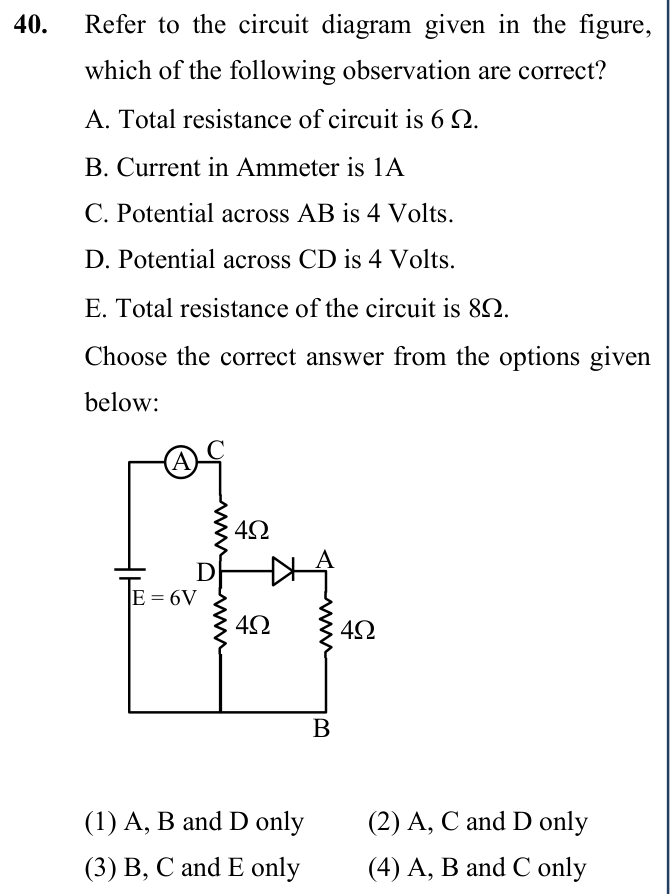
(1) A, B and D only
(2) A, C and D only
(3) B, C and E only
(4) A, B and C only
4Ω
6V
D
A
4Ω
B
A
C
4Ω
4
6
4
4Ω
⇓
⇓
6
2Ω
4Ω
⇓
6
6
Current through ammeter = 1 A
Rnet = 6Ω
6V
D
A
0.5A
B
A
C
0.5A
1A
VAB = 0.5 × 4 = 2 volt
VCD = 1 × 4 = 4 volt
A, B & D are correct
QUESTION 21
Current Electricity
SECTION B · NUMERICAL (+4, 0)
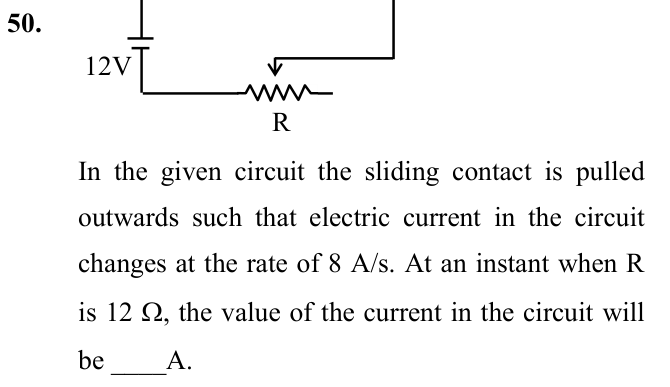
ε = LdI
–
– IR
0
dt
12 – 3 × (–8) – I × 12 = 0
I = 3
1
JEE–MAIN EXAMINATION – JANUARY 2025
QUESTION 22
Semiconductor Electronics
SECTION A · MCQ (+4, -1)
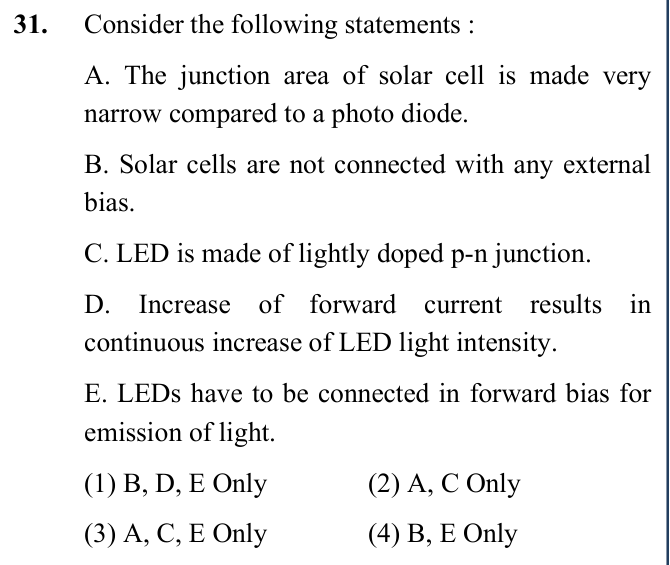
(1) B, D, E Only
(2) A, C Only
(3) A, C, E Only
(4) B, E Only
Conceptual
QUESTION 23
Electrostatic Potential & Capacitance
SECTION B · NUMERICAL (+4, 0)
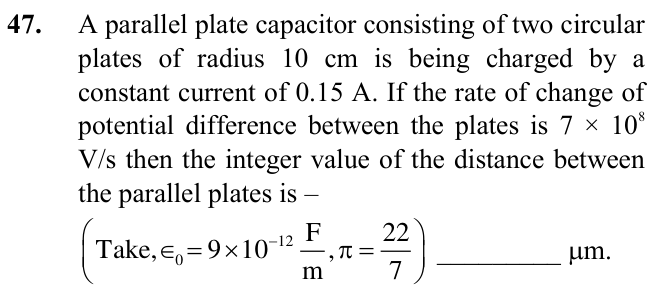
(
)
2
0
0
Q
it
itd
V
A
C
r
d = = = ∈
)
∈
π
(
[
)
(
)
2
0
r
v
d
i
t
∈
π
)
⇒ = (
[
)
(
)
(
)
(
)
2
12
8
22
9 10
0.1
7
7 10
m
0.15 - ) × (
[
) = ×
d = 1320 µm
QUESTION 24
Electrostatic Potential & Capacitance
SECTION A · MCQ (+4, -1)
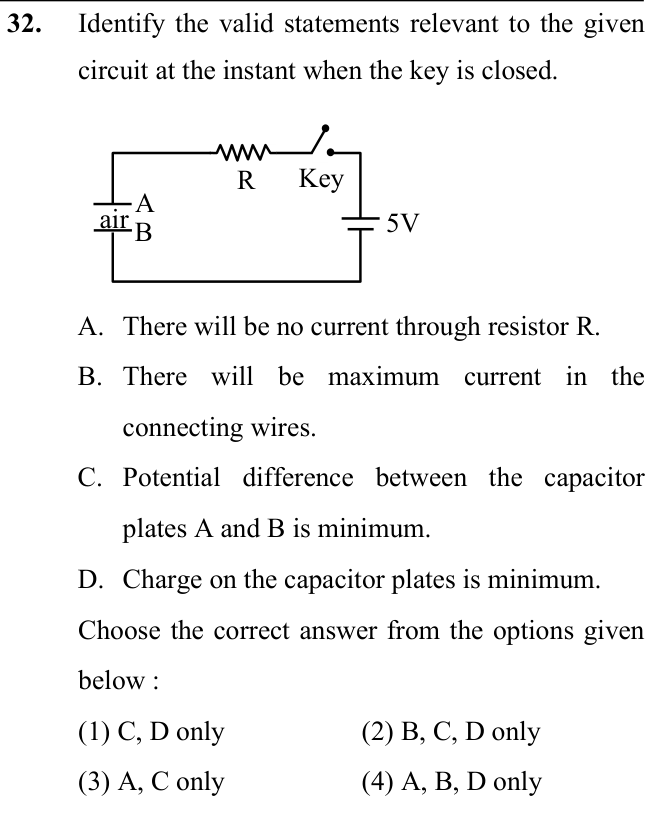
(1) C, D only
(2) B, C, D only
(3) A, C only
(4) A, B, D only
Initially capacitor behave as a short circuit.
So current will be maximum.
Charge on capacitor will be zero.
Potential difference across capacitor will be zero.
QUESTION 25
Current Electricity
SECTION A · MCQ (+4, -1)
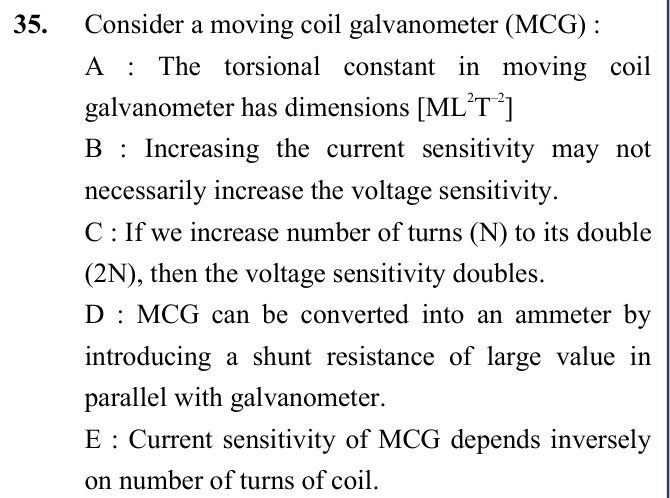
(1) A, B only
(2) A, D, only
(3) B, D, E only
(4) A, B, E only
(A) τ = Cθ ⇒ [ML
2T
–2] = [C][1]
(B) C.S = θ=BNA
I
C
;
V.S. = BNA
RC [R also depends on ‘N’]
(C)
NAB
V.S.
CR
∝
R → NR
(D) False [Theory]
(E) E [False]
C.S ∝ N
NAB
C.S.
C
⇒
=
QUESTION 26
Current Electricity
SECTION B · NUMERICAL (+4, 0)
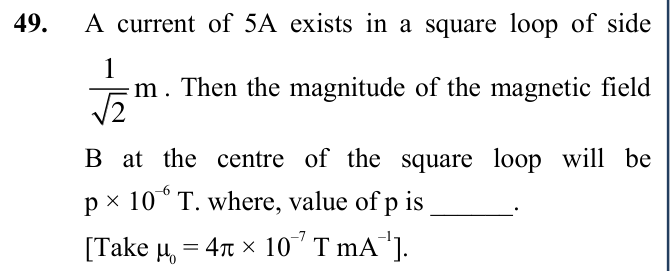
45°
45°
i=5A
Square loop
Let B be the magnetic field due to single side
then
(
)
0
1
2
i
B
sin
sin
4 d
μ = θ+
θ
π
7
6
10
5 2
1
2 10
1
2
2 2 - -
×× = × = ×
∴ Bnet at centre O = 4B
= 8 × 10
–6
∴ P = 8 Ans.
QUESTION 27
Alternating Current
SECTION A · MCQ (+4, -1)
A capacitor of C = 10 μF is connected to a 50 Hz AC supply. Its capacitive reactance is (π = 3.14):
(1) 3180 Ω
(2) 31.8 Ω
(3) 3.18 Ω
(4) 318 Ω
X_C = 1/(2πfC) = 1/(2 × 3.14 × 50 × 10 × 10⁻⁶) = 1/0.00314 ≈ 318 Ω.
QUESTION 28
Alternating Current
SECTION A · MCQ (+4, -1)
The household AC mains supply is rated at 220 V (RMS). What is the peak (maximum) value of this supply voltage?
(1) 440 V
(2) 220 V
(3) 311 V
(4) 110 V
Peak value V0 = V_rms × √2 = 220 × 1.414 ≈ 311 V.
QUESTION 29
Alternating Current
SECTION A · MCQ (+4, -1)
An inductor of inductance L = 0.1 H is connected to an AC source of frequency f = 50 Hz. Its inductive reactance is (π = 3.14):
(1) 3.14 Ω
(2) 314 Ω
(3) 0.1 Ω
(4) 31.4 Ω
X_L = ωL = 2πfL = 2 × 3.14 × 50 × 0.1 = 31.4 Ω.
QUESTION 30
Alternating Current
SECTION A · MCQ (+4, -1)
The capacitive reactance of a capacitor of capacitance C at angular frequency ω is
(1) 1/ωC
(2) ωC
(3) ω/C
(4) C/ω
Capacitive reactance is X_C = 1/ωC = 1/(2πfC).
QUESTION 31
Alternating Current
SECTION A · MCQ (+4, -1)
An inductor of 0.2 H has an inductive reactance of 125.6 Ω. The frequency of the AC source is (π = 3.14):
(1) 100 Hz
(2) 50 Hz
(3) 200 Hz
(4) 20 Hz
From X_L = 2πfL, f = X_L/(2πL) = 125.6/(2 × 3.14 × 0.2) = 125.6/1.256 = 100 Hz.
QUESTION 32
Alternating Current
SECTION A · MCQ (+4, -1)
The average power dissipated in a resistor R connected to an AC source of RMS voltage V is
(1) V/R
(2) 2V²/R
(3) V²/R
(4) V²/2R
Using RMS values, the average power in a pure resistor is P = V²/R.
QUESTION 33
Alternating Current
SECTION A · MCQ (+4, -1)
In a purely inductive AC circuit, the current lags the applied voltage by
(1) 0°
(2) 45°
(3) 180°
(4) 90°
In a pure inductor the current lags the voltage by a quarter cycle (90°).
QUESTION 34
Alternating Current
SECTION A · MCQ (+4, -1)
In a series LCR circuit, the impedance Z is correctly given by:
(1) Z = R + X_L + X_C
(2) Z = √[R² + (X_L − X_C)²]
(3) Z = R + X_L − X_C
(4) Z = √[R² + (X_L + X_C)²]
The resistor voltage and the net reactance voltage (X_L − X_C) are 90° apart, so the impedance is the hypotenuse of the impedance triangle: Z = √[R² + (X_L − X_C)²].
QUESTION 35
Alternating Current
SECTION A · MCQ (+4, -1)
For an ideal transformer, the correct relationship between primary (p) and secondary (s) voltages, currents, and turns is:
(1) V_s × V_p = N_s × N_p
(2) V_s/V_p = N_p/N_s = I_s/I_p
(3) V_s/V_p = N_s/N_p = I_p/I_s
(4) V_s/V_p = N_s/N_p = I_s/I_p
Voltage scales directly with the number of turns (V ∝ N), and, by energy conservation V_p I_p = V_s I_s, current scales inversely with voltage, giving V_s/V_p = N_s/N_p = I_p/I_s.
QUESTION 36
Alternating Current
SECTION A · MCQ (+4, -1)
In a purely resistive AC circuit, how are the instantaneous voltage and current related?
(1) Voltage and current are in antiphase (180° apart).
(2) Current leads voltage by 90°.
(3) Current lags voltage by 90°.
(4) Voltage and current are in phase (zero phase difference).
A resistor obeys Ohm's law v = iR at every instant, so if v = V0 sin(ωt) then i = (V0/R) sin(ωt): both peak and pass through zero at the same instants, giving zero phase difference.
QUESTION 37
Alternating Current
SECTION A · MCQ (+4, -1)
An electric current whose magnitude changes continuously and whose direction reverses periodically is called
(1) direct current
(2) steady current
(3) alternating current
(4) pulsating current
Alternating current varies and reverses direction each half-cycle.
QUESTION 38
Alternating Current
SECTION A · MCQ (+4, -1)
At resonance in a series LCR circuit, the impedance is
(1) maximum and equal to √(R² + X_L²)
(2) zero
(3) minimum and equal to R
(4) infinite
At resonance X_L = X_C, so Z = R, its minimum value.
QUESTION 39
Alternating Current
SECTION A · MCQ (+4, -1)
The frequency of the AC mains supply used in India is
(1) 50 Hz
(2) 25 Hz
(3) 100 Hz
(4) 60 Hz
The Indian domestic AC supply has a frequency of 50 Hz.
QUESTION 40
Alternating Current
SECTION A · MCQ (+4, -1)
A series LCR circuit has R = 40 Ω and impedance Z = 50 Ω; its power factor is
(1) 0.5
(2) 1.25
(3) 0.8
(4) 1.0
Power factor cos φ = R/Z = 40/50 = 0.8.
QUESTION 41
Alternating Current
SECTION A · MCQ (+4, -1)
As the frequency of the AC source increases, the inductive reactance of an inductor
(1) becomes zero
(2) remains constant
(3) decreases
(4) increases
Since X_L = 2πfL, inductive reactance grows directly with frequency.
QUESTION 42
Alternating Current
SECTION A · MCQ (+4, -1)
A series LCR circuit has L = 2 H and C = 8 μF. Its resonant angular frequency ω0 is:
(1) 250 rad/s
(2) 1000 rad/s
(3) 125 rad/s
(4) 500 rad/s
ω0 = 1/√(LC) = 1/√(2 × 8 × 10⁻⁶) = 1/√(16 × 10⁻⁶) = 1/(4 × 10⁻³) = 250 rad/s.
QUESTION 43
Alternating Current
SECTION A · MCQ (+4, -1)
A resistor of 100 Ω is connected to an AC source of 220 V (RMS). The average power dissipated is:
(1) 220 W
(2) 484 W
(3) 968 W
(4) 242 W
P_avg = V_rms²/R = 220²/100 = 48400/100 = 484 W.
QUESTION 44
Alternating Current
SECTION A · MCQ (+4, -1)
The length of a phasor in phasor representation is equal to the
(1) peak (amplitude) value
(2) average value
(3) RMS value
(4) instantaneous value
A phasor's length equals the peak amplitude of the alternating quantity.
QUESTION 45
Alternating Current
SECTION A · MCQ (+4, -1)
The power factor of an AC circuit is defined as:
(1) cos φ = Z/R
(2) cos φ = R/Z
(3) cos φ = R/X_C
(4) cos φ = X_L/R
The power factor is the cosine of the phase angle, which from the impedance triangle is the adjacent side R over the hypotenuse Z: cos φ = R/Z.
QUESTION 46
Alternating Current
SECTION A · MCQ (+4, -1)
In a purely capacitive AC circuit, the current leads the applied voltage by
(1) 90°
(2) 45°
(3) 180°
(4) 0°
For a pure capacitor the current leads the voltage by 90°.
QUESTION 47
Alternating Current
SECTION A · MCQ (+4, -1)
The power factor of an AC circuit is given by
(1) cos φ = R/X_C
(2) cos φ = X_L/R
(3) cos φ = R/Z
(4) cos φ = Z/R
The power factor is cos φ = R/Z, the cosine of the phase angle.
QUESTION 48
Alternating Current
SECTION A · MCQ (+4, -1)
In a purely capacitive AC circuit, what is the phase relationship between the current and the applied voltage?
(1) Current leads voltage by 45°.
(2) Current and voltage are in phase.
(3) Current leads voltage by 90°.
(4) Current lags voltage by 90°.
Since charge q = C v, the current i = C(dv/dt) is the rate of change of voltage, so it peaks when the voltage is changing fastest (at its zero crossings). Hence the current leads the voltage by 90° (ICE).
QUESTION 49
Alternating Current
SECTION A · MCQ (+4, -1)
Two alternating voltages of the same frequency, 3 V and 4 V peak, are in phase. The peak value of their resultant is:
(1) 12 V
(2) 5 V
(3) 1 V
(4) 7 V
In-phase phasors point in the same direction and add algebraically: 3 V + 4 V = 7 V.