
⚡ OFFICIAL NTA ASSESSMENT GENERATOR & WORD (.DOCX) EXPORTER
Dual Nature of Radiation and Matter · Practice Worksheet
JEE Main Physics · Curated Assessment Set Print directly or export as a beautifully formatted Microsoft Word document with embedded 180-DPI mathematical prompt clips and step-by-step derivations.
EDUPROD JEE MAIN TEST SERIES · NTA PATTERN
Dual Nature of Radiation and Matter · Practice Worksheet
JEE Main Physics · Curated Assessment Set · Assessment Code: JEE-101
Total Marks: 60
Marking: +4 / -1 (Sec A) · +4 / 0 (Sec B)
QUESTION 1
PHYSICS · Dual Nature of Radiation and Matter
SECTION A · MCQ (+4, -1)
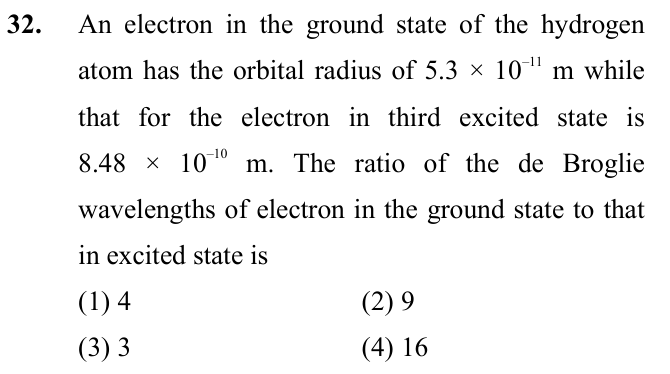
Candidate Response:
(1) (2) (3) (4)
QUESTION 2
PHYSICS · Dual Nature of Radiation and Matter
SECTION A · MCQ (+4, -1)
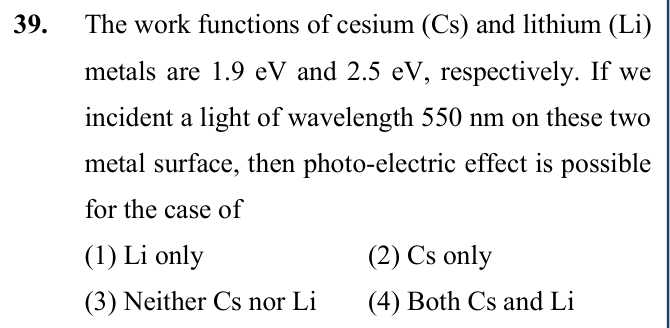
Candidate Response:
(1) (2) (3) (4)
QUESTION 3
PHYSICS · Dual Nature of Radiation and Matter
SECTION A · MCQ (+4, -1)
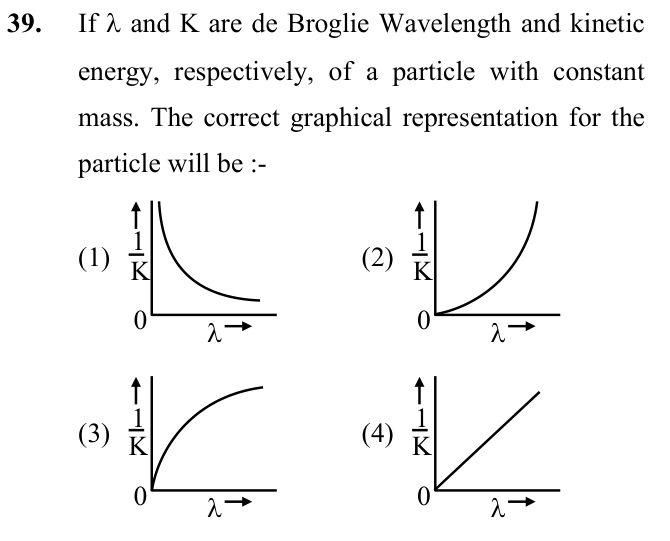
Candidate Response:
(1) (2) (3) (4)
QUESTION 4
PHYSICS · Dual Nature of Radiation and Matter
SECTION A · MCQ (+4, -1)
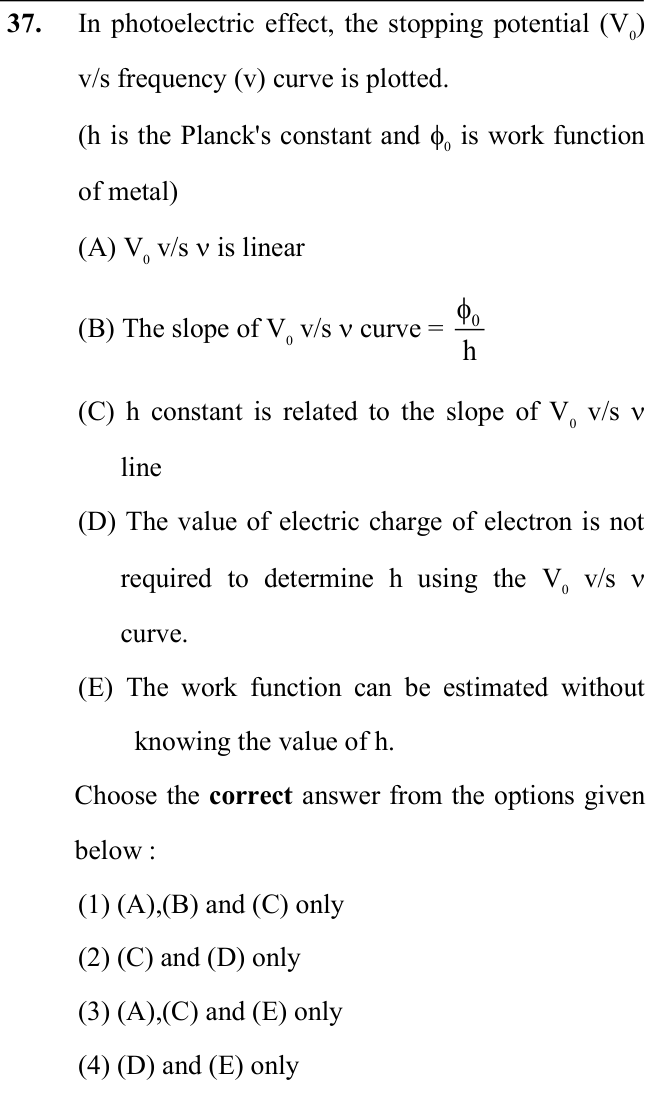
Candidate Response:
(1) (2) (3) (4)
QUESTION 5
PHYSICS · Dual Nature of Radiation and Matter
SECTION A · MCQ (+4, -1)
Candidate Response:
(1) (2) (3) (4)
QUESTION 6
PHYSICS · Dual Nature of Radiation and Matter
SECTION A · MCQ (+4, -1)
Candidate Response:
(1) (2) (3) (4)
QUESTION 7
PHYSICS · Dual Nature of Radiation and Matter
SECTION A · MCQ (+4, -1)
Candidate Response:
(1) (2) (3) (4)
QUESTION 8
PHYSICS · Dual Nature of Radiation and Matter
SECTION A · MCQ (+4, -1)
Candidate Response:
(1) (2) (3) (4)
QUESTION 9
PHYSICS · Dual Nature of Radiation and Matter
SECTION A · MCQ (+4, -1)
The existence of a threshold frequency in the photoelectric effect cannot be explained by:
(1) Einstein's photon theory
(2) Wave theory of light
(3) Planck's quantum theory
(4) de Broglie's hypothesis
Candidate Response:
(1) (2) (3) (4)
QUESTION 10
PHYSICS · Dual Nature of Radiation and Matter
SECTION A · MCQ (+4, -1)
A metal has a work function of 2 eV. Its threshold frequency is (h = 6.6 × 10⁻³⁴ J·s, 1 eV = 1.6 × 10⁻¹⁹ J):
(1) 2.4 × 10¹⁴ Hz
(2) 4.8 × 10¹⁵ Hz
(3) 9.6 × 10¹⁴ Hz
(4) 4.8 × 10¹⁴ Hz
Candidate Response:
(1) (2) (3) (4)
QUESTION 11
PHYSICS · Dual Nature of Radiation and Matter
SECTION A · MCQ (+4, -1)
The de Broglie wavelength of a particle with momentum 6.6 × 10⁻²⁴ kg m s⁻¹ is (h = 6.6 × 10⁻³⁴ J s):
(1) 10⁻⁶ m
(2) 10⁻⁸ m
(3) 10⁻¹⁰ m
(4) 10⁻¹² m
Candidate Response:
(1) (2) (3) (4)
QUESTION 12
PHYSICS · Dual Nature of Radiation and Matter
SECTION A · MCQ (+4, -1)
According to Einstein's explanation of the photoelectric effect, when light of frequency ν falls on a metal surface, the energy delivered to a single electron by a single absorbed photon is:
(1) mν
(2) hν
(3) hν/2
(4) h/ν
Candidate Response:
(1) (2) (3) (4)
QUESTION 13
PHYSICS · Dual Nature of Radiation and Matter
SECTION A · MCQ (+4, -1)
The minimum energy required by the most energetic conduction electron to just escape from a metal surface is called the work function (Φ₀). Which option correctly lists the four mechanisms by which electrons are emitted from a metal surface?
(1) Conduction, induction, radiation and convection
(2) Thermionic, field, photoelectric and secondary emission
(3) Thermionic, radioactive, chemical and photochemical emission
(4) Alpha, β, γ and neutron emission
Candidate Response:
(1) (2) (3) (4)
QUESTION 14
PHYSICS · Dual Nature of Radiation and Matter
SECTION A · MCQ (+4, -1)
A photon of energy 4 eV ejects an electron with maximum kinetic energy 2 eV; the work function of the metal is:
(1) 6 eV
(2) 2 eV
(3) 4 eV
(4) 8 eV
Candidate Response:
(1) (2) (3) (4)
QUESTION 15
PHYSICS · Dual Nature of Radiation and Matter
SECTION A · MCQ (+4, -1)
According to de Broglie, a particle of momentum p has an associated wavelength given by λ = h/p. This relation implies that:
(1) The wavelength is independent of the particle's momentum
(2) Only charged particles exhibit wave behaviour
(3) A particle with larger momentum has a shorter associated wavelength
(4) A particle with larger momentum has a longer associated wavelength
Candidate Response:
(1) (2) (3) (4)