
⚡ OFFICIAL NTA ASSESSMENT GENERATOR & WORD (.DOCX) EXPORTER
Mechanical Properties of Solids · Practice Worksheet
JEE Main Physics · Curated Assessment Set Print directly or export as a beautifully formatted Microsoft Word document with embedded 180-DPI mathematical prompt clips and step-by-step derivations.
EDUPROD JEE MAIN TEST SERIES · NTA PATTERN
Mechanical Properties of Solids · Practice Worksheet
JEE Main Physics · Curated Assessment Set · Assessment Code: JEE-101
Total Marks: 60
Marking: +4 / -1 (Sec A) · +4 / 0 (Sec B)
QUESTION 1
PHYSICS · Mechanical Properties of Solids
SECTION B · NUMERICAL (+4, 0)
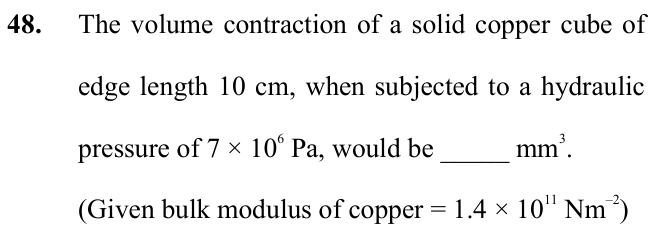
Numerical Value:
[ ]
QUESTION 2
PHYSICS · Mechanical Properties of Solids
SECTION B · NUMERICAL (+4, 0)
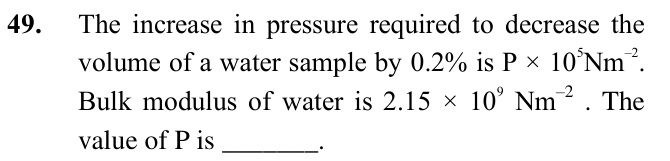
Numerical Value:
[ ]
QUESTION 3
PHYSICS · Mechanical Properties of Solids
SECTION A · MCQ (+4, -1)
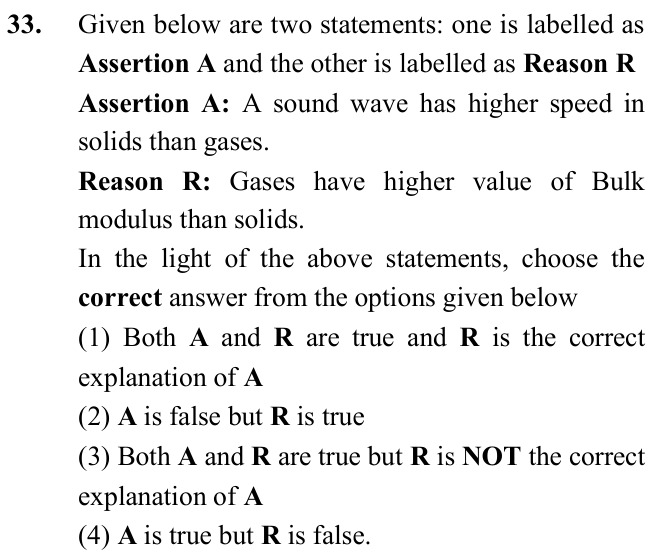
Candidate Response:
(1) (2) (3) (4)
QUESTION 4
PHYSICS · Mechanical Properties of Solids
SECTION B · NUMERICAL (+4, 0)
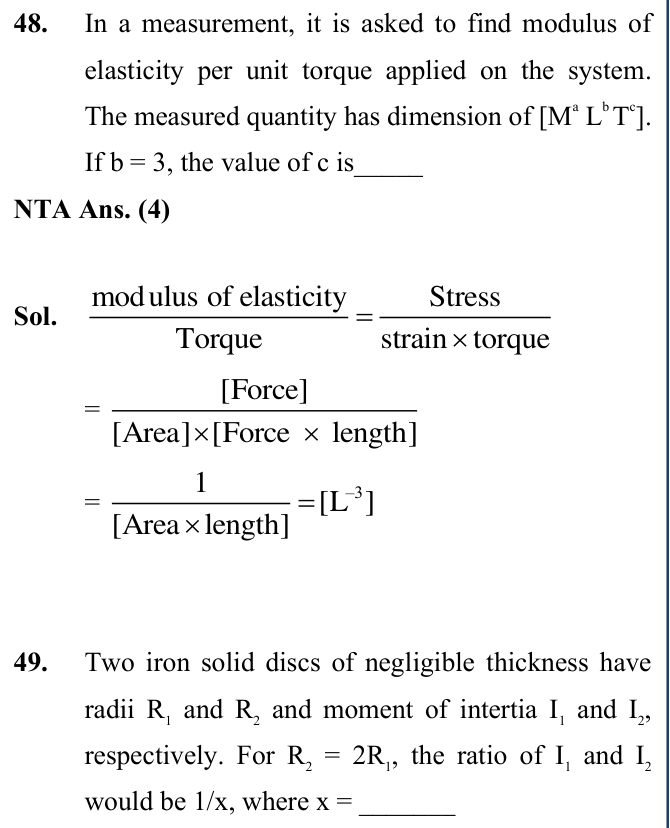
Numerical Value:
[ ]
QUESTION 5
PHYSICS · Mechanical Properties of Solids
SECTION A · MCQ (+4, -1)
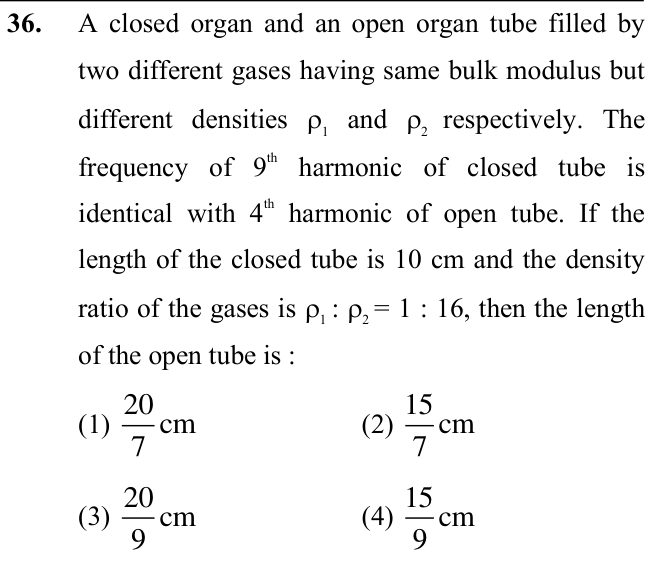
Candidate Response:
(1) (2) (3) (4)
QUESTION 6
PHYSICS · Mechanical Properties of Solids
SECTION A · MCQ (+4, -1)
A tangential force is applied parallel to one face of a cube while the opposite face is held fixed. Which type of stress and strain is produced?
(1) Longitudinal stress and longitudinal strain
(2) Tensile stress and tensile strain
(3) Shearing stress and shearing strain
(4) Hydraulic (volumetric) stress and volumetric strain
Candidate Response:
(1) (2) (3) (4)
QUESTION 7
PHYSICS · Mechanical Properties of Solids
SECTION A · MCQ (+4, -1)
On the stress-strain curve of a ductile material, the point up to which stress is directly proportional to strain (Hooke's law is obeyed) is called the:
(1) Ultimate tensile strength
(2) Yield point
(3) Proportional limit
(4) Fracture point
Candidate Response:
(1) (2) (3) (4)
QUESTION 8
PHYSICS · Mechanical Properties of Solids
SECTION A · MCQ (+4, -1)
The interatomic force constant k of a solid can be linked to its Young's modulus Y and the equilibrium interatomic separation r0. Which relation is correct?
(1) k = r0 / Y
(2) k = Y × r0²
(3) k = Y × r0
(4) k = Y / r0
Candidate Response:
(1) (2) (3) (4)
QUESTION 9
PHYSICS · Mechanical Properties of Solids
SECTION A · MCQ (+4, -1)
For a fixed load and length, the depression (δ) of a loaded beam varies with its thickness d as
(1) δ ∝ d³
(2) δ ∝ 1/d³
(3) δ ∝ d²
(4) δ ∝ 1/d
Candidate Response:
(1) (2) (3) (4)
QUESTION 10
PHYSICS · Mechanical Properties of Solids
SECTION A · MCQ (+4, -1)
Poisson's ratio (ν) for a wire is defined as:
(1) ν = (ΔL/L) / (Δd/d)
(2) ν = -(Δd/d) / (ΔL/L), the negative ratio of lateral strain to longitudinal strain
(3) ν = (ΔL/L) + (Δd/d)
(4) ν = (Δd/d) × (ΔL/L)
Candidate Response:
(1) (2) (3) (4)
QUESTION 11
PHYSICS · Mechanical Properties of Solids
SECTION A · MCQ (+4, -1)
In the beam depression formula δ = W·L³/(4·Y·b·d³), increasing which single dimension is most effective at reducing the sag of a rectangular beam?
(1) The load W
(2) The breadth b
(3) The length L
(4) The depth d (raised to the power 3 in the denominator)
Candidate Response:
(1) (2) (3) (4)
QUESTION 12
PHYSICS · Mechanical Properties of Solids
SECTION A · MCQ (+4, -1)
Which material exhibits large, non-linear elastic deformation (up to about 700%) without a well-defined yield point?
(1) Elastomer (e.g. rubber)
(2) Ductile metal (e.g. copper)
(3) Brittle solid (e.g. glass)
(4) Ceramic
Candidate Response:
(1) (2) (3) (4)
QUESTION 13
PHYSICS · Mechanical Properties of Solids
SECTION A · MCQ (+4, -1)
The property of a solid by which it regains its original shape and size after the removal of the deforming force is called
(1) Elasticity
(2) Malleability
(3) Ductility
(4) Plasticity
Candidate Response:
(1) (2) (3) (4)
QUESTION 14
PHYSICS · Mechanical Properties of Solids
SECTION A · MCQ (+4, -1)
The ratio of tensile stress to longitudinal strain within the elastic limit is called
(1) Shear modulus
(2) Young's modulus
(3) Bulk modulus
(4) Poisson's ratio
Candidate Response:
(1) (2) (3) (4)
QUESTION 15
PHYSICS · Mechanical Properties of Solids
SECTION A · MCQ (+4, -1)
The safe working stress of a material is related to its yield (or breaking) stress and the factor of safety (n) as:
(1) Safe working stress = factor of safety / yield stress
(2) Safe working stress = yield stress × factor of safety
(3) Safe working stress = yield stress + factor of safety
(4) Safe working stress = yield stress / factor of safety
Candidate Response:
(1) (2) (3) (4)