
⚡ OFFICIAL NTA ASSESSMENT GENERATOR & WORD (.DOCX) EXPORTER
Magnetism and Matter · Practice Worksheet
JEE Main Physics · Curated Assessment Set Print directly or export as a beautifully formatted Microsoft Word document with embedded 180-DPI mathematical prompt clips and step-by-step derivations.
EDUPROD JEE MAIN TEST SERIES · NTA PATTERN
Magnetism and Matter · Practice Worksheet
JEE Main Physics · Curated Assessment Set · Assessment Code: JEE-101
Total Marks: 60
Marking: +4 / -1 (Sec A) · +4 / 0 (Sec B)
QUESTION 1
PHYSICS · Motion in a Straight Line
SECTION A · MCQ (+4, -1)
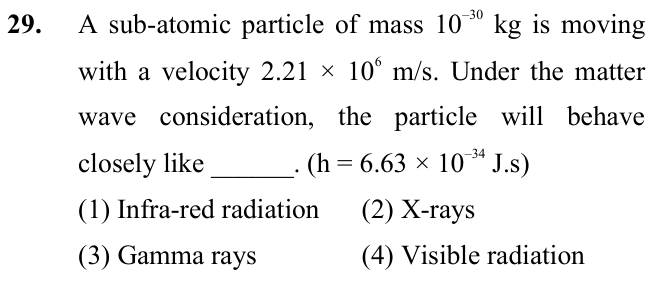
Candidate Response:
(1) (2) (3) (4)
QUESTION 2
PHYSICS · Magnetism and Matter
SECTION A · MCQ (+4, -1)
At a place on Earth's surface, the total magnetic field B_E makes an angle (dip) δ with the horizontal. If B_H and B_V are its horizontal and vertical components, which pair of relations is correct?
(1) B_H = B_V sin δ, B_V = B_E tan δ, so tan δ = B_E / B_V
(2) B_H = B_E cos δ, B_V = B_E sin δ, so tan δ = B_H / B_V
(3) B_H = B_E sin δ, B_V = B_E cos δ, so tan δ = B_H / B_V
(4) B_H = B_E cos δ, B_V = B_E sin δ, so tan δ = B_V / B_H
Candidate Response:
(1) (2) (3) (4)
QUESTION 3
PHYSICS · Magnetism and Matter
SECTION A · MCQ (+4, -1)
The phenomenon by which certain materials attract small pieces of iron, cobalt and nickel is called
(1) induction
(2) magnetism
(3) electricity
(4) gravitation
Candidate Response:
(1) (2) (3) (4)
QUESTION 4
PHYSICS · Magnetism and Matter
SECTION A · MCQ (+4, -1)
Which statement about magnetic field lines and Gauss's law for magnetism is correct?
(1) Gauss's law for magnetism has the same monopole-source form as Gauss's law in electrostatics
(2) ∮ B·dA = μ₀ I_enclosed, because free magnetic poles produce a net outward flux
(3) Magnetic field lines begin on N poles and terminate on S poles, so the divergence of B is nonzero at the poles
(4) ∮ B·dA = 0, because magnetic field lines form closed loops with no isolated magnetic monopoles
Candidate Response:
(1) (2) (3) (4)
QUESTION 5
PHYSICS · Magnetism and Matter
SECTION A · MCQ (+4, -1)
Materials that are weakly repelled by an external magnet are called
(1) ferromagnetic
(2) ferrimagnetic
(3) paramagnetic
(4) diamagnetic
Candidate Response:
(1) (2) (3) (4)
QUESTION 6
PHYSICS · Magnetism and Matter
SECTION A · MCQ (+4, -1)
A material acquires a magnetisation M = 2000 A/m when placed in a magnetising field H = 5000 A/m. Its magnetic susceptibility χ_m is:
(1) 0.25
(2) 4.0
(3) 2.5
(4) 0.4
Candidate Response:
(1) (2) (3) (4)
QUESTION 7
PHYSICS · Magnetism and Matter
SECTION A · MCQ (+4, -1)
Which classification of magnetic materials is correct?
(1) Diamagnetic (χ > 0, strongly attracted), paramagnetic (χ < 0, repelled), ferromagnetic (χ = 0)
(2) Diamagnetic (χ < 0, weakly repelled, temperature independent), paramagnetic (χ > 0, obeys Curie's law χ = C/T), ferromagnetic (χ ≫ 1, domain alignment)
(3) Diamagnetic (obeys Curie's law), paramagnetic (χ < 0), ferromagnetic (weakly repelled)
(4) Diamagnetic (χ ≫ 1), paramagnetic (temperature independent), ferromagnetic (χ < 0)
Candidate Response:
(1) (2) (3) (4)
QUESTION 8
PHYSICS · Magnetism and Matter
SECTION A · MCQ (+4, -1)
Every magnet, however small it may be, always has how many poles?
(1) one
(2) three
(3) four
(4) two
Candidate Response:
(1) (2) (3) (4)
QUESTION 9
PHYSICS · Magnetism and Matter
SECTION A · MCQ (+4, -1)
The magnetic susceptibility of a diamagnetic substance is
(1) small and negative
(2) large and positive
(3) small and positive
(4) zero
Candidate Response:
(1) (2) (3) (4)
QUESTION 10
PHYSICS · Magnetism and Matter
SECTION A · MCQ (+4, -1)
In the B–H hysteresis loop of a ferromagnetic material, which statement is correct?
(1) Retentivity and coercivity are independent of the material's composition
(2) Retentivity (B_r) is the residual induction at H = 0, and coercivity (H_c) is the reverse field needed to reduce B to zero
(3) The area of the loop equals the magnetic energy stored and available for useful work
(4) Coercivity is the residual induction at H = 0, and retentivity is the reverse field needed to reduce B to zero
Candidate Response:
(1) (2) (3) (4)
QUESTION 11
PHYSICS · Magnetism and Matter
SECTION A · MCQ (+4, -1)
The magnetic field lines outside a bar magnet run from the
(1) south pole to north pole
(2) centre to the poles
(3) north pole to south pole
(4) west pole to east pole
Candidate Response:
(1) (2) (3) (4)
QUESTION 12
PHYSICS · Magnetism and Matter
SECTION A · MCQ (+4, -1)
The horizontal component of Earth's magnetic field at a place is 0.35 G and the total field is 0.70 G. The angle of dip at that place is:
(1) 45°
(2) 60°
(3) 90°
(4) 30°
Candidate Response:
(1) (2) (3) (4)
QUESTION 13
PHYSICS · Magnetism and Matter
SECTION A · MCQ (+4, -1)
Magnetisation (M) of a material is defined as the magnetic moment per unit
(1) area
(2) volume
(3) mass
(4) length
Candidate Response:
(1) (2) (3) (4)
QUESTION 14
PHYSICS · Magnetism and Matter
SECTION A · MCQ (+4, -1)
The magnetic length of a bar magnet is approximately what fraction of its geometric length?
(1) 5/6
(2) 6/5
(3) 1
(4) 1/2
Candidate Response:
(1) (2) (3) (4)
QUESTION 15
PHYSICS · Magnetism and Matter
SECTION A · MCQ (+4, -1)
Which statement correctly relates magnetic intensity H, magnetisation M, and magnetic flux density B inside a material?
(1) H = B + μ₀ M, with H measured in tesla
(2) B = μ₀(H + M), with both H and M measured in A/m
(3) B = μ₀ M only, independent of H
(4) B = μ₀(H − M), with M measured in tesla
Candidate Response:
(1) (2) (3) (4)